Nobody Wanted the Widow With Three Children. Then the Mountain Man Showed Her the Fourth Bed.
Martha Higgins had three pennies, three hungry children, and one night left before the world expected her to disappear.
The three pennies lay in her palm like an insult.
One was dull with age. One was scratched across Lincoln’s profile. The third was so worn smooth that Sarah had once asked whether it was still money.
That afternoon, inside Elias Abernathy’s mercantile, those pennies were all that stood between Martha’s children and hunger.
Apparently, they were not enough.
“I can’t extend the credit.”
Abernathy did not even look ashamed.
He stood behind his polished counter with both hands spread beside the ledger in which Martha’s name appeared three pages deep in red ink.
Outside the broad front windows, early November wind whipped mud across Oak Haven’s main street. Winter had arrived before the snow.
Martha kept her shoulders straight.
“Half a sack of flour, then.”
“No.”
“A pound of salt pork.”
“You’re three months behind.”
“I’ll work.”
Abernathy finally looked up.
Martha hated what happened next.
His eyes moved over her.
Not like a man admiring a woman.
Like a merchant estimating the weight of spoiled livestock.
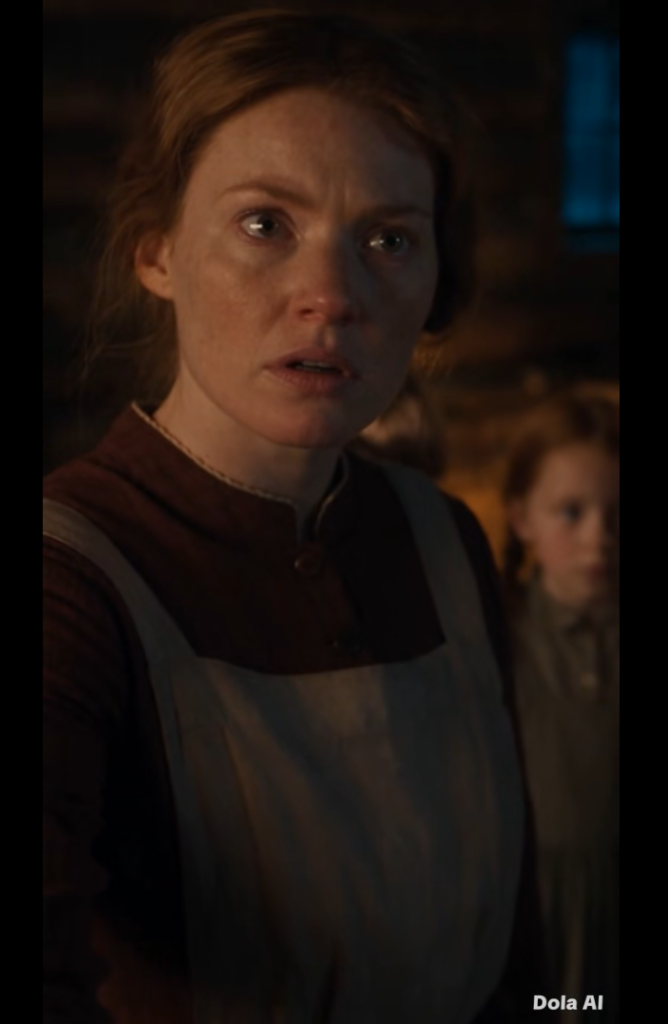
Martha had always been large. Her mother had been large before her, a laughing woman with powerful arms who could knead six loaves of bread at once and carry two water buckets without spilling a drop.
Martha had inherited the same broad hips, strong thighs, round face, full breasts, and thick arms.
She had also inherited her mother’s hazel eyes and chestnut hair.
Once, before children and grief and hunger had hollowed out everything inside her, Thomas Higgins had called her beautiful.
Oak Haven called her other things.
Abernathy cleared his throat.
“You have three children, Martha. Winter’s coming. You require… considerable upkeep.”
A laugh came from somewhere near the pickle barrels.
Martha did not turn around.
She knew the voice.
Mrs. Bell.
Church every Sunday.
Cruel every other day.
Ten-year-old Caleb stood beside Martha with his jaw clenched so tightly that a muscle jumped in his cheek.
Seven-year-old Sarah had wrapped both arms around Martha’s burgundy skirt.
Three-year-old Bess sat on a feed sack by the door, swinging her little boots and humming because she had not yet learned that poverty was supposed to be humiliating.
Martha lowered her voice.
“I’ll scrub floors.”
Abernathy sighed.
“For who?”
That hurt more than his refusal.
Because they both knew the answer.
The boarding house had replaced her.
Her laundry customers had disappeared one by one after Thomas died.
The hotel manager claimed guests complained that Martha was “too slow,” although Martha could wash twice the linen of any woman in town.
Even Reverend Cole’s wife had stopped sending mending.
Charity, Martha had learned, lasted only until suffering became inconvenient.
Then suffering became a character flaw.
She closed her fingers around the pennies.
“Come on, children.”
Caleb snatched up Bess.
Martha pushed open the door.
The bell above it jingled cheerfully.
She hated that sound.
Outside, the wind slapped cold against her cheeks.
Caleb waited until the mercantile door closed behind them.
“We ain’t got food, Ma?”
Martha looked down at him.
Thomas’s eyes.