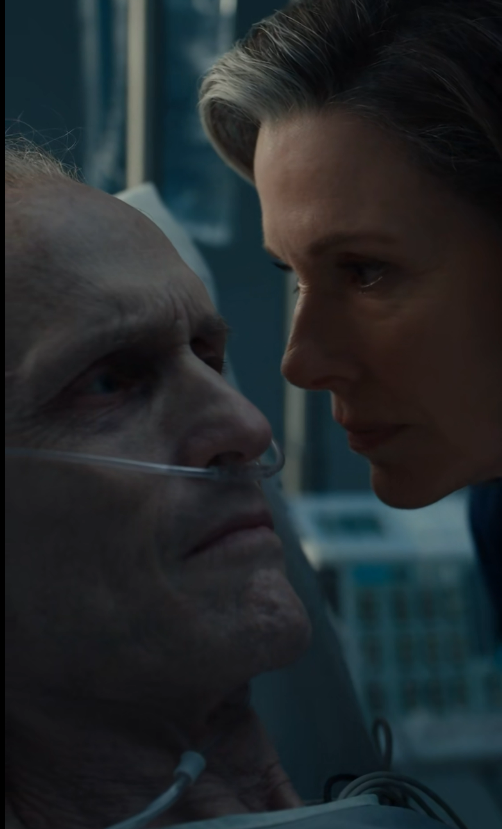
Judson’s throat tightened.
“You married me under false pretenses.”
“Yes.”
“You used me.”
“At first.”
He looked away.
Winifred whispered, “And then the lie became the truest thing in my life.”
Judson shut his eyes.
He wanted to forgive her.
That was the problem.
He wanted it too much.
They delivered Silas, his men, and Gar to the marshal two days later.
Gar received consideration for helping capture Silas, though the marshal promised he would still answer for several crimes.
Before being taken away, Gar stopped beside Winifred.
“You hit like a mule.”
“Thank you.”
“That wasn’t praise.”
“I accepted it as such.”
Judson almost smiled.
Then the marshal approached carrying a ledger recovered from Silas’s saddlebag.
“You two need to see this.”
Inside were payments.
Surveyors.
Assayers.
Officials.
And one name Judson recognized immediately.
AMOS BELL.
The marriage broker.
Judson felt cold.
“What does Bell have to do with this?”
The marshal pointed to an entry dated eight months earlier.
Payment for locating Elias Hayes’s surviving heir.
Winifred stared.
“Me.”
Another entry appeared three months later.
Payment for arranging marriage to J. McIntyre.
Judson’s face hardened.
Their marriage had not been coincidence.
Silas had arranged it.
But why?
The marshal found the answer in a letter tucked inside the ledger.
Winifred read it aloud.
Her voice failed halfway through.
Judson took the page.
The plan was simple.
Get Elias Hayes’s heir legally married to the current occupant of the disputed claim.
Wait until both established residence.
Kill them in an apparent winter accident.
With no surviving Hayes or McIntyre heir, Silas intended to acquire the property through forged debt documents.
Judson slowly lowered the letter.
Winifred whispered, “He chose me for you.”
“No.”
Judson looked toward the jail.
“He chose us to die.”
Amos Bell disappeared before they could arrest him.
For three months, there was no trace.
Spring came.
Judson and Winifred rebuilt the cabin.
Not because either had decided what their marriage was.
But because they had nowhere else they wanted to be.
One afternoon, Judson found Winifred planting wildflowers near the porch.
He leaned against a post.
“Flowers don’t serve a practical purpose.”
She continued digging.
“Neither do you, most days.”
He smiled.
Then grew serious.
“Winnie.”
She looked up.
“I was cruel to you.”
She said nothing.
“I judged you before you spoke ten words.”
“Yes.”
“I humiliated you.”
“Yes.”
“You could make this easier.”
“No.”
He nodded.
Fair enough.
“I thought strength looked like me,” he said. “Hard. Angry. Able to sleep in snow and kill what needed killing.”
His voice softened.
“Then you came here and taught me strength can bake biscuits, sew curtains, cry over a chicken, knock an outlaw unconscious with cookware, and forgive a fool who doesn’t deserve it.”