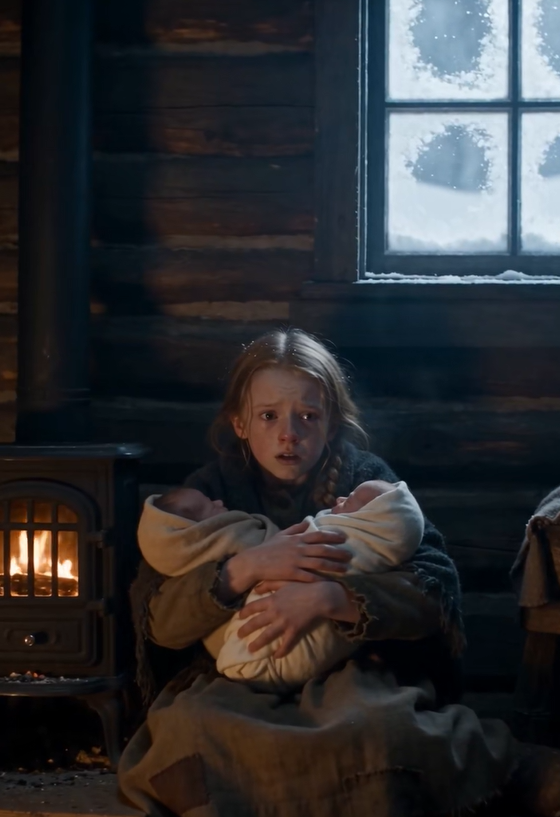
She struggled upright.
Her back ached.
Her ankles were swollen.
The baby seemed determined to lodge one foot permanently beneath her ribs.
The cabin looked different by morning light.
There were two rooms, though calling the second one a room was generous.
A rough plank partition separated Silas’s bunk from the main living area.
Everything else existed together: table, stove, hearth, shelves, guns, traps, dried herbs, sacks of flour, and enough cured meat to survive an army siege.
Lydia found yesterday’s pot beside the stove.
She lifted the lid.
One sniff confirmed what she had suspected.
The substance Silas called stew was not food.
It was punishment.
By the time he returned carrying an armload of split pine, Lydia had rolled up her sleeves.
He stopped inside the doorway.
“What are you doing?”
“My job.”
“You ought to be resting.”
“You’re paying me to cook.”
“You arrived half frozen yesterday.”
“And if I eat another spoonful of whatever you cooked, I’ll wish the cold finished me.”
Silas stared at her.
Lydia waited.
Then his mouth twitched.
The mountain man actually laughed.
It was only one sound—a rough exhale—but Lydia felt absurdly victorious.
She fried salt pork and mixed flour, lard, and buttermilk into biscuits.
She found dried apples and simmered them with cinnamon.
When Silas sat at the table, he ate the first biscuit in three bites.
The second disappeared almost as quickly.
Lydia folded her arms.
“Your stomach doesn’t seem to mind waiting when it knows something edible is coming.”
Silas glanced up.
“Don’t get proud.”
“You’ve eaten four.”
“Cold weather.”
“Five.”
He reached for another.
She slapped his hand lightly with the wooden spoon.
“Save some for supper.”
Silas looked at the spoon.
Then at Lydia.
For half a heartbeat she wondered whether she had gone too far.
Then he leaned back.
“Yes, ma’am.”
And Lydia smiled for the first time in months.
Life settled into a rhythm.
Silas rose before daylight.
He checked trap lines, chopped timber, repaired fences, hunted, and sometimes disappeared for hours into the forest with his rifle.
Lydia cooked.
She scrubbed.
She mended.
She organized the mountain of tools Silas apparently believed belonged on the dining table.
She discovered he owned exactly three plates but eleven hunting knives.
“You know,” she said one afternoon, “people usually keep knives in drawers.”
“People in towns.”
“And forks?”
“Same.”
“How have you survived thirty-seven years?”
He narrowed his eyes.
“How’d you know my age?”
“Your Bible.”
That got his attention.
“You read my Bible?”
“I moved it while cleaning.
Your mother’s handwriting is inside.”
Silas said nothing.
The book suddenly seemed less like an object and more like a closed door.
Lydia softened.
“I didn’t read anything personal.”
He nodded once.
But that evening he took the Bible from the shelf and carried it behind his partition.