Instead she heard herself say, “Mr.
Cole?”
He looked up.
“Perhaps whoever placed the advertisement knew something you didn’t.”
Ethan almost laughed.
It was not amusement.
It was exhaustion.
“That wouldn’t surprise me anymore.”
Clara lifted her chin.
“I have enough money for a room in town for several nights.
Give me one week.”
“For what?”
“To prove whoever placed that advertisement was right.”
Ethan stared at her.
Then from the kitchen came Annie’s horrified voice.
“The biscuits!”
Smoke drifted into the hall.
Ethan closed his eyes again.
Clara waited.
Finally he stepped aside.
“One week.”
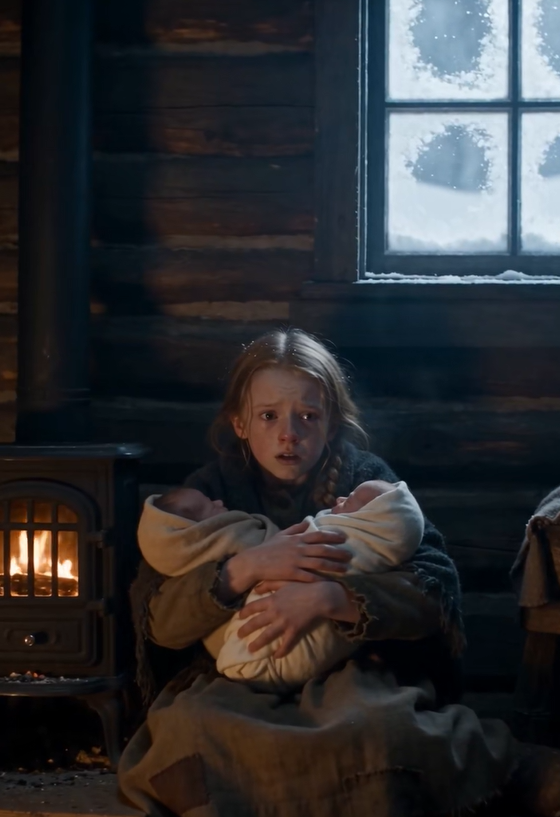
By the third morning, Clara understood that the Cole household was not merely disorganized.
It was drowning.
Nine-year-old Annie woke before sunrise.
She tried to light the stove.
She prepared breakfast.
She washed her siblings.
She swept.
She collected eggs.
She attempted laundry.
She reminded her father about bills.
She packed food for him.
And whenever something went wrong, Annie apologized as though the mistake belonged to her.
Clara watched the child burn her hand lifting a kettle.
Annie jerked away.
“I’m all right.”
“You’re nine,” Clara said.
“I know.”
“You don’t sound like you know.”
Annie stared at her.
That afternoon Clara found the girl standing on a stool, trying to scrub one of her father’s shirts.
Clara took the brush from her.
“I can do it.”
“I always do Papa’s washing.”
“Not anymore.”
Annie stiffened.
“Mama said I had to help.”
“Helping is carrying plates to the table.”
Clara gently lifted the child down.
“Helping is gathering eggs or folding your own clothes.”
Annie’s mouth tightened.
“Who will do everything else?”
“I will.”
“For how long?”
The question stopped Clara.
Annie stared up at her.
There was no childish curiosity in the girl’s face.
Only fear.
“Everyone leaves,” Annie said.
Clara knelt.
“I can’t promise forever.”
“I knew it.”
“But I can promise today.”
Annie looked away.
Clara took her small roughened hands.
“And today, Annie Cole,
you are allowed to be nine years old.
”
The girl began crying without making a sound.
Clara held her until the tears stopped.
Samuel was different.
He followed Clara everywhere.
Never close enough to touch.
Never speaking.
But always near.
When Clara peeled potatoes, Samuel sat beneath the window.
When she hung laundry, he stood beside the porch.
When she kneaded bread, he watched her hands.
She never asked him to speak.
Other people had apparently tried.
Doctors.
Neighbors.
The minister.
Ethan himself.
Everyone had asked Samuel questions until silence became another wall around him.
Clara simply talked while she worked.
“Your father owns the most stubborn flour bin I’ve ever met.”
Samuel watched.
“And I believe that rooster has a personal grievance against me.”
Nothing.
The next day she added, “If he attacks my skirt again, I may put him in Sunday stew.”
Samuel’s mouth twitched.
Clara pretended not to notice.
Four days later, she dropped a wooden spoon.
Samuel picked it up.
“Thank you,” Clara said.
He placed it in her hand.
Then almost silently—
“Clara.”
The spoon slipped from her fingers.
Samuel’s eyes widened.
Clara did not gasp.
She did not call Ethan.
She only smiled.
“Yes.”

Samuel stared at her.
Then ran outside.
That evening Ethan entered the kitchen while Clara was slicing carrots.