She looked back at Owen.
“That’s the first lie of yours I don’t believe anymore.”
The wagon carried him away.
Two weeks later, Mae returned to Caleb’s cabin.
The bruises were fading.
Some scars never would.
Caleb understood that.
He had scars like that himself, though most couldn’t be seen.
They sat on the porch as autumn began touching the cottonwoods gold.
For several minutes neither spoke.
Then Mae said, “There’s something I haven’t told you.”
Caleb smiled slightly.
“You’ve developed a habit.”
“I’m serious.”
“So am I.”
She held something in her lap.
A brass key.
Caleb recognized it.
“The stolen family property?”
“It wasn’t theirs.”
Mae stood.
“Come with me.”
They rode back to the place where Caleb had found her.
The empty trail.
The white boulder.
The abandoned stage station.
Caleb dismounted.
Mae walked inside the ruined building.
Behind a collapsed stove lay three loose stones.
She removed them.
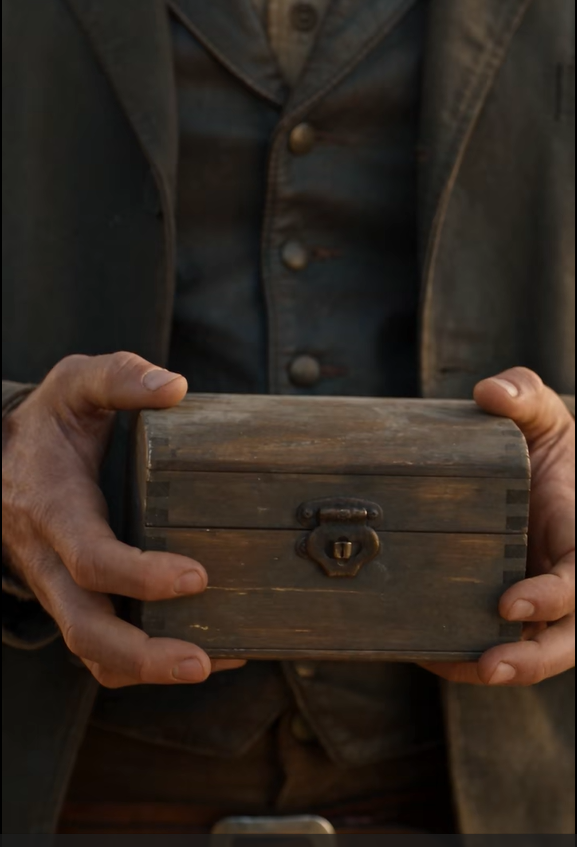
Inside was a small iron box.
Caleb stared.
“You put that here?”
“Before you found me.”
“When?”
“That morning.”
She inserted the brass key.
The lock opened.
Inside were letters.
A deed.
And a small tintype photograph.
Mae handed the picture to Caleb.
His heart stopped.
A girl stood beside an old wooden fence.
Sixteen.
Dark hair.
Laughing eyes.
Red ribbon.
Beside her stood a skinny twelve-year-old boy wearing boots too large for him.
Caleb could not breathe.
“Nora.”
Mae’s eyes filled.
“My mother’s real name wasn’t Miriam.”
Caleb looked at her.
Mae whispered:
“It was Nora.”
The world seemed to tilt beneath him.
“No.”
“She changed her name after leaving Mercy Bend.”
Caleb stared at the photograph.
“My mother was Nora Rusk.”
He looked at Mae.
She was crying now.
“Your sister.”
Caleb’s knees weakened.
Mae reached for him.
For the first time, he let her.
She put the letters in his hands.
The first was addressed in handwriting Caleb remembered from another lifetime.
Caleb,
If this ever reaches you, forgive me for not coming home.
Silas Drayton caught me copying papers from his study.
I had discovered what he had done to three families, and I was frightened he would hurt you and Pa if he knew I had spoken.
A man named Joseph Larkin helped me escape.
I married him two years later.
We have a daughter.
Her name is Mae.
Caleb stopped reading.
His vision blurred.
Mae was sobbing.
“Nora lived?”
“For seventeen years after she disappeared.”
“Why didn’t she find me?”
“She tried.”
Mae handed him another letter.
Three had been returned unopened.
One addressed to the Rusk farm after Caleb’s father died.
Another to a ranch where Caleb had worked in Wyoming.
A third to an army post months after he had left it.