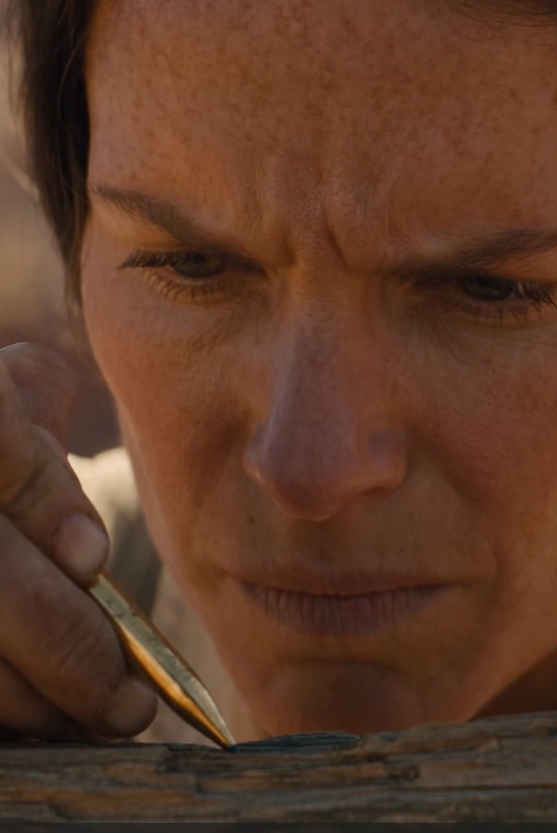
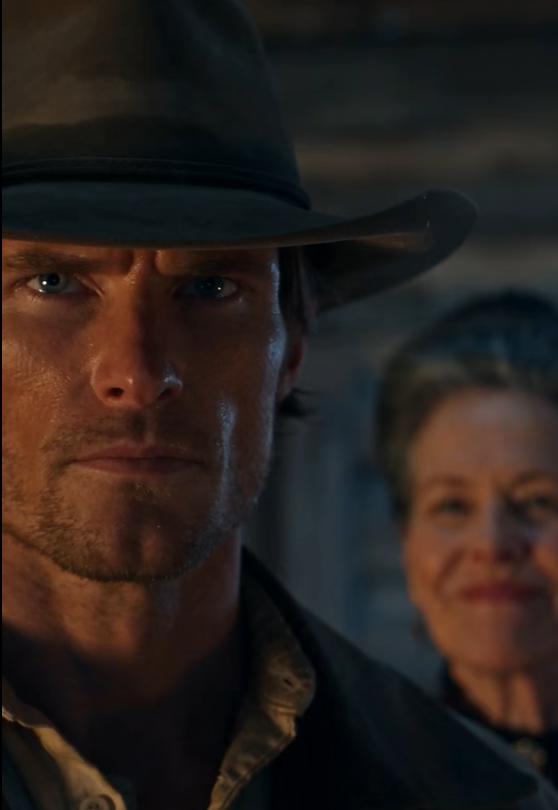
Then he removed a small tin from his saddlebag.
“Bear grease and willow bark.”
“Sounds unpleasant.”
“Works better than complaining.”
Mercy almost laughed.
He rubbed the salve into her fingers with surprising gentleness.
His own scarred hands were warm.
For a moment, neither spoke.
Then Mercy asked, “Why haven’t you married before?”
Dutch continued working.
“Was married once.”
She went still.
“What happened?”
“She died.”
“I’m sorry.”
“So am I.”
He closed the tin.
“Her name was Abigail.”
Mercy heard something in his voice that discouraged further questions.
Instead, she told him about Thomas.
How they had married young.
How Thomas had dreamed of owning a small farm.
How their son, Samuel, had been born during a thunderstorm in June.
And how, eight months later, the copper mine collapsed.
“My husband was working underground,” she said. “I had brought him his lunch. Samuel was sleeping in his basket beside me.”
Her voice weakened.
“There was an explosion. The ceiling came down.”
Dutch stopped walking.
Mercy stared at the mountains.
“I remember trying to reach his basket. Then something struck my hand. When I woke up, they told me both of them were dead.”
“Did you see their bodies?”
The question came too quickly.
Mercy looked at him.
“No.”
“Why?”
“Pratt said the remains were buried too deep. The company held a memorial.”
Dutch turned away.
His jaw worked beneath his beard.
“Something wrong?” Mercy asked.
“Just thinking.”
“About what?”
He looked toward the snow-covered peaks.
“About how often powerful men ask grieving people to believe things they can’t prove.”
They reached the cabin shortly before sunset on the fourth day.
It stood in a sheltered valley surrounded by towering pines, with a clear creek running nearby.
A barn and smokehouse occupied the eastern clearing.
Wood was stacked neatly beneath a covered porch.
Mercy had expected filth.
Instead, the cabin was clean, solid, and surprisingly comfortable.
There were two bedrooms.
A large stone fireplace.
A kitchen with shelves full of preserved food.
And, beside the southern window, a beautiful oak sewing table.
Mercy touched its smooth surface.
“You have a sewing table?”
“Bought it in Durango last spring.”
“Why?”
Dutch took off his coat.
“Thought somebody might need one someday.”
She ran her fingers over the polished wood.
A sewing machine stood beside it.
A Singer.
Nearly new.
Mercy turned toward him.
“Dutch…”
“Does it work?”
“Yes, but—”
“Then that’s settled.”
He carried her bags upstairs.
Mercy remained beside the table, fighting tears.
Six men had seen her damaged hand and decided she was incapable of work.
The seventh had bought her a sewing machine.
That night, Dutch showed her the second bedroom.
“You’ll sleep here.”
Mercy frowned.
“Are we not married?”
“We are.”
“Then why separate rooms?”
He leaned against the doorframe.
“Because marriage vows don’t mean you owe me your body before you’re ready.”
Mercy stared at him.
His expression was completely serious.
“I didn’t marry you to frighten you,” he continued. “We’ll learn each other first.”
After he left, Mercy sat on the edge of the bed.
She touched the silver ring on her finger.
Then she began to cry.
Not because she was unhappy.
But because she had forgotten what it felt like to be treated as a person rather than a problem.
Chapter Four: The Locked Cellar
Life in the mountains developed its own rhythm.
Dutch rose before dawn.
Mercy baked bread, tended the chickens, repaired clothing, and gradually learned the trails around the cabin.
He taught her how to recognize approaching storms, how to build a fire in wet weather, and how to shoot a rifle.
She taught him how to mend torn blankets properly.
His first attempt looked like a spider had died fighting a needle.
Mercy laughed so hard she had to sit down.
Dutch examined the crooked stitching.
“Still holds.”
“Barely.”
“Then it’s useful.”
She shook her head.
“You’re an impossible man.”
“Been told.”
Weeks passed.
Their conversations grew longer.
Their silences became comfortable.
Sometimes Dutch returned from the trap lines to find Mercy waiting on the porch.
Sometimes she caught him watching her across the supper table with an expression he quickly concealed.
One evening, she reached for his hand.
He looked surprised.
She placed her twisted fingers against his burned wrist.
“Does this bother you?”
“No.”
“Then stop looking away when I touch you.”