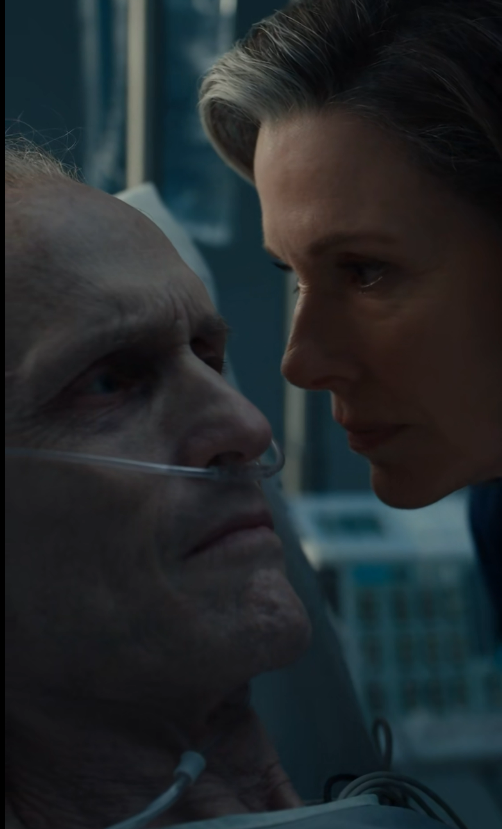
“My father built the gun.”
I looked at the numbers.
“Flynn pulled the trigger himself.”
The emergency board meeting took place nine days later.
Flynn arrived expecting to save his company.
Gordon arrived expecting to save his family.
I arrived carrying my father’s gray folder.
Flynn’s eyes locked on me the moment I entered.
“You don’t belong in this meeting.”
The board counsel stood.
“Actually, Mr. Vance, she does.”
Flynn looked at him.
“What?”
“Mrs. Vance is here as a shareholder.”
Gordon’s face was gray.
I took my seat.
Flynn leaned toward his father.
“You told me her father’s shares were extinguished.”
Gordon whispered something I couldn’t hear.
The meeting began.
Martin presented the ownership history.
Flynn interrupted constantly.
“This is ridiculous.”
“Those agreements are ancient.”
“My father built this company.”
Finally I said,
“Your father almost lost this company.”
Flynn turned toward me.
“My father saved it.”
“No. Mine did.”
Silence.
Martin produced the wire records showing Richard Hale’s eight-million-dollar investment.
Gordon stared at the table.
Flynn looked at him.
“Dad?”
Gordon said nothing.
Then came Northline.
Six million dollars.
Shell companies.
The private equity side agreement.
Pension exposure.
Flynn stopped interrupting.
Then came the necklace.
The receipt appeared on the presentation screen.
$110,000.
Charged to Vance Global.
Flynn looked at me with naked hatred.
“This is revenge.”
I shook my head.
“No. Revenge would have been smashing the necklace.”
Martin placed Schedule Seven before every director.
“This is governance.”
Gordon finally exploded.
“That clause was never meant to survive restructuring!”
Martin smiled.
“Then perhaps you shouldn’t have personally signed seven separate successor acknowledgments confirming that it did.”
Flynn stared at his father.
Again.
Gordon’s silence told the truth.
One director asked, “What exactly happens now?”
Martin looked at me.
I could have answered.
Instead, I looked toward the representatives of the employee trust.
Two of them had been on the video meeting.
One was a woman named Priya Shah who had worked at Vance Global for fourteen years.
Flynn had once forgotten her name during an awards banquet.
Priya stood.
“Under Schedule Seven, the employee trust’s voting rights are activated.”
Another director asked, “How much control?”
Martin answered.
“Combined with Mrs. Vance’s position and temporary investigative proxies…”
He paused.
“Fifty-three percent.”
Flynn went white.
“No.”
Nobody spoke.
“No,” he repeated. “That’s impossible.”
I looked at him.
“Apparently not.”
“You can’t take my company.”
I almost felt sorry for him.
Almost.
“Flynn, that’s the problem.”
I leaned forward.
“You never bothered to learn whose company it was.”
The vote came forty minutes later.
Gordon Vance was removed as chairman pending investigation.
Northline transactions were frozen.
The private equity sale was terminated.
An independent forensic audit was authorized.
Then came the final motion.
Removal of Flynn Vance as chief executive officer for misuse of corporate funds, breach of fiduciary duty and failure to disclose related-party transactions.
Flynn looked around the table.
These were people who had feared him for years.
People whose bonuses he controlled.
People whose careers depended on pleasing him.
Now he looked at them one by one.
Nobody came to his rescue.
The vote passed.
Eleven to two.
Flynn turned to me.