Then she suddenly understood.
The land.
The bank.
The threats.
Gideon had not been trying merely to seize her tiny cabin.
Through Isaac, Peter legally inherited half of Crowe Ridge.
Through Silas, Jonah inherited the other half.
Gideon Mercer had starved a widow because two hungry boys unknowingly stood between him and control of one of the largest ranches in northern Montana.
But greed had made one fatal mistake.
He had believed hunger would make Miriam weak.
Instead, hunger had brought Silas Crowe to her door.
And that knock had reunited a broken family, exposed a murderer, saved half a town—and brought a father back to the son he had mourned for ten years.
That evening, Miriam cooked cornbread.
A whole skillet.
Golden and thick.
Peter reached for the first piece.
Jonah slapped his hand away.
“Ma gets first.”
Miriam laughed.
“I think there’s enough for everybody.”
Silas stood at the stove.
He looked at the black skillet.
The same skillet that had once held their final scrap of food.
The same skillet Miriam had used to knock a murderer’s pistol from his hand.
He cut four pieces.
One for Peter.
One for Jonah.
One for Miriam.
One for himself.
Nobody counted the crumbs.
Nobody lied about being hungry.
Nobody pushed a portion away.
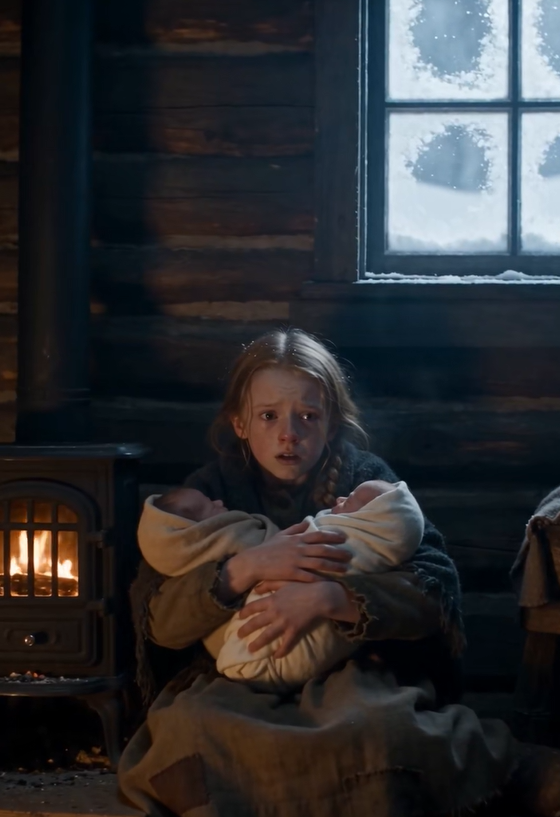
And when Miriam looked around the table—at Peter talking with his mouth full, at Jonah pretending not to smile when Silas corrected his knife grip, at the empty chair where Isaac would always exist in memory—she understood something she had not understood during the worst night of winter.
Sometimes salvation did not arrive looking like salvation.
Sometimes it stood outside in the snow for too long because it was frightened too.
Sometimes it wore an old black coat, carried years of anger, and knocked only after nearly losing its courage.
And sometimes the last piece of bread was not the end of a family.
Sometimes it was the final meal before the truth came home.