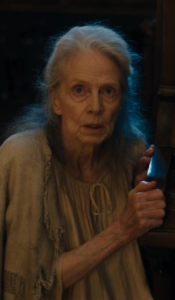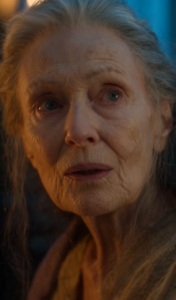
The woman they had buried twelve years earlier was sitting beside the piano when Maxwell Anderson opened the door.
For a moment, his mind refused to let her be a person.
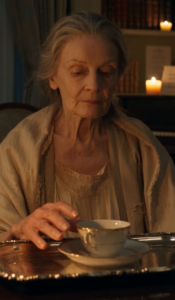
She was candlelight caught in an old mirror. A memory made cruel by exhaustion. Anything but the silver-haired woman in the faded cream nightgown, her narrow shoulders wrapped in a lavender shawl.
Then her hand moved across the little wooden music box.
Its last notes faltered into silence.
“Maxwell,” she whispered. “My little storm boy.”
The brass key slipped from his fingers.
Only his mother had ever called him that.
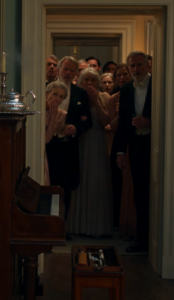
Behind him, a hundred wedding guests seemed to stop breathing at once.
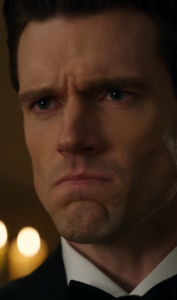
Maxwell stood in the doorway wearing a black tuxedo and a white rose boutonniere. He had spent that morning worrying about vows, photographs, and whether the rain would spoil the terrace reception.
Now his lips struggled to form one word.
“Mother?”
Elena Marlowe moved past him.
The young maid dropped to her knees beside the chair, her dark amber violin held against her chest. Tears ran down her face.
“I kept your song alive,” she said. “Just like I promised.”
Eleanor Anderson touched the instrument with two trembling fingers.
“I heard.”
Maxwell crossed the room without remembering how.
Up close, she looked impossibly frail. Her wrists were thin enough to frighten him. There was a small scar above her eyebrow, and another near her temple. But her eyes were the same grey-green eyes that had watched him learn to swim, brought him warm towels, and caught him lying about broken windows.
She lifted her hand to his cheek.
“You grew so tall,” she whispered. “I counted every storm.”
He fell to his knees.
“They told me you were gone.”
His forehead pressed against her hands. They smelled faintly of lavender soap.
The smell undid him.
Behind them, Vanessa Caldwell appeared in the doorway, her Paris-designed gown dragging through dust. Her blonde updo had come loose. Diamonds trembled at her throat.
Her mother followed.
Cecilia Caldwell took one look at the woman beside the piano and stepped backward.
“It’s not possible,” she said. “We signed the papers.”
Eleanor raised her eyes.
She looked past her son.
Straight at Vanessa.
Maxwell slowly stood.
“You knew she was alive.”
Cecilia seized her daughter by the shoulder and shoved her forward.
“Tell him it was her idea.”
Vanessa stumbled.
Eleanor lifted one frail finger.
“She brought me my tea every night for twelve years.”
The guests gasped.
Vanessa’s knees buckled.
Before that night, Maxwell remembered his mother’s death as a telephone call.
He had been twenty-three, living in Boston and determined to prove that the Anderson name was not the most interesting thing about him.