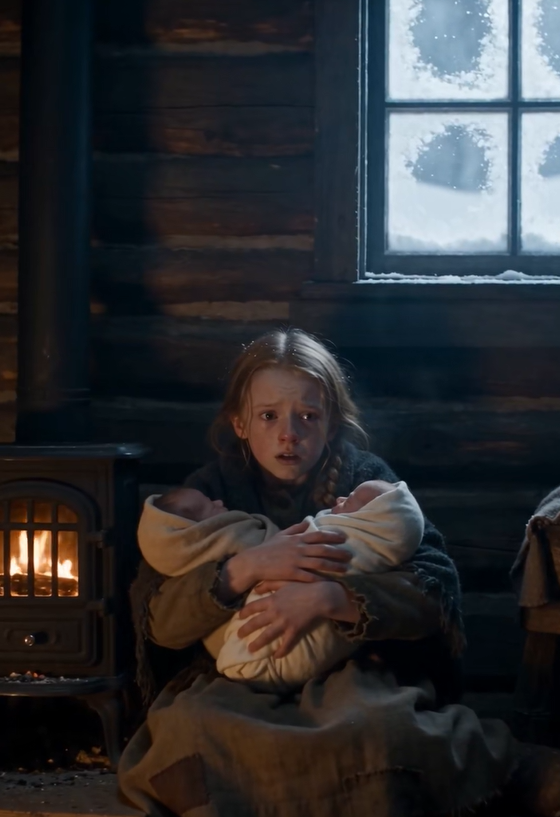
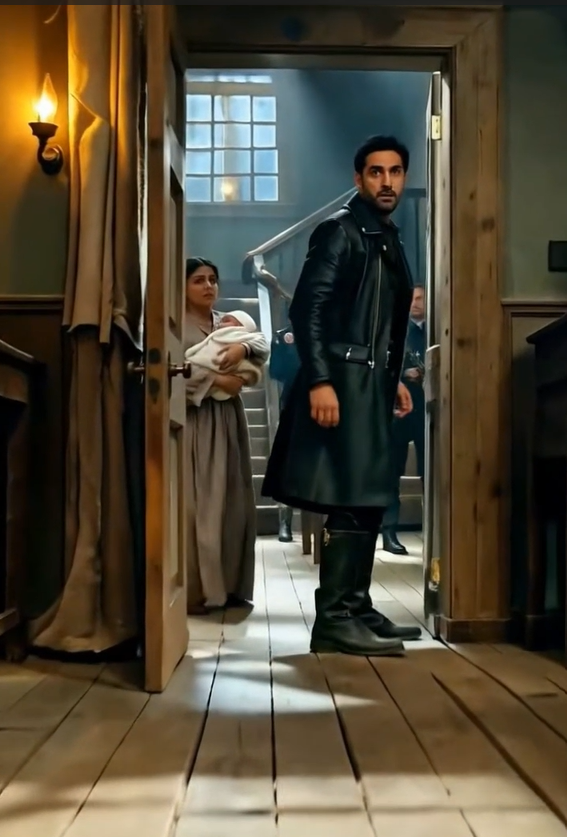
She moved things.
Not dramatically.
Just enough that he noticed.
The coffee tin shifted closer to the stove.
Fresh herbs appeared near the window.
His shirts began hanging instead of lying folded on chairs.
The kitchen smelled like bread.
Then one morning Tom reached automatically for the cracked blue mug he had used for years.
It wasn’t there.
He frowned.
Nora pointed toward the table.
A steaming cup waited beside his chair.
“Black,” she said. “No sugar.”
Tom stared at it.
“How’d you know?”
“You’ve made coffee every morning for three weeks.”
“So?”
“You never reach for sugar.”
He had no answer.
Another morning, Nora discovered fresh kindling stacked beside the stove.
She looked at Tom.
“Was this you?”
“No.”
Caleb, entering behind him, said, “Sure wasn’t the wood fairy.”
Tom glared at him.
Caleb immediately found something fascinating outside the window.
A week later, Tom’s winter coat tore on barbed wire.
He left it over a chair.
The next morning the tear had been repaired so neatly he needed several seconds to find the seam.
Tom looked toward Nora.
She was kneading dough.
“You fix this?”
“No.”
Tom raised an eyebrow.
Nora smiled without looking up.
“Must’ve been the sewing fairy.”
From outside, Caleb laughed so hard he began coughing.
That evening Tom repaired the loose leg on Nora’s chair.
Neither of them mentioned it.
Their strange courtship began like that.
Not through declarations, but through work quietly done for the other person.
A bucket carried.
A lamp filled.
A blanket warmed near the stove.
A gate repaired before anyone asked.
Lily became the bridge between them.
She followed Tom almost everywhere.
At first he discouraged it.
“Horses are dangerous.”
“I know.”
“Bulls are dangerous.”
“I know.”
“Tools are dangerous.”
“I know.”
Tom stared at her.
“Everything’s dangerous.”
Lily considered this.
Then she asked, “Are you?”
Tom nearly smiled.
“No.”
“Then I’ll stay near you.”
And she did.
She brought him crooked nails while he repaired fences.
She named one calf Napoleon and another Princess Thunder.
She spent three days trying to convince Caleb that cows understood English but deliberately ignored people.
She asked Tom approximately five thousand questions.
“Why do horses sleep standing?”
“Sometimes they lie down.”
“Why?”
“They get tired.”
“Why do they get tired?”
“Because they’re horses.”
“Do horses know they’re horses?”
Tom looked at Caleb.
Caleb said, “Don’t drag me into this.”
Lily climbed onto the fence.
“Mr. Hale?”
“What?”
“Did you ever have children?”
Everything stopped.
Caleb lowered his eyes.
Tom’s hand tightened around the fence rail.
For one terrible second he saw a tiny grave beneath snow.
Then he said, “Almost.”
Lily studied him.
“What happened?”
“Lily.”
Nora’s voice came sharply from behind them.
The girl turned.
Nora stood several yards away holding a basket.
Her face had gone white.
“Come help me.”
Lily scrambled down.
Tom watched Nora lead her toward the house.
Something about Nora’s reaction bothered him.
Not because she had stopped the question.
Because she looked frightened by it.
He almost followed.
He didn’t.
Tom Hale had survived most of his life by refusing to open doors better left closed.
He did not yet understand that some doors opened whether a man wanted them to or not.
By November, everyone in Bitter Creek had opinions about Nora.
Some thought she was a widow who refused to discuss her husband.
Others believed she had never been married.