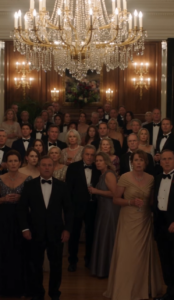
She looked back.
And then Caleb Whitmore—who had frightened bankers into revising loan agreements and once fired twelve men before breakfast—laughed.
A real laugh.
Low and rusty from disuse.
Beatrice’s expression softened.
“There,” she said.
“There what?”
“So you are human.”
“Don’t spread it around.”
“Your reputation might never recover.”
The laughter faded.
But not the warmth.
Caleb wrapped her hand with surprising gentleness.
Outside, the storm howled.
Inside the kitchen, the range radiated heat. Copper pots glowed beneath lantern light. The scent of rosemary, coffee, and baked bread lingered in the air.
Caleb suddenly realized that the kitchen felt more alive than any room in his mansion had felt since the day it was finished.
Because she was in it.
That thought unsettled him.
“How did you know what the clause meant?” he asked.
“I read it.”
“That is not what I meant.”
Beatrice sat at the long preparation table.
“You want to know how an overweight woman in a poor cabin learned contracts.”
His jaw tightened.
“I did not say that.”
“Most people do not need to.”
“Most people are fools.”
She studied him.
Then she began untying her apron.
“My father kept accounts for freight companies. He taught me numbers before he taught me to knead dough.”
“Where is he?”
“Dead.”
Caleb recognized the finality in the word.
He knew how grief sounded when a person had carried it long enough for tears to dry.
“My mother too,” she added. “Fever. Eleven years ago.”
“And you stayed in Oakhaven?”
“Yes.”
“Why?”
Beatrice hesitated.
“Someone had to.”
It was an odd answer.
Before Caleb could ask what she meant, Abernathy entered.
“Whitmore.”
His face had become grave.
“I believe we have a larger difficulty.”
He placed several pages on the table.
“These figures in Pendleton’s folder. Shipment forecasts. Loan maturity schedules. Even estimated reserves from your north shaft.”
Caleb went pale beneath his beard.
“Only four people have access to those reserves.”
“Then one of those four people is selling you.”
A silence fell.
Caleb stared at the sheets.
Beatrice saw something in his face.
Not fear.
Betrayal.
“What four people?” she asked.
“Myself. My mine superintendent, Elias Rowe. My accountant in Denver.”
He stopped.
“And?”
Beatrice asked quietly.
Caleb looked toward the ceiling.
“Martin Vale.”
The foreman currently guarding Pendleton.
A floorboard creaked above them.
All three looked upward.
Caleb drew his revolver.
“Stay here.”
Beatrice rose.
“No.”
“That was not a request.”
“And I am not your employee anymore. Dinner ended an hour ago.”
“You will remain here.”
She picked up the fire poker.
“I dislike being ordered about.”
“This is dangerous.”
“So are you, apparently, and I rode up the mountain with you.”
Abernathy muttered, “I begin to understand why the staff left.”
Caleb shot him a look.
Then the three moved into the hall.
The mansion seemed different at night.
Less grand.
More sinister.
Long shadows stretched beneath mounted elk heads and framed mining maps. Wind moaned around the eaves.
Caleb climbed the staircase first.
Pendleton’s guest room door stood open.
Martin Vale was gone.
So was Pendleton.
Caleb swore.
Beatrice entered the room.
The window was open.
Snow blew across the carpet.
“No tracks,” Caleb said after looking outside.
“They didn’t go out the window,” Bee replied.