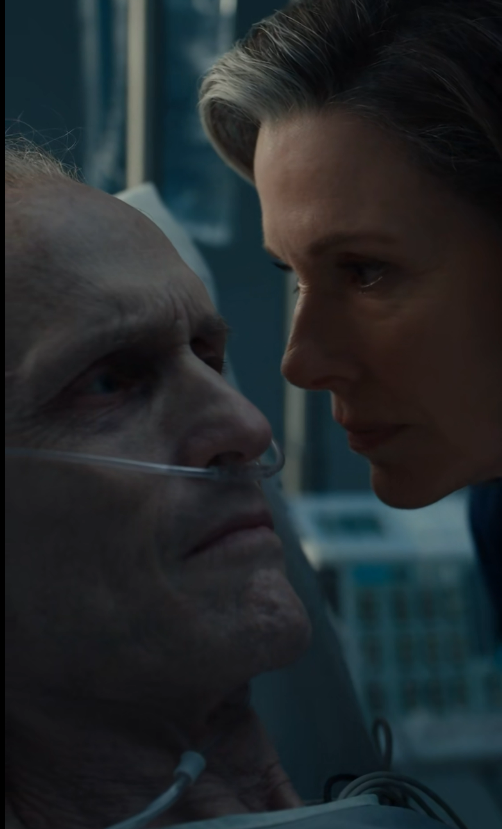
He’d recorded it three weeks before his death.
His hair was thin.
His cheeks hollow.
But when he looked into the camera, I saw the man who’d once carried me home after I broke my ankle at thirteen.
“Claire,” he began.
Then he cried.
I had never seen my father cry.
“I thought disappearing would save you.”
He wiped his face.
“I spent eleven years learning that absence can wound people just as badly as danger can.”
He confessed everything.
His involvement.
His cowardice.
His fear.
My mother’s role.
The money.
The lies.
Then he said something I watched seventeen times.
“Your mother will tell herself everything she did was for you. Some of it was. That’s the dangerous thing about love mixed with control. Eventually the person controlling you can no longer tell the difference.”
I thought of the dress.
The fiancé.
The hidden money.
The fake funeral.
My entire family history.
He continued.
“If I could give you one inheritance worth having, it would be this: never allow anyone to make your choices and call it love. Not your mother. Not your sister. Not a husband. Not even the memory of me.”
I closed the laptop and cried until morning.
A year and eight months after my wedding that wasn’t, I returned to the Beaumont Royale.
Alone.
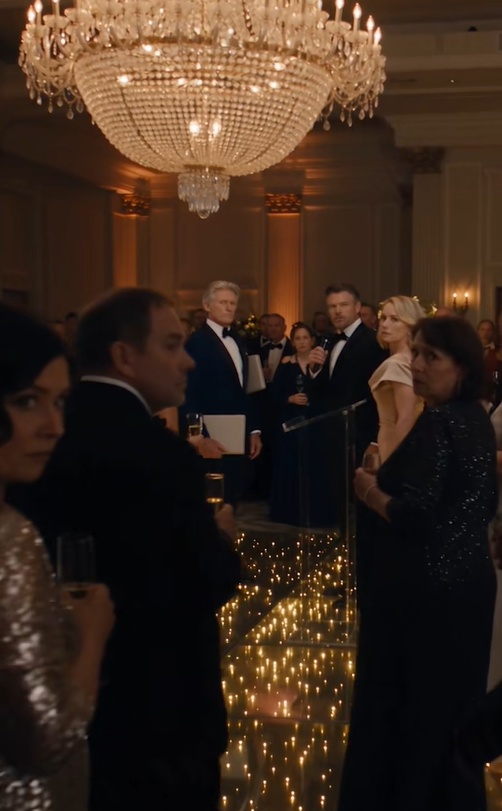
The Grand Ballroom was hosting a children’s hospital fundraiser.
The chandeliers were unchanged.
The marble gleamed.
For a moment I could almost see my abandoned rhinestone dress pooled beside the altar.
Then someone said my name.
“Claire.”
Daniel stood near the staircase.
He looked older.
So did I, probably.
There was no dramatic music.
No champagne.
No aisle.
Just two people who had once nearly built a marriage on top of a lie.
“Hi,” I said.
“Hi.”
We talked for nine minutes.
I know because later I checked.
He was working for a nonprofit legal clinic.
He asked about Meridian.
I asked about his mother.
Neither of us mentioned love.
Finally he smiled.
“You look good.”
“So do you.”
Silence.
Then he said, “I should let you enjoy your evening.”
He turned away.
“Daniel.”
He stopped.
I don’t know why I called him back.
Maybe because my father had been right.
Freedom wasn’t only the ability to walk away.
Sometimes it was the ability to make a choice without letting fear make it first.
“Coffee,” I said.
Daniel stared at me.
“What?”
“Coffee.”
I almost smiled.
“Not forgiveness. Not reconciliation. Definitely not an engagement.”
His mouth twitched.
“Understood.”
“Coffee.”
“When?”
I looked toward the ballroom.
“Tomorrow.”
He nodded.
“I’d like that.”
Then he walked away.
I didn’t watch him for long.
There were people waiting for me inside.
Lila was among them.
She had cut her hair short and started working at a nonprofit that helped victims of financial coercion.
Sometimes life possesses a sense of irony so sharp it feels deliberate.
She waved.
I joined her.
Halfway across the ballroom, she slipped her arm through mine.
“You know,” she said, “Mom still says the rhinestone dress photographed better.”
I stopped.
Then laughed.
Not politely.
Not carefully.
I laughed until my eyes watered.
Lila laughed too.
For the first time in years, neither of us cared who was watching.