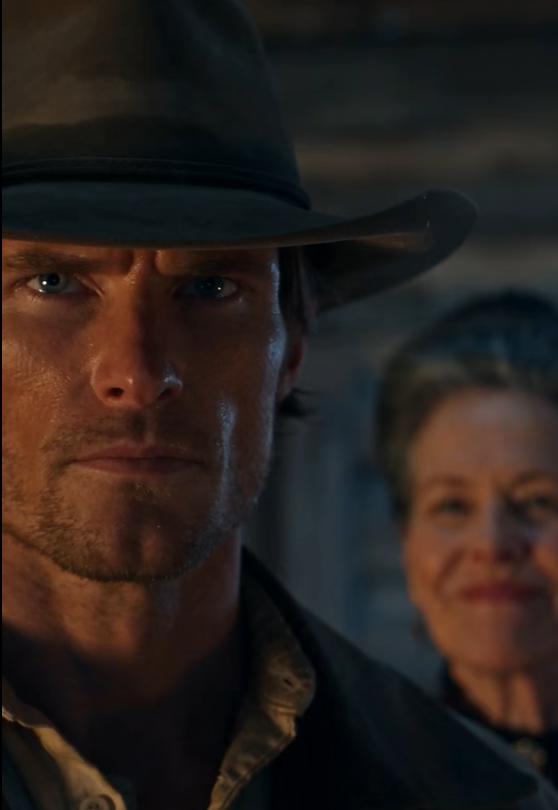
Lila turned toward him.
“I already know where to look.”
The smile vanished.
She reached into her pocket.
And withdrew a small folded note.
“I found this in the lining of my father’s coat after he died.”
Cole took it.
There were only seven words.
Where the blue rivers run, stars return.
He stared at the sentence.
Then a memory rushed back.
His mother singing.
Lila singing in the kitchen.
Sleep, little star, where the blue rivers run…
Cole looked at her.
“The lullaby.”
Lila nodded.
“Margaret taught it to me.”
His breath caught.
“Where the blue rivers run.”
He looked toward the map above the fireplace.
Beyond the northern boundary lay a fork in the creek where mineral deposits sometimes gave the water a strange bluish color at dusk.
Locals called it Blue River Crossing.
There was an abandoned mission there.
A place nobody had visited in years.
Cole stared at Lila.
“She left us a direction.”
Lila’s eyes filled.
“Yes.”
Darrenholt suddenly began struggling.
“No.”
Cole turned.
The wounded man looked terrified.
“No, you cannot go there.”
Cole slowly smiled.
For the first time, Darrenholt saw something he had never expected.
Not rage.
Not despair.
But certainty.
“She’s alive,” Cole whispered.
Darrenholt closed his eyes.
And Cole knew they had finally reached the truth.
Chapter Seventeen: The Woman at Blue River Crossing
They rode north that afternoon.
Darrenholt remained under guard while Wade escorted the sheriff and the ledger to a federal marshal stationed in the neighboring county.
Cole took Lila with him.
Neither spoke much during the journey.
Too many revelations lay between them.
Too many wounds.
But when Cole reached for her hand as they crossed the creek, she held it.
By evening, the abandoned mission appeared beyond a stand of cottonwoods.
Its roof sagged.
Its bell tower was cracked.
Wild roses climbed its stone walls.
A thin ribbon of smoke rose from the chimney.
Cole dismounted.
Someone lived there.
Lila touched his arm.
“Are you ready?”
He stared at the little building.
“No.”
She squeezed his hand.
“Neither am I.”
They approached the door.
Cole knocked.
Footsteps sounded within.
Slow.
Measured.
Then the door opened.
An elderly woman stood inside.
Her silver hair was braided neatly over one shoulder.
She wore a faded blue dress.
Her face was lined by years of hardship.
But her eyes—
Cole felt his knees weaken.
Her eyes were the same pale gray-green as his own.
The woman stared at him.
Her lips parted.
The cup in her hand fell to the floor.
“Julian?”
Cole swallowed.
“No, ma’am.”
The woman looked at Lila.
Then back at Cole.
A trembling hand rose to her mouth.
“Cole?”
He could not answer.
She reached toward his face.
Her fingertips touched his cheek.
Then she began to cry.
“Oh, my baby.”
Cole’s chest broke open.
He had spent his life believing himself abandoned by everyone he loved.
Yet here stood a woman who had never stopped waiting.
He fell to his knees.
Margaret Vale knelt with him.
And mother and son embraced for the first time in thirty-eight years.
Lila stood beside the doorway, weeping silently.
After a while, Margaret looked up.
She saw the young woman.
“Lila?”
Lila rushed forward.
Margaret opened her arms.
“My sweet girl.”
The three held each other on the threshold as evening sunlight poured through the cottonwoods.
For the first time, Cole understood something his father had tried to teach him.
A home was not land or wealth or walls. It was the place where love finally stopped running away.
Chapter Eighteen: The Truth That Changed Texas
The investigation lasted five months.
Darrenholt survived his wound.
Then watched his carefully constructed empire collapse.
The ledger exposed forged deeds, bribed officials, fraudulent water claims, and the disappearance of several landowners.
The sheriff resigned before he could be removed.
Mercer testified in exchange for leniency.
And Margaret Vale appeared before a federal court to confirm her identity and the original trust.
Her testimony electrified the county.
For decades, Silas Darrenholt had maintained that Margaret died in childbirth.
Instead, she stood before the court alive, holding the original marriage documents proving that he was not Julian Vale.
His true identity was Silas Vale.
The younger brother who had murdered Julian and stolen his name.
Thomas Bennett’s role was also exposed.
He had initially participated in the land fraud before turning against Darrenholt.
But rather than surrender the infant Cole to his uncle, he had hidden the child and raised him as his own.
Later, Thomas had helped Margaret escape captivity.
To protect her, he arranged for her to live under an assumed name.
Elias Whitcomb had continued collecting evidence until Darrenholt framed him.
Every sacrifice had been made to preserve one child and a truth powerful men wanted buried.
Cole listened to the testimony with a heavy heart.
The father who raised him had been neither entirely innocent nor entirely corrupt.
He had made terrible mistakes.
Then spent the remainder of his life trying to repair them.
It was not the simple story Cole wished he could have believed.
But it was human.
And it was true.
The court restored the disputed property to the Vale trust.
That made Cole the legal beneficiary of the estate.
But the land included farms stolen from families who had lived there for generations.
Cole faced a choice.
Keep everything.
Or surrender much of the wealth that had defined his entire life.
One evening, he stood beside Lila overlooking the northern pasture.
The sunset turned the grass gold.
“Forty thousand acres,” he murmured.
Lila looked at him.
“What about them?”
“I spent half my life building this ranch.”
“I know.”
“And now I discover half of it never belonged to the people who sold it to us.”
She said nothing.