“Please.”
Vale pointed past Jack toward Mary’s portrait.
“That woman.”
Jack stopped breathing.
The sheriff frowned.
Vale continued.
“Your dead wife.”
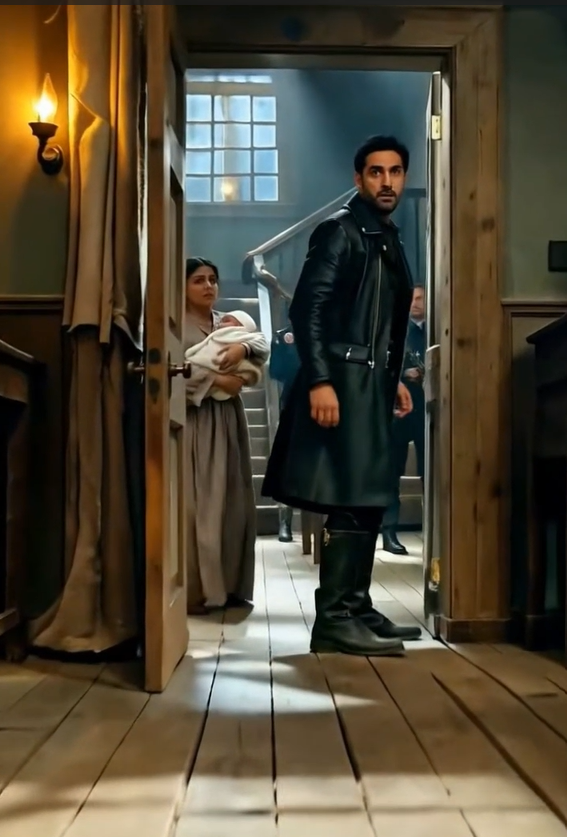
Jack closed the door on the sheriff, the deputies, and Edwin Vale.
For the moment.
Reed had reluctantly agreed to give them twenty minutes.
Jack turned.
Clara stood beside the table, still holding Lily.
“Give her to me.”
Clara flinched.
“Jack—”
“My daughter.”
Her face twisted with pain.
But she obeyed.
Jack took Lily.
Then he pointed toward the chair.
“Talk.”
Clara sat.
For several seconds she seemed incapable of beginning.
Finally she removed something from beneath her dress.
A small silver locket.
She placed it on the table.
Jack opened it.
Inside was a faded photograph of two girls.
One was unmistakably Mary at perhaps twelve years old.
Beside her stood another girl slightly younger, smiling fiercely into the camera.
Clara.
Jack looked up.
“Mary was my sister.”
The cabin seemed to tilt.
“No.”
“Half sister.”
“You told me you didn’t know her.”
“I was afraid.”
“You lied to me every day.”
“I know.”
“Mary told me she had no family except an aunt who died before we married.”
“She believed that.”
Jack stared at her.
Clara wiped her face.
“Our mother died when I was six. My father remarried Mary’s mother. Mary was eight. For five years we were sisters in everything but blood.”
Her voice softened.
“She taught me to read. I taught her to whistle through her fingers. We slept in the same bed when thunderstorms frightened us.”
Jack thought of Mary pretending she hated storms.
“She never mentioned you.”
“My father made sure of that.”
Clara looked toward the window.
“When Mary was thirteen, she discovered what he was doing at the mines.”
Jack frowned.
“What?”
“Charging workers for food and tools at prices that kept them permanently indebted. Men who complained were beaten. Families who tried to leave were threatened.”
Clara’s jaw tightened.
“Mary stole his account book and tried to give it to a newspaper.”
Jack almost smiled despite himself.
That sounded like Mary.
“What happened?”
“My father caught her.”
Clara’s fingers twisted together.
“He sent her away. Told everyone she had run off. Told Mary that I hated her and never wanted to see her again.”
Her voice broke.
“He told me Mary was dead.”
Jack looked again at the photograph.
“When did you learn the truth?”
“Eight years later.”
“Before or after she married me?”
“Before.”
Jack’s anger returned.
“Then why didn’t you come?”
“I tried.”
Clara stood abruptly.
“I wrote nineteen letters.”
“Nineteen?”
“Every one came back unopened.”
She laughed through tears.
“I thought Mary hated me. I thought perhaps Father had been right about her wanting nothing to do with us.”
She opened the locket again.
“Then last year one letter didn’t come back.”
Jack stared.
“Mary answered.”
Clara nodded.
“She told me she had never received the others. She told me she was married to a rancher named Jack Turner in Dry Willow.”
Jack’s throat tightened.
“She never told me.”
“There was more.”
Clara’s expression changed.
Fear returned.
“She said she had discovered Father was intercepting our letters. She believed someone in the postal route worked for him.”
“Why would he care after all those years?”
“Because Mary still remembered the ledger.”
Jack frowned.
“That makes no sense.”
“The original ledger vanished when Mary was sent away.”
“And?”
Clara looked directly at him.
“Father believed Mary had hidden it.”
Jack laughed in disbelief.
“She was thirteen.”
“She was brave.”
That ended the laugh.