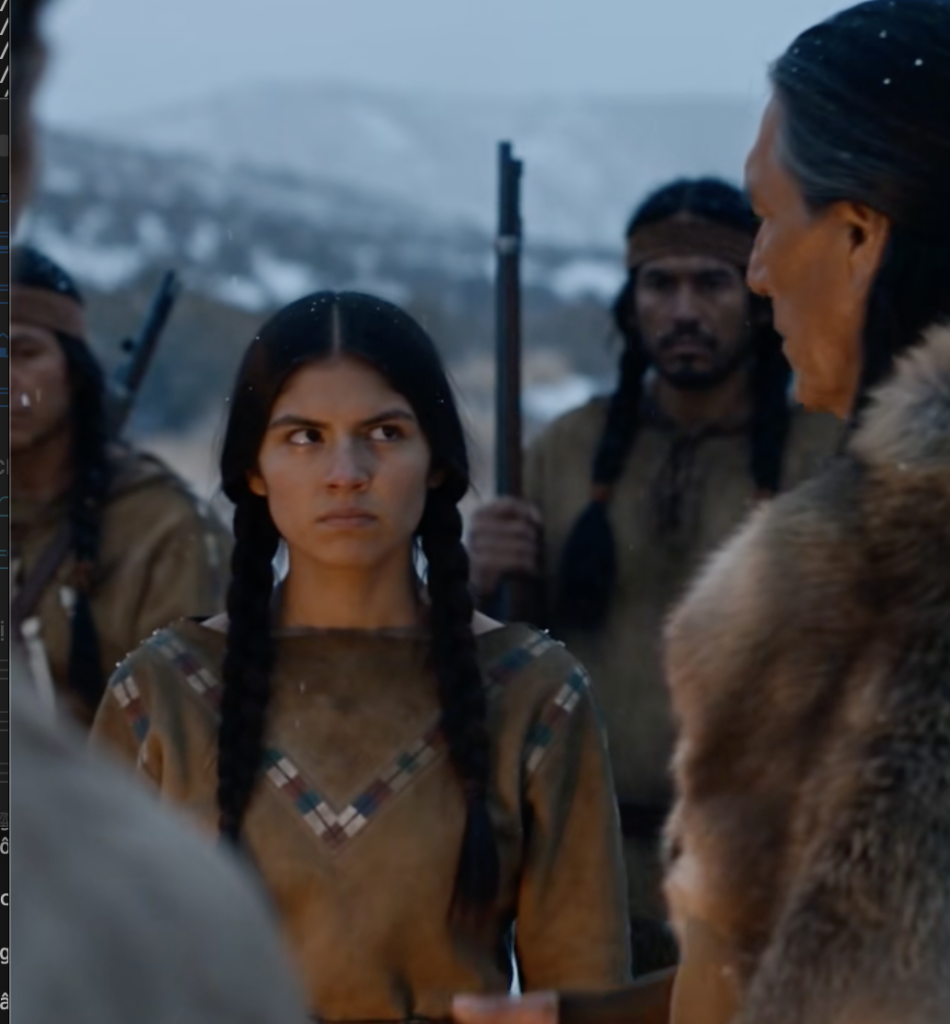

He Saved the Apache Chief’s Son and Was Ordered to Marry the Chief’s Furious Daughter. Before Winter Ended, Caleb Learned Why the Chief Had Chosen Him—and Why Someone Had Been Hunting Him for Three Years.
The sound that stopped Caleb Morrison in the frozen mountains was not a gunshot.
It was worse.
A human groan—low, broken, and fading—followed by the brutal clang of iron against stone.
Caleb sat perfectly still in the saddle while the November wind clawed through his coat.
His horse, Rust, lifted his head.
The gelding’s ears turned toward a dark stand of pine trees fifty yards below the trail.
Then the sound came again.
Metal.
Pain.
A man trying desperately not to scream.
Caleb knew that sound.
A steel trap.
And somewhere beyond those trees, someone was caught in it.
For several seconds he considered riding on.
Three years earlier, he would not have hesitated.
Three years earlier, Caleb Morrison had still believed there were things a man could fix.
Then came Tonto Basin.
Smoke.
Gunfire.
Burning shelters.
Women running through darkness.
Children crying for mothers who would never answer.
Men wearing uniforms shouting that orders were orders.
Caleb had spent three years trying to outride those memories.
Arizona had not been far enough.
New Mexico had not been far enough.
Colorado would not be far enough either.
Guilt had a horse faster than any man alive.
Another groan rose from the trees.
Caleb closed his eyes.
“Damn it.”
He turned Rust downhill.
The clearing appeared suddenly between the pines.
Snow covered the ground except where something had fought violently against it.
Branches were broken.
Blood streaked the white earth.
And near a granite boulder lay an Apache warrior.
One leg was imprisoned inside the enormous rusted jaws of a bear trap.
The teeth had bitten through leather and flesh just below his knee.
The man was young, perhaps twenty-five, with long black hair half frozen against his cheek.
His skin had gone gray from cold and blood loss.
But his eyes were alive.
Fiercely alive.
The instant he saw Caleb, he raised a knife.
Caleb reached instinctively toward his Winchester.
The warrior tightened his grip.
For a heartbeat they stared at one another.
Two men.
Two weapons.
Two histories neither one understood.
Then Caleb slowly removed his hand from the rifle.
He swung down from the saddle.
The Apache tried to push himself backward, but the movement shifted the trap.
Pain ripped through him.
His knife trembled.
Caleb unbuckled his gun belt.
The warrior watched.
Caleb laid the revolver in the snow.
Then he removed the rifle from its scabbard and placed that beside it.
He stepped away from both weapons.
“I’m not here to kill you.”
The words meant nothing.
The gesture did.
Caleb pulled his canteen from the saddle.
He approached until the knife lifted higher.
Then he stopped.
“All right.”
He knelt.
Placed the canteen in the snow.
Pushed it toward the injured man.
“You decide.”
Neither moved.
Wind hissed through the trees.
Finally, the warrior seized the canteen.
He smelled it first.
Then drank.
Not greedily.
Carefully.
Caleb understood that.
Men who had been hunted learned caution before gratitude.