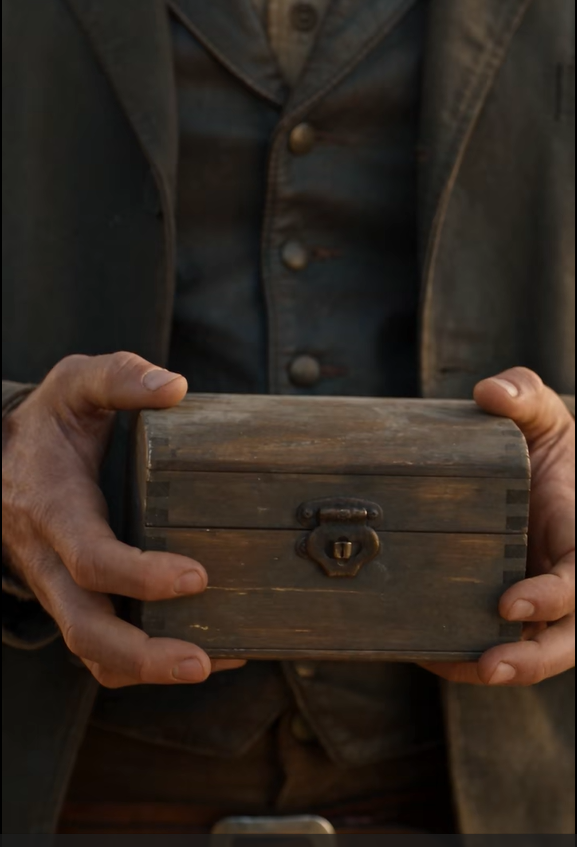
When Eli was eleven, he had once dropped it between floorboards and spent two hours pulling up planks before his father came home.
His father had laughed until he cried.
Eli heard his own voice from very far away.
“Where did you get that?”
Serina placed it carefully on the table.
“From Miriam Mercer.”
The world vanished.
Eli looked up.
“My mother died in 1858.”
“No,” Chaska said.
One word.
Softly spoken.
More violent than any gunshot.
Eli rose so quickly his chair fell backward.
“My mother died.”
Waya did not move.
“We believed you should know the truth.”
“I buried her.”
“You buried a box.”
Eli stared at her.
Then memory tore open.
Yellow fever.
Quarantine.
Men wearing cloth across their mouths.
A closed coffin.
Someone telling a twelve-year-old boy he was not permitted to see the bodies.
His father’s name on one box.
His mother’s on another.
He had never questioned it.
Children did not question coffins.
Chaska’s voice came gently.
“Your father died.”
Eli could barely hear her.
“But your mother survived.”
Miriam Mercer had awakened two weeks later in a church infirmary forty miles south.
By then, the settlement where Eli had lived had scattered beneath fear of disease. Records had been lost. Families had fled.
Someone told Miriam her husband and son were both dead.
She believed them.
For seventeen years.
“She traveled,” Serina explained. “Eventually she worked as a midwife.”
Chaska smiled sadly.
“She delivered my son.”
Eli sat without moving.
A thousand impossible thoughts collided inside him.
“My mother knew you?”
“Yes.”
“When?”
“1874.”
The same year their search began.
Chaska reached across the table but stopped before touching his hand.
“I told her about the canyon. About the young cowboy who risked his life for us. I did not know your surname. Only that I had heard one of the pursuing men shout something that sounded like ‘Eli.’”
Miriam had asked questions.
What color were his eyes?
Did he ride a gray mare?
Did he have a thin white scar across the base of his left thumb?
Eli looked down at that scar now.
He had gotten it at nine years old opening a tin can with his father’s knife.
“When we told her about the scar,” Serina said, “she began to cry.”
Eli’s throat closed.
“She knew?”
“She hoped.”
“Why didn’t she find me?”
This time nobody answered immediately.
Chaska’s eyes filled.
“She tried.”
Eli understood before she said it.
“No.”
“She became ill during the winter.”
“No.”
“She lived until March.”
He stood and walked toward the window.
Outside, Calico flicked her tail at flies.
Nothing had changed.
The mountains were still there.
The creek still crawled between cottonwood roots.
The whole world had somehow remained standing while Eli’s understanding of his own life collapsed beneath him.
“She died believing you might still be alive,” Chaska said.
Eli’s shoulders trembled once.
Only once.
He pressed the heel of one hand against his mouth.
For twenty-one years he had carried the grief of losing his mother at twelve.
Now grief came again, crueler because it carried possibility with it.
She had lived seventeen more years.
Seventeen birthdays.
Seventeen winters.
Seventeen chances to pass each other on some road.
He turned.
“Why did it take five years?”
Waya answered.
“Because you are extremely difficult to find.”