
Seven Boys Expected Mercy Calloway to Leave. By Spring, She Would Learn Why Their Mother Had Whispered Her Name Before She Died.
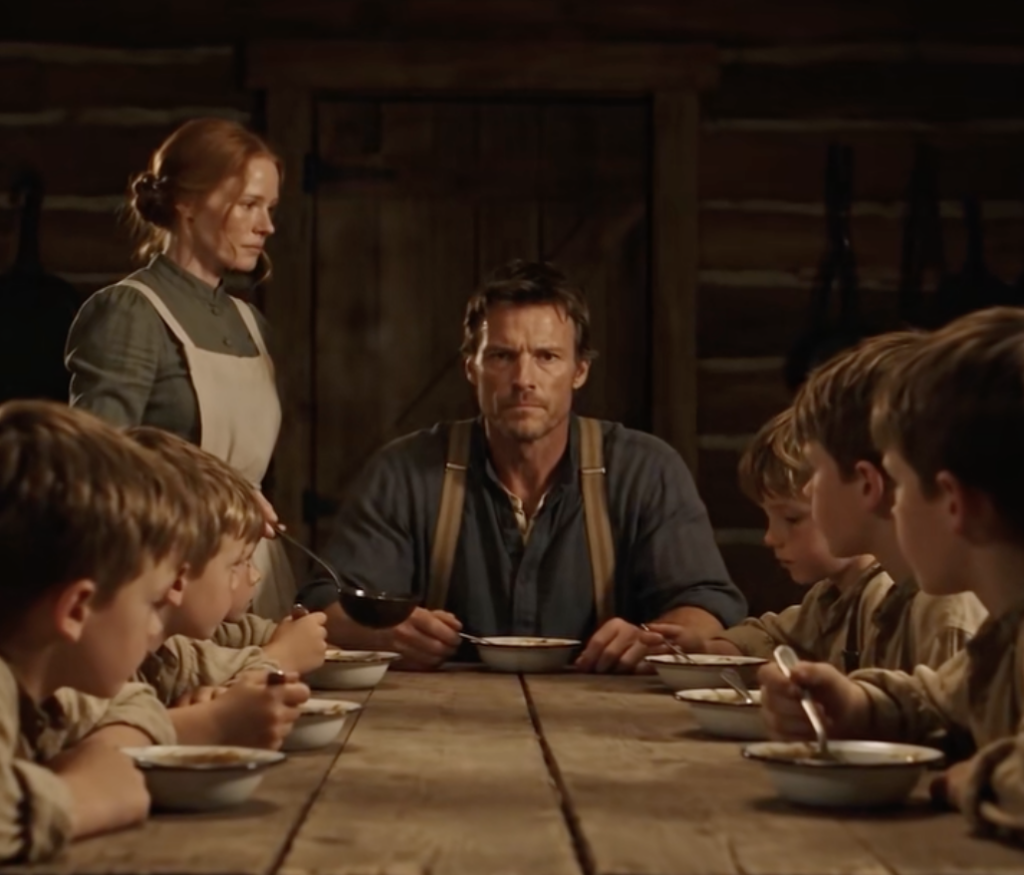
Seven boys sat around the Bell ranch table as if Mercy Calloway were on trial.
No one smiled.
No one welcomed her.
And before supper had even been served,
every one of them seemed convinced of the same thing.
She would leave.
The oldest boy had warned her before her trunk was fully unpacked.
“The last two women didn’t last a week.”
The youngest said nothing at all.
He simply watched Mercy with the wary eyes of a child who had learned something cruel too early—
Never become attached to anyone who arrives carrying luggage.
Then Mercy lifted the lid from the heavy supper pot.
Steam rolled toward the rafters.
The smell of beans, potatoes, onions, molasses, and warm bread filled a kitchen that had gone far too long without comfort.
Suddenly the room became so quiet Mercy could hear the fire snapping behind her.
Wyoming Territory, 1888.
Six hours earlier, Mercy had stepped from the train at Larkspur Crossing with one trunk, a coat too thin for the cutting wind, and absolutely no illusions about romance.
Thomas Bell’s advertisement had been short.
Widower.
Seven sons.
Working ranch.
Marriage possible with a capable woman.
Capable.
Mercy had almost laughed when she read that word.
People had called her capable her entire life.
Usually when something needed carrying.
Fixing.
Cooking.
Burying.
Or surviving.
She had buried the woman who raised her when Mercy was nine.
Years later, she had buried an empty coffin for
Samuel Harlan
, the young man she had expected to marry, after word arrived that he had been killed during fighting in the western territories.
By thirty, Mercy understood that being dependable often meant people valued what you could endure more than they valued you.
Still, practical promises were easier to believe than romantic ones.
So she had answered Thomas Bell.
He met her at the station.
Tall.
Weathered.
Dark-haired except for streaks of premature gray at his temples.
He looked exhausted in a way sleep could not cure.
His first words had been:
“You’re smaller than I expected.”
Mercy looked him over.
“So are you.”
For half a second, something almost like amusement touched his face.
Then it vanished.
The ranch explained everything his letters had not.
The kitchen stove was cold.
Dirty water sat gray in a basin.
Clothes waited in piles for mending.
The cupboards were almost empty.
And seven growing boys looked as though nobody had fed them properly in months.
This was more than a neglected house.
It was a family that had forgotten how to continue after losing the woman who once held everything together.
Mercy removed her coat.
Then she rolled up her sleeves.
Beans.
Potatoes.
Onions.
Molasses.
Enough flour for bread if she measured carefully.
The stove fought her.
Mercy fought back.
By sunset, supper bubbled inside a black iron pot.
One by one, the boys drifted toward the kitchen.