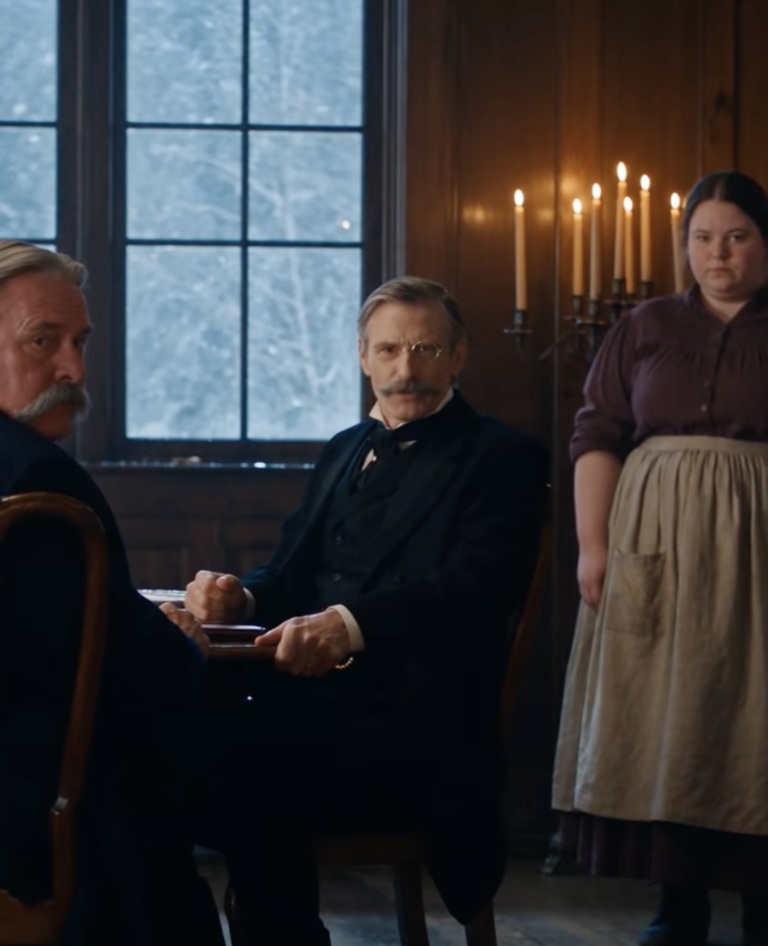
“And a thumb that healed badly after being broken.”
Corvin slowly lowered his hand.
The young woman dismounted.
She walked forward.
Then, in clear English, she spoke for the first time.
“I asked my father whether dead men sometimes grow older.”
Corvin could not move.
The old warrior’s eyes never left him.
Then he said the words Corvin had spent seventeen years trying to bury.
“Your name is not Corvin Torne.”
Silence.
The world seemed to tilt.
The old man spoke again.
“Your name is Elias Vale.”
Corvin’s knees almost failed.
No one had called him that since Fort Mercy burned.
The past returned in fragments.
Smoke.
Gunfire.
Screaming horses.
A child beneath a wagon.
Blood on his hands.
Corvin—Elias—stared at the old Apache man.
“You’re wrong.”
The old man’s face did not change.
“Am I?”
“Yes.”
The young woman stepped closer.
She reached inside a small pouch at her waist.
Corvin’s heart stopped when she withdrew a silver object.
A military insignia.
Blackened around the edges.
A cavalry eagle.
Its lower corner bent.
Corvin knew that bend.
He had made it himself after dropping the insignia against a rock while cleaning his uniform.
The woman held it out.
Corvin did not take it.
“Where did you get that?”
“My mother kept it.”
Corvin looked at her face.
Something inside him shattered.
“How old are you?”
“Twenty-three.”
He stepped backward.
“No.”
She stared at him.
“My mother’s name was Nalin.”
The valley disappeared.
Corvin saw rain.
An army camp.
A young Apache woman with furious eyes standing beneath a torn canvas shelter while he cut rope from her wrists.
Nalin.
The name had survived seventeen years inside the darkest room of his memory.
He whispered it.
“Nalin.”
The old warrior nodded.
“My sister.”
Corvin looked at him.
Then at the young woman.
“I thought she died.”
“She did.”
The words struck harder than a bullet.
Corvin looked away.
For seventeen years he had wondered.
For seventeen years he had hoped.
For seventeen years he had also feared the answer.
The old warrior continued.
“But she lived twelve years after Fort Mercy.”
Corvin shut his eyes.
Fort Mercy.
There had never been much mercy there.
In 1866, Elias Vale had been a lieutenant in the territorial cavalry.
Twenty-five years old.
Proud.
Ambitious.
Stupid.
He had believed uniforms made righteous men.
Captain Abram Voss commanded the garrison.
Voss was respected in Tucson.
Praised in newspapers.
Called a protector of settlers.
But beyond the walls of Fort Mercy, Voss ran a different operation.
His soldiers seized Apache prisoners during patrols.
Some were exchanged.
Some disappeared.
Women and children were held as leverage.
Men were forced to guide troops through mountain passes.