Except perhaps me.
I had been chasing the memory of the boy Caleb used to be.
Six days before his thirty-third birthday, I finally called him.
He answered on the second ring.
Neither of us spoke at first.
Then he whispered, “Mom?”
“I found a letter from your father.”
Silence.
“What did it say?”
I looked through my office window at thousands of lights glowing across the city.
“It said we were supposed to let you fall.”
Caleb released a shaky breath.
“Sounds like Dad.”
I smiled through tears.
“Yes.”
Then I told him about the trust.
The real structure.
The inheritance that had never existed.
For nearly thirty seconds, he said nothing.
Then something happened that I never expected.
Caleb laughed.
Not bitterly.
Not angrily.
He laughed until he started crying.
“All of that,” he finally said.
“Yes.”
“For nothing.”
“No.”
I waited.
“You learned what everything was actually worth.”
He became quiet.
Then he said, “I miss you.”
I closed my eyes.
“I miss you too.”
That was not forgiveness.
Not completely.
It was something smaller.
And perhaps more valuable.
A beginning.
Months later, Caleb visited my home for dinner.
No Tiffany.
No Sterling family.
No chauffeurs.
No cameras.
He arrived in a used Honda and brought grocery-store flowers.
We cooked spaghetti together.
He burned the garlic.
I complained.
He told me I was controlling.
For one terrible second, we both froze.
Then Caleb smiled.
“So I guess some things really are true.”
I threw a dish towel at him.
And we laughed.
Real laughter.
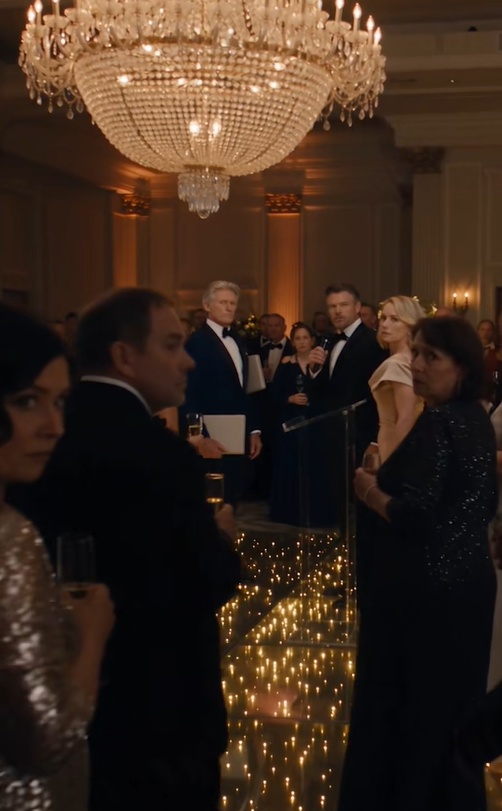
Nothing like the laughter in that ballroom.
Before leaving, Caleb stopped beside the front door.
“Mom?”
“Yes?”
“I’ve thought about that wedding every day.”
“So have I.”
“I keep wishing I’d stood up.”
I looked at him.
“You can’t change that moment.”
“I know.”
He nodded.
“But if anything like it ever happens again…”
He stopped.
I waited.
His eyes met mine.
“I won’t stay seated.”
I believed him.
Not because he was my son.
Not because I wanted to.
Because for the first time in his life, Caleb was learning that character is not inherited.
Neither is courage.
And dignity does not belong to the richest person in the room.
That night at the wedding, Tiffany Sterling thought she was humiliating a powerless old woman in a cheap navy dress.
Richard Sterling thought salvation was one signature away.
Caleb thought his future depended on money he had not yet inherited.
They were all wrong.
Because the most valuable thing I possessed was never Vance Global.
It was never the billions.
It was never Project Sterling.
It was the ability to walk away from people who believed love required me to tolerate humiliation.
And the strength to leave the door unlocked—not wide open, not without boundaries, but unlocked—for a son willing to become better than the man who had once sat silently while the entire room laughed at his mother.
Some inheritances come from a will.
The ones that matter most come from finally understanding what your parents were trying to teach you before it is too late.