Corvin said quietly:
“And he failed you.”
Vale stopped fighting.
Those four words did what bullets could not.
Corvin continued.
“He saved your life and then left you.
Maybe he thought he had reasons.
Maybe he was terrified.
Maybe he believed an orphan home was safer.”
Vale’s eyes reddened.
“But he failed you.”
No one had ever said it to him.
Corvin could see that.
Vale looked toward the ridges.
Toward Mara.
Toward Kele.
Then toward the well.
“He wrote to me once.”
Corvin froze.
“What?”
Vale laughed weakly.
“When I was nineteen.”
“What did he say?”
“That someday I would come looking for what my father lost.”
Corvin’s heart pounded.
“And?”
Vale looked at him.
“He said he hoped I would find you first.”
Silence.
Then Vale did something nobody expected.
He reached inside his coat.
Mara raised her rifle.
“Wait,” Corvin shouted.
Vale withdrew a folded envelope.
Old.
Worn.
He handed it to Corvin.
The handwriting belonged to Gideon.
On the front were two words.
For Samuel.
Corvin unfolded it.
Samuel,
If you ever return to the valley, you will believe I chose another boy over you.
You will be right.
And wrong.
I was afraid Henry’s men would search for his son, so I hid you where I believed they would not look.
I intended to return within a month.
I was arrested before I could.
By the time I found you again, you had run away.
I searched for three years.
Corvin looked up.
Vale’s face had gone pale.
“You never read this?”
“I read the first line.”
Corvin stared.
Vale laughed, tears standing unexpectedly in his eyes.
“I spent twenty-six years hating him because I read the first line.”
Mara lowered her rifle.
Corvin continued.
If hatred brings you back, then let it bring you.
But before you take anything from that valley, find Corvin.
He carries no blood of mine.
Neither do you.
But if there is one decent thing I leave this world, I hope it is that two boys I once failed might someday refuse to become the men who destroyed their fathers.
Corvin could no longer speak.
Vale looked away.
Around them, the fighting had stopped.
Men stood breathing hard in the settling dust.
No one had been killed.
By some miracle, no gunshot had found a body.
Vale stared into the well.
Then he removed his expensive coat.
He dropped it into the dirt.
“Bring a hook.”
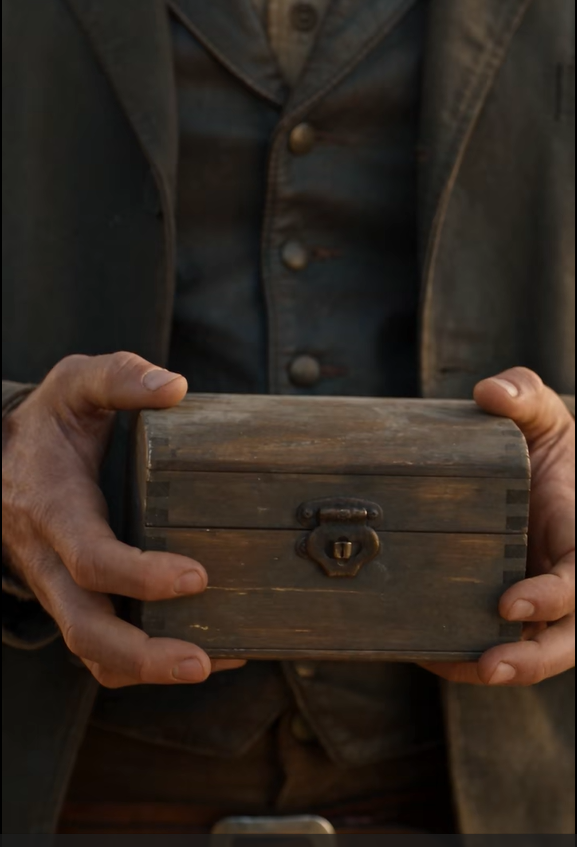
The metal box had rested forty feet down inside a narrow stone cavity behind the well shaft.
Gideon had sealed it in waxed canvas.
Inside were maps.
Survey papers.
Letters.
Payment records.
And three written orders signed by Henry Vale.
Burn the northern settlement.
Drive survivors east.
Destroy water stores.
No official court could easily dismiss them.
Ezra Vale sat beneath the porch while Corvin read.
By afternoon, the great railroad man looked twenty years older.
At last he said:
“My company is finished if those become public.”
Corvin folded one letter.
“Maybe.”
Vale looked at him.
“You could ask anything.”
“I know.”
“Money?”
“No.”
“Half of Red Meridian?”
“No.”
Vale frowned.
“What, then?”
Corvin glanced toward Kele and Mara.
The three hundred riders had dismounted.
Some watered horses.
Others shared food.
For the first time since dawn, the ranch no longer looked surrounded.
It looked occupied by guests.
Corvin pointed toward the land.
“You abandon every claim in this valley.”
Vale’s jaw tightened.
“All?”
“All.”
“That copper is worth millions.”
“That water is worth more.”
Vale stared at him.
Corvin continued.
“You transfer the surrounding acreage into a protected trust.”