No diamonds.
No account ledger.
There was only a photograph.
My grandfather.
My mother.
Marcus.
And a fourth person.
A woman.
Young.
Blonde.
Smiling.
On the back, someone had written:
Evelyn was never the first one who tried to stop him.
Below that was a name.
Vanessa Sinclair.
When I confronted her, Vanessa stared at the photograph for almost a minute.
Then she began crying.
She had been twenty-three.
My grandfather had recruited her into one of his companies.
She discovered what he was doing.
She tried to expose him.
He destroyed her career, threatened her parents, and forced her into silence.
Everything Vanessa later became—the obsession with status, control, reputation, never appearing weak—had grown around that wound like scar tissue.
It didn’t excuse what she did to me.
She never claimed it did.
But it explained something I had misunderstood.
Vanessa hadn’t recognized my mother’s dress.
She’d recognized the stitching.
My grandfather used the same silver thread to mark documents connected to people he considered dangerous.
When Vanessa saw it that evening, she panicked.
She thought I knew.
She thought I was threatening her.
So she tried to destroy the dress.
Instead, she opened it.
That was the final irony.
The woman who had spent her entire adult life terrified that Arthur Whitmore would destroy her if she ever revealed the truth…
was the person who accidentally exposed the evidence that finally destroyed him.
Months later, Vanessa visited the exhibition.
I happened to be there.
We stood silently before the dress.
She stared at the torn seam.
“Do you ever wish I hadn’t done it?”
I thought about my mother.
My sister.
My father.
The stolen families who finally received restitution.
My grandfather sitting in prison.
Then I looked at Vanessa.
“No.”
She nodded.
Neither of us smiled.
Before leaving, she touched the glass lightly.
“Your mother made beautiful things.”
“Yes,” I said.
“She did.”
Vanessa walked away.
I remained there for another minute.
Then I noticed something I’d never seen before.
Inside the display case, beneath the repaired section of the gown, one tiny strand of silver thread had come loose.
It shimmered beneath the museum lights.
I thought about pulling it.
Instead, I laughed.
Some threads, I had learned, should be left alone.
Others need to be pulled until every hidden thing comes apart.
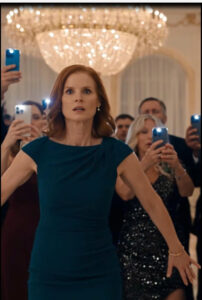
And whenever I remember that night—the chandeliers, the cameras, the ripped fabric, Vanessa’s cruel smile—I no longer remember it as the night my dress was destroyed.
I remember it as
the night one woman tried to humiliate me in front of three hundred people and accidentally tore open the secret that had been holding four generations of our families hostage.
She thought she was destroying something my mother made.
She was actually finishing what my mother started.