He knelt.
There were scratches along its edge.
His heart began pounding.
Together, they pulled.
Nothing.
Sela crouched beside him.
“Again.”
They pulled harder.
The stone shifted.
Behind it was a cavity.
Corvin reached inside.
His fingers touched metal.
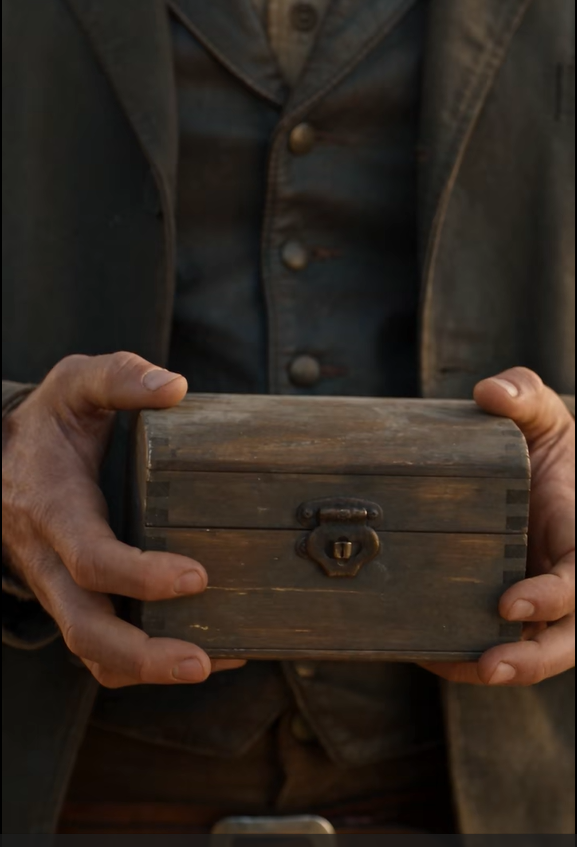
He removed a narrow iron box wrapped in rotting oilcloth.
For a moment, neither spoke.
Then Corvin whispered:
“What did you do, Pa?”
The lock had rusted.
Sela broke it with a rock.
Inside were papers.
Dozens.
Survey records.
Receipts.
Letters.
Old military dispatches.
And a leather-bound journal.
Corvin recognized the handwriting immediately.
His father’s.
The first page contained only six words.
IF CORVIN FINDS THIS, I FAILED.
Corvin sat heavily beside the well.
His hands trembled.
He turned the page.
Josiah Torne’s confession had waited thirty years to be read.
In 1857, before Corvin was born, Josiah had served as a civilian scout for the Army.
He had guided soldiers through Apache country.
At first, he believed he was protecting settlements.
Then the orders changed.
Villages were mapped.
Water holes were recorded.
Families were driven away from places ranchers wanted.
Certain officers became rich.
Josiah quit.
But quitting did not erase what he had helped build.
Years later, he learned that several former officers and cattle investors were resurrecting the same scheme.
Among the names were Ransom Pike’s father.
And the father of Elias Crowe.
Corvin read faster.
Josiah had gathered proof.
He hid copies beneath the well.
Then came the paragraph that made Corvin’s hands stop moving.
The land beneath my house was never honestly mine.
He read it twice.
Sela stood silently beside him.
Corvin continued.
The deed to Torne Ranch had been created from a fraudulent territorial survey.
The original boundary recognized Red Mesa families’ use of the spring and surrounding valley.
Pike’s father had bribed a clerk.
Maps had been replaced.
Families removed.
Josiah discovered the fraud after purchasing the property.
He attempted to expose it.
Nobody listened.
So he stayed.
Not because he believed the land belonged to him.
Because he feared that if he abandoned the well, men like Pike would take it permanently.
Corvin reached the final pages.
There, the handwriting changed.
Less steady.
Written shortly before Josiah’s death.
Elias Crowe came today.
Corvin stopped.
He remembered Elias visiting twelve years earlier.
They had eaten supper.
His father and Elias had argued afterward.
Corvin had never known why.
The next morning, Josiah rode into the canyon.
His horse returned alone.
Everyone said he’d fallen.
His body had been found below a cliff.
Corvin stared at the next line.
The boy has become his father.
A shadow crossed the page.
Sela looked toward the southern road.
Dust.
A great wall of it.
Bugles sounded.
Cavalry.
Captain Elias Crowe had arrived.
Forty soldiers rode toward Torne Ranch in two disciplined columns.
At their head sat a handsome man with a gray cavalry coat and polished boots.
Corvin hadn’t seen him in almost a year.
Crowe raised a hand.
His men stopped.
He looked at the Apache riders.
Then at Pike.
Then at Corvin.
His expression was perfect concern.
“Corvin!” he called.
Relief nearly rose in Corvin out of habit.