Someone placed a wreath on his door that first Christmas.
Jack threw it into the stove.
The following year, he stopped attending church.
By the third year, people stopped inviting him.
By the sixth, Callahan Ranch had become the sort of place children hurried past and adults spoke about quietly.
Jack did not care.
At forty-three, he survived through repetition.
Up before dawn.
Coffee.
Barn.
Cattle.
Fences.
Wood.
Supper.
Sleep.
He worked until pain in his muscles became louder than memory.
He kept Mary’s dresses in the wardrobe.
He left her sewing basket beside the parlor window.
And Lucy’s bedroom remained exactly as it had been on the morning she became sick.
Her wooden horse waited beside the wall.
A rag doll named Miss Abigail sat on the windowsill.
A faded blue quilt lay folded at the foot of the bed.
Jack never entered.
He kept the door locked.
There were griefs a man survived by facing.
There were others he survived by refusing to look at them.
Then, three days before Christmas, someone knocked.
Jack almost ignored it.
Snow had been falling since morning, and by afternoon the world beyond his windows had disappeared beneath white.
The knock came again.
Three soft taps.
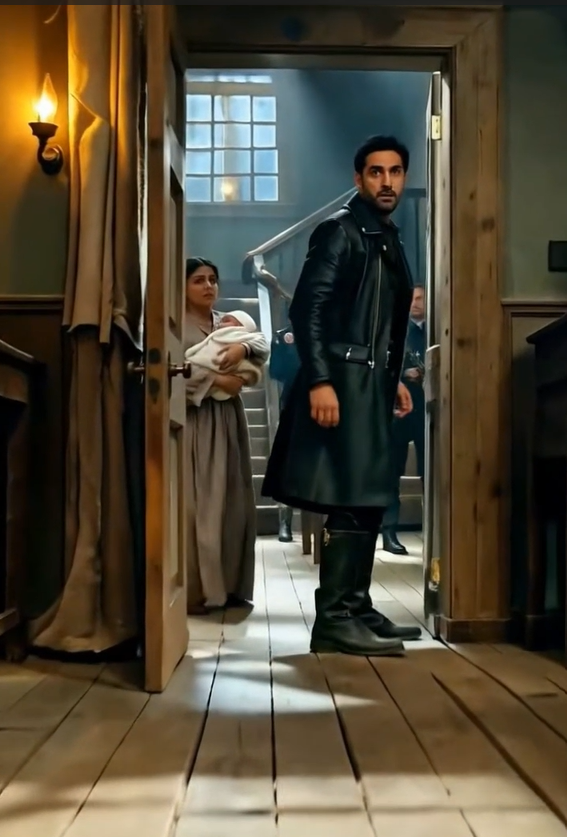
Jack opened the door.
A young woman stood on the porch.
She could not have been more than twenty-four.
Her coat was too thin for Wyoming winter, her boots were badly worn, and melting snow clung to strands of dark brown hair escaping from beneath her bonnet.
In her arms was a little girl wrapped in a patched wool blanket.
“My name is Sarah Collins.”
Jack waited.
She swallowed.
“Mrs. Parker said you might need someone to prepare Christmas dinner.”
Jack almost laughed.
He had not prepared Christmas dinner in six years.
“I don’t celebrate Christmas.”
The disappointment on Sarah’s face appeared only for an instant.
Then she nodded.
“I understand.”
She turned.
The little bundle in her arms moved.
A child’s face emerged.
Golden curls.
Pink cheeks.
And blue eyes.
Jack’s heart stopped.
The child stared directly at him.
No fear.
No shyness.
Only curiosity.
Jack gripped the doorframe.
Lucy.
It was absurd.
Impossible.
Cruel.
But for one heartbeat, his daughter seemed to be standing in the snow.
The little girl smiled.
“Horse,” she said.
Jack followed her pointing finger.
Behind him, through the open doorway, she could apparently see an old iron horseshoe nailed above the kitchen entrance.
Sarah shifted the child on her hip.
“I’m sorry to bother you.”
“Wait.”
The word came from Jack before he could stop it.
Sarah turned.
Jack looked at the child again.
“What can you cook?”
“Anything.”
“That usually means nothing.”
A faint spark appeared in Sarah’s eyes.
“Biscuits, cornbread, beef stew, roast, chicken and dumplings, apple pie, blackberry cobbler, bread, potatoes six different ways, and a ham good enough to make a Methodist forget he’s supposed to share.”
Jack stared at her.
A smile almost happened.
Almost.
“How much?”
Sarah hesitated.
“Whatever you think is fair.”
“I’ll provide the food. Twenty dollars for three days.”
Her lips parted.
Twenty dollars was clearly more than she had expected.
“Mr. Callahan—”
“Jack.”
She glanced down at the girl.
Then back at him.
“Thank you.”
He stepped aside.
“It’s only Christmas dinner.”
Sarah entered.
The child looked around solemnly from her mother’s arms.
“What’s her name?”
“Grace.”
Jack went still.
Sarah smiled faintly.