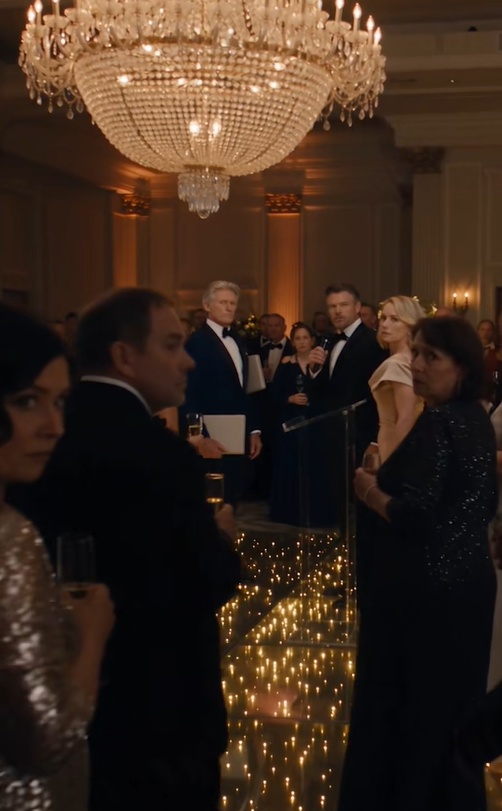
“Dad!”
Marcus laughed.
“What?”
“You forgot something.”
“What did I forget?”
She pointed at me.
“Mom’s lunch.”
The audience laughed.
Marcus looked confused.
Then I understood.
So did David.
A year earlier, I had walked into the hospital carrying a lunch Marcus never ate.
That morning, before the ceremony, Lily had insisted we stop at the same deli.
I reached beneath my chair and lifted a brown paper bag.
Marcus covered his face.
Inside was a turkey sandwich on rye.
Salt-and-vinegar chips.
Apple pie.
And beneath the fork was a note.
He opened it at the podium.
I watched his eyes move across the words.
Then he looked at me.
Tears ran down his face.
The note said:
You don’t have to take care of everyone.
Let us have a turn.
That evening, the six of us ate dinner together.
Marcus burned the garlic bread.
Julian complained about the baseball game.
Nora and I argued over whether Sofia needed another slice of cake.
Lily stole icing with her finger and blamed Marcus.
Nothing about our family made sense on paper.
Two sets of parents.
Two daughters.
One deliberate embryo switch.
One leukemia diagnosis.
One transplant.
One dead woman’s unforgivable decision.
And one truth that had taken me an entire year to understand.
The day I entered St. Matthew’s, I believed David was about to tell me something that would divide my life into before and after.
He did.
But the dividing line was not Marcus’s leukemia.
It was not the embryo switch.
It was not Sofia.
It was not even Evelyn’s confession.
The dividing line was simpler.
Before that day, I believed the people we loved belonged to us because of promises, names, marriage certificates, and blood.
Afterward, I understood something else.
People never belong to us.
We simply get the astonishing privilege of walking beside them for whatever time we are given.
Marcus reached beneath the table and found my hand.
Sofia was laughing.
Lily was trying to steal her cake.
Nora was pretending not to notice.
I looked around at the family that should never have existed in this form.
Then I looked at my husband.
One year earlier, every person in that hospital had known something about Marcus that I did not.
Now I knew more than any of us had imagined possible.
And somehow, impossibly, he was still here.
I squeezed his hand.
He squeezed back.
For once, neither of us needed to hide anything.
And for the first time in a very long time, nothing in our house was waiting to be saved.