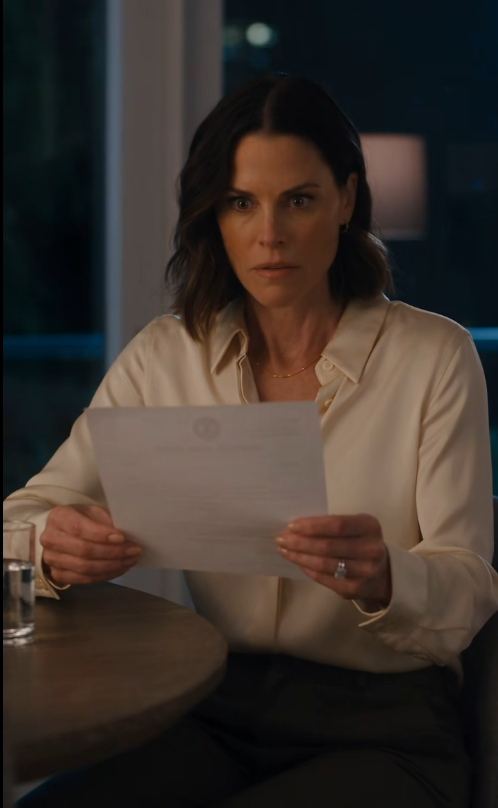
When she fell asleep, I stood in her doorway for nearly an hour.
She had Marcus’s habit of sleeping with one foot outside the blanket.
Or at least I had always called it Marcus’s habit.
Now I wondered if I had simply invented similarities because parents were supposed to find themselves in their children.
Her dark hair.
My stubborn chin.
Marcus’s smile.
My mother’s laugh.
How many things had I seen because I wanted to see them?
Then the thought came that made me physically ill.
If Lily was not ours, someone else’s child had been sleeping in our house for eight years.
And somewhere, perhaps, our child had been calling another woman Mom.
I ran to the bathroom and vomited.
Afterward, I sat on the cold tile floor until midnight.
At twelve fourteen, my phone buzzed.
Marcus.
I nearly ignored it.
Then I answered.
“Hi.”
His voice was weak.
“Did she go to sleep?”
“Yes.”
“Was she worried?”
“I told her you had an infection.”
“Thank you.”
Silence.
Then:
“Claire, I found something.”
My entire body tightened.
“What?”
“The fertility center still has archived transfer logs.”
I stood.
“How?”
“St. Matthew’s acquired the clinic six years ago. The records are in hospital storage.”
My heart began hammering.
“And?”
“There were four transfers that morning.”
I gripped the kitchen counter.
“Four women?”
“Yes.”
“Do you know who they were?”
Another silence.
“Marcus.”
“I know one.”
My breathing stopped.
“How?”
“Because I’ve met her daughter.”
The refrigerator hummed behind me.
“What did you just say?”
He inhaled slowly.
“There was another couple scheduled twenty-three minutes after us.”
“Who?”
“Nora and Julian Reyes.”
I waited.
Marcus’s next words came almost as a whisper.
“Their daughter was born three days after Lily.”
The room blurred.
“What does that prove?”
“Nothing yet.”
“Then why are you telling me?”
“Because their daughter was treated at St. Matthew’s last month.”
“For what?”
“Appendicitis.”
“And?”
“She needed blood work.”
I closed my eyes.
“Marcus.”
“David found the records after the lab questioned Lily’s markers.”
“What records?”
“The girl’s blood type. Some archived genetic screening from when she was a newborn.”
His voice cracked.
“Claire, she has my blood type. She has a marker that runs in my father’s family. And according to the embryo logs, the Reyes embryo and ours were processed at the same station within minutes of each other.”
My knees weakened.
“Are you saying—”
“I’m saying there may be another eight-year-old girl in this city who is biologically ours.”
Her name was Sofia Reyes.
I learned that three days later in a conference room that smelled of coffee and disinfectant.
The hospital’s general counsel sat at one end of the table.