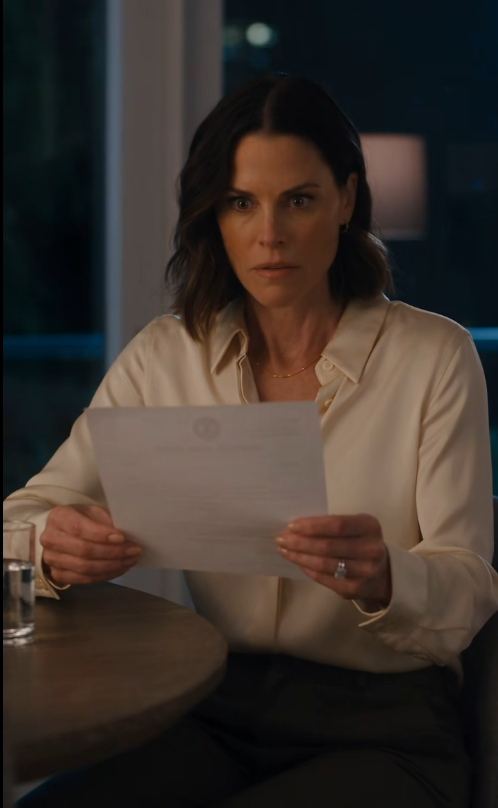
Then she turned the page over.
There was one final line.
One neither of them had expected.
P.S. Amos—if you’re the one delivering this, try not to send her to Gideon with one of your damned jokes.
For a heartbeat there was silence.
Then Mabel laughed so violently she nearly dropped the letter.
Across the yard, Amos saw their faces.
His expression changed.
“Oh, hell.”
Gideon began laughing too.
Soon the girls joined them without knowing why.
And beneath the cottonwood, on land Mabel had once crossed believing she owned nothing in the world, five people stood together surrounded by neighbors, cattle, sunlight and the wild music of children.
Years later, people in Sorrow Creek would tell the story differently.
Some said Gideon Cross rescued a widow and her three starving daughters.
Others said Mabel Harlo rescued the loneliest cowboy in the territory.
Both versions were wrong.
Gideon had never rescued Mabel.
Mabel had never rescued Gideon.
They had simply opened the right door at the moment when two broken lives finally reached the same place.
And the woman everyone had once called a tragedy became one of the wealthiest ranchers in the county—not because money had saved her, but because she had survived long enough to discover that what had been stolen from her was never the measure of what she was worth.
Her daughters grew up knowing something Mabel had learned the hard way.
A home was not a deed.
It was not a house.
It was not a man.
It was not even safety.
A home was the place where you no longer had to make yourself smaller to deserve staying.
And on certain evenings, when sunset turned the prairie gold and children’s laughter spilled from the porch, Mabel would sometimes remember that first terrible day.
Twelve cents in her pocket.
Dust on her shoes.
Three hungry daughters behind her.
A town convinced her life was already over.
And a lonely cowboy opening a door.
If Mabel could have returned to that exhausted woman standing on Gideon Cross’s porch, she would not have told her about the money waiting in the bank.
She would not have mentioned Silas Vane.
Or Samuel’s ledger.
Or the deed.
Or the wedding beneath the cottonwood.
She would have told her only one thing.
The thing she had needed most desperately to hear.
Knock anyway.
Because sometimes the door that looks like your last chance is not the end of your story.
Sometimes it is the first place your future has been waiting for you.