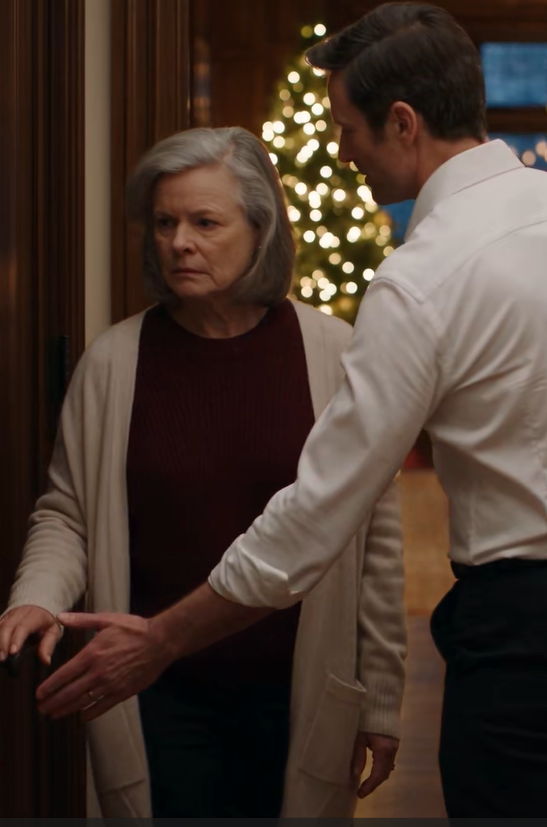
The moment I realized I had become invisible in my own family was not when my daughter-in-law insulted me.
It was when I counted twelve name cards around my Christmas table and discovered that every guest had a seat except me.
I had cooked the turkey.
I had baked the pies.
I had polished the silver and laid out the china my husband and I had spent decades collecting.
Yet Melissa stood in my kitchen with a glass of wine in her hand and said, almost casually, “Maybe you’d be more comfortable upstairs tonight.”
For a moment, I thought I had misunderstood her.
Outside the windows, snow drifted softly over our quiet Ohio street, covering the hedges and sidewalks in white. Inside, the house glowed with the same Christmas lights Howard had strung around the front windows every December until his knees became too bad for ladders.
The smell of turkey, sage, cinnamon, and warm butter filled the kitchen.
Everything should have felt familiar.
Instead, I felt like a stranger.
“Upstairs?” I repeated.
Melissa took a sip of wine.
Her red dress was immaculate. Her blond hair fell over one shoulder in careful waves, and the diamond earrings Daniel had given her last anniversary caught the kitchen light.
“Well, yes. Just for dinner.”
I looked toward the dining room.
Twelve chairs.
Twelve place settings.
Twelve folded linen napkins.
And twelve handwritten cards.
None said Evelyn.
I was sixty-eight years old that Christmas.
My name is Evelyn Mercer, and the house Melissa was asking me to disappear inside had belonged to me for thirty-one years.
For twenty-five Christmases, my husband Howard had celebrated beside me.
He had been gone for six years.
That morning, I had gotten up at 4:30 while snow covered the street outside. Old Christmas songs played softly from the radio as I chopped onions, prepared stuffing, rolled pastry, peeled potatoes, and basted the turkey.
By afternoon, flour covered my faded red apron.
My hands smelled like sage and butter.
And somehow, I was being told I did not belong at my own dinner.
“We didn’t really plan this as your thing,” Melissa explained.
“My thing?”
“The gathering. It’s mainly my family and several people from work.”
She smiled as though explaining something obvious to a child.
“I just thought you might enjoy some quiet.”
I looked at her for several seconds.
Then I asked, “Who cooked the dinner?”
Her smile tightened.
“That isn’t the point.”
“Who bought the groceries?”
“Evelyn—”
“Whose china is on that table?”
She set her glass down harder than necessary.
“You always make everything about ownership.”
That sentence almost made me laugh.
Because for nine months, I had been doing exactly the opposite.
I had been pretending ownership did not matter.
Daniel and Melissa were supposed to be staying temporarily.
That was what my son had promised when their lease ended after the collapse of a business opportunity.
“Three months,” Daniel had said.
“Maybe four.”
He was my only child.
So I said the words any mother would say.
“Come home.”
I had no idea how quickly my home would stop feeling like mine.