“Of what?”
She looked down.
“My leaving.”
Caleb waited.
Mae did not explain.
His ranch eventually appeared beyond a low hill—a modest cabin, weathered barn, chicken coop, wind-battered corral, and several hundred acres of grassland stretching north toward broken mountains.
It wasn’t beautiful.
But it looked peaceful.
To Mae, it might as well have been heaven.
A black-and-white dog raced from beneath the porch.
Mae startled so violently that Juniper sidestepped.
Caleb raised a hand.
“Easy. That’s Moses. Biggest coward in Montana.”
The dog barked ferociously, then saw Mae looking at him and retreated behind Caleb’s legs.
For the first time that day, something almost resembling amusement touched her face.
Caleb noticed.
He pretended he didn’t.
Inside, he heated water.
He left clean bandages, soap, a man’s cotton shirt, and a pair of trousers outside the spare bedroom.
“I’ll be in the barn.”
Mae stared at the closed door after he left.
No lock.
No demand.
No warning.
Nothing.
Her hands began trembling again.
She washed carefully.
Blood swirled pink into the basin.
When she removed the ruined dress, something hard fell from inside the hem and struck the floor.
Mae froze.
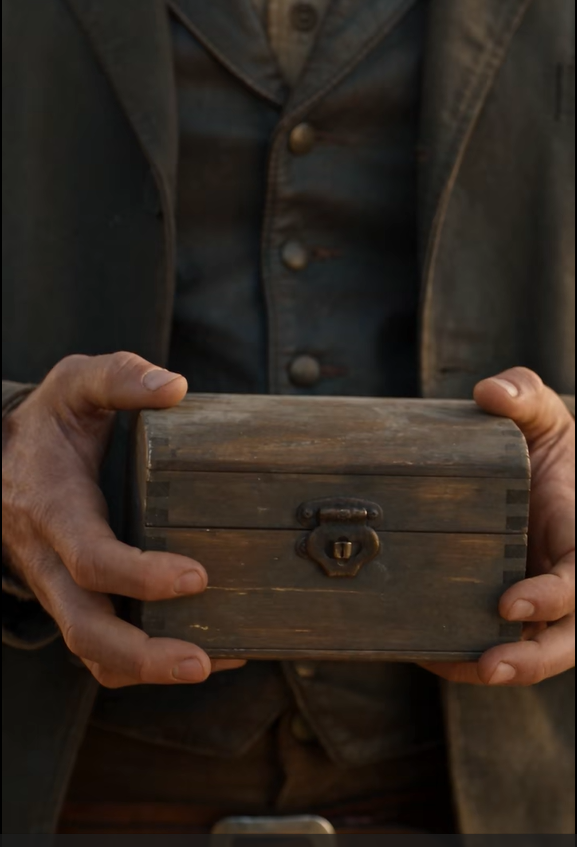
A small brass key.
She snatched it up.
For weeks she had carried it sewn beneath the blue calico.
The reason Owen had beaten her that morning.
The reason she had climbed through the washroom window before dawn.
The reason men would soon be searching every road surrounding Mercy Bend.
Mae held the key in her palm.
Then she whispered to the empty room:
“You better be worth it.”
Caleb returned near sunset.
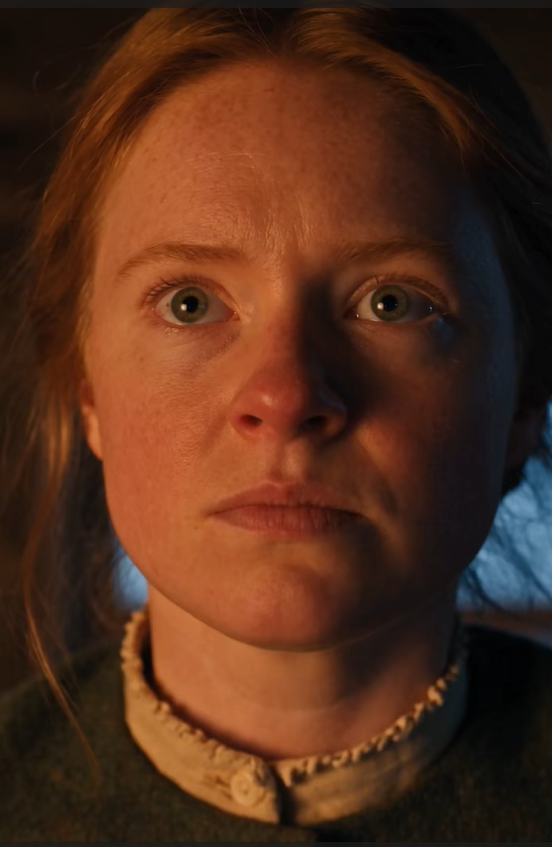
Mae sat beside the cold stove wearing his shirt and trousers rolled at the ankles.
Her damp chestnut hair hung loose.
She looked younger without the Drayton clothes.
Twenty-five instead of forty.
But her eyes were ancient.
Caleb put beans and coffee on the stove.
Neither mentioned the scars.
They ate quietly.
Finally, Caleb said, “How long?”
Mae knew what he meant.
“Four years.”
His spoon stopped.
“You married him four years ago?”
“Yes.”
“What about your family?”
“Dead.”
“Friends?”
A faint, bitter smile.
“Owen made certain I eventually stopped having those.”
Caleb looked at his plate.
Mae studied him.
“You knew his name.”
“Everybody knows it.”
“No.”
Her voice sharpened.
“You knew it differently.”
Caleb lifted his eyes.
Mae waited.
After a long pause, he leaned back.
“My father had trouble with the Draytons.”
“What kind?”
“Land.”
That single word contained years.
Caleb continued.
“Drayton cattle started crossing our south boundary when I was sixteen. Then their surveyor claimed two thousand acres of our grazing land belonged to them.”
“What happened?”
“My father fought.”
“And?”
“He died.”
Mae stared.
“How?”
“Horse threw him.”
“You believe that?”
“I did.”
The answer hung heavily between them.
Caleb looked toward the window.
“Until the horse came home.”
Mae frowned.
“No broken tack. No blood. Nothing. Animal was calm as church Sunday.”
Caleb’s jaw tightened.
“They found Pa at the bottom of Miller’s Cut.”
Mae’s breathing changed.
“When?”
“Eleven years ago.”
“What was his name?”
“Jacob Rusk.”
The tin cup slipped from Mae’s hand.