I threw my shoulder against it.
Nothing.
Fire climbed the curtains.
The roof beams groaned.
I grabbed a chair and smashed the front window.
Heat chased me across the room.
I climbed through broken glass.
A hand grabbed me.
I screamed.
“Morgan!”
Nathan.
He pulled me into the dirt as the roof collapsed behind us.
For several seconds we lay coughing beneath the stars.
Then I remembered.
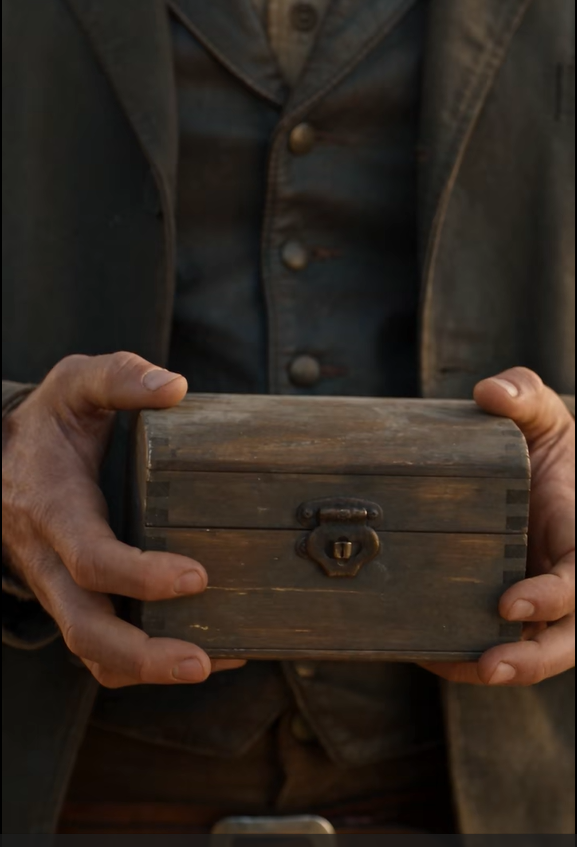
“The box!”
Nathan held me down.
“No.”
“Caleb’s papers!”
“No.”
I clawed at him.
“They’re all we have!”
“The copies aren’t inside.”
I stopped.
He coughed.
“What?”
“I removed them this afternoon.”
“Where?”
He looked toward town.
“The church.”
We both turned.
A shadow was moving near the road.
Nathan sprang to his feet.
The shadow ran.
Nathan chased him.
A horse thundered away in the darkness.
Nathan fired once into the air.
The rider disappeared.
Behind us, my home collapsed.
I watched nine years of marriage become sparks.
Caleb’s table.
Our bed.
The blue cup he had chipped the first week we were married.
Everything.
Nathan stood beside me.
I whispered, “I have nothing.”
He looked at the burning house.
Then at me.
“You have your name.”
I almost laughed bitterly.
Then he said:
“And tomorrow, that may be more dangerous than a gun.”
We spent the rest of the night inside the church.
Reverend Amos Keller gave me a blanket, coffee, and the small room beside his study.
Nathan placed Caleb’s documents beneath the floorboards below the altar.
Around dawn, I heard voices outside.
People from town.
Martha brought clothes.
Samuel brought bread.
The schoolchildren collected blankets.
By sunrise, perhaps fifty people had gathered around the ruined shell of my house.
I watched from the church steps.
Yesterday those people had watched me tied to a post.
Today they stood in the ashes.
Martha approached me first.
She had been crying.
“I should have stopped them.”
“You couldn’t have.”
“I could have tried.”
That mattered.
Perhaps more than success would have.
Samuel Turner removed his hat.
“Caldwell took my brother’s ranch sixteen years ago.”
Someone behind him spoke.
“My father’s too.”
Then another.
“He doubled our mill fees after my husband died.”
Another woman said, “He made me sign something after we lost our cattle.”
Voices began multiplying.
Stories.
Threats.
Loans.
Foreclosures.
Land seized for debts nobody understood.
Nathan listened.
Then he asked the question Caleb had apparently spent months asking.
“Did any of you keep copies?”
By noon, the church table was covered.
Loan agreements.
Deeds.
Receipts.
Foreclosure notices.
Nathan compared signatures.
Then he pointed toward three documents.
“Same witness.”
I leaned over.
Each transfer had been witnessed by a man named Charles Vane.
“Who’s Charles Vane?”
Nobody answered.
Then Reverend Keller went pale.
“He’s dead.”
“When?”
“Twenty-two years ago.”
Nathan tapped a document.
“This one was signed eleven years ago.”
A silence fell.
Then Samuel muttered, “Dear God.”
The fraud went back decades.
Perhaps to Victor’s father.
Perhaps farther.
Nathan turned toward me.
“Caleb wasn’t investigating one forged loan.”
He surveyed the table.
“He was investigating the theft of an entire town.”
At three that afternoon, Sheriff Boone arrived.
He brought six deputies.
I had known Elias Boone most of my life.
He had a soft belly, a red beard, and the nervous habit of scratching his cheek whenever he lied.