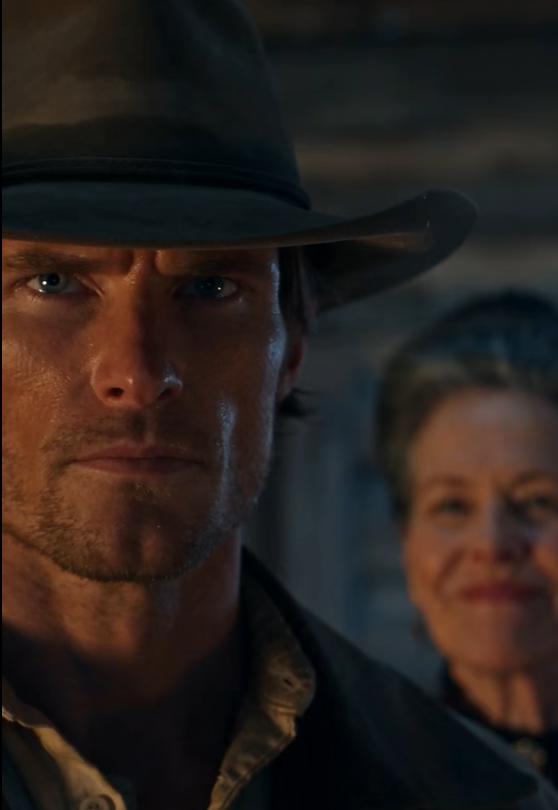
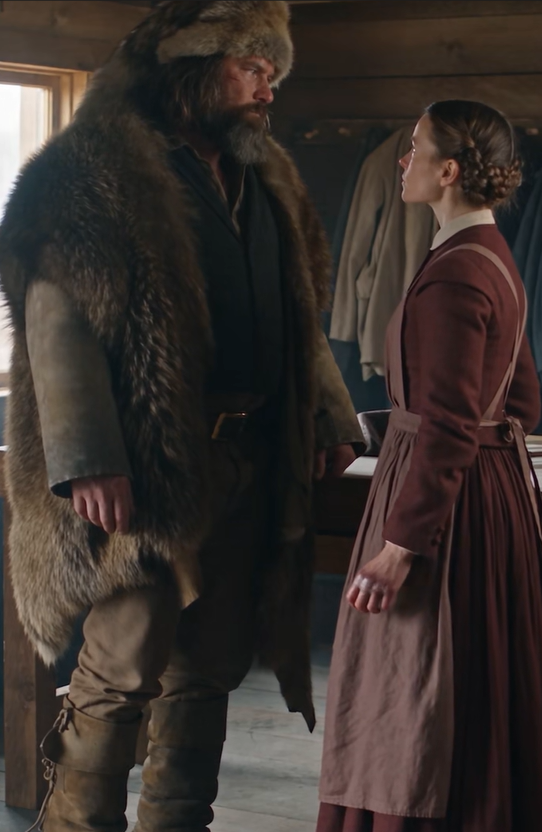
No kiss.
Now Henry gestured toward the bed.
“You take that.”
Clara glanced toward the cot.
“And you?”
“Here.”
“You don’t have to.”
“I know.”
There was something almost painful about his refusal to look at her.
She understood immediately.
He had agreed to marry her, but he had not yet agreed to let her close.
Clara placed her little carpetbag beside the bed.
“Good night, Henry.”
He stopped feeding wood into the stove.
It was the first time she had used his given name.
“Good night, Clara.”
Neither slept much.
Chapter Two: The Marriage of Small Things
Clara’s first loaf of bread resembled a geological formation.
Her second collapsed in the middle.
Her third burned so badly that Henry carried it outside with fireplace tongs.
“Don’t say a word,” she warned.
“I wasn’t going to.”
“You’re thinking something.”
“Mostly about the chickens.”
“What chickens?”
“The ones that would refuse to eat this.”
Clara threw a dishcloth at him.
Henry caught it.
Then, unexpectedly, laughed.
It was a deep, rusty sound, as though it had been buried inside his chest for years.
Clara stared.
“You should do that more often.”
“What?”
“Laugh.”
“Not much reason.”
“Then I’ll have to provide one.”
Henry turned away before she could see his expression.
During their first week, Clara discovered that mountain life offered little consideration for a woman’s intentions.
Water came from a well behind the cabin.
Firewood needed splitting.
Wet laundry froze stiff if left outside.
The stove smoked when fed too quickly.
The floor collected mud regardless of how often she swept.
And Henry worked from before sunrise until after dark.
He never complained about her cooking.
That almost made it worse.
One evening, she slammed a pot of scorched beans onto the table.
“You could tell me they’re terrible.”
Henry lifted his spoon.
“They’re terrible.”
Clara stared.
He continued eating.
“Then why are you eating them?”
“Hungry.”
“Henry Mercer, you are the most impossible man I’ve ever met.”
“You haven’t met many men around here.”
“I’m beginning to see why.”
The following morning, she discovered a small jar on the kitchen table.
Bear grease and pine pitch.
Beside it lay a clean strip of linen.
Her hands had become raw from work.
Cracks ran across her palms.
Henry had noticed.
“I don’t need charity,” she said when he returned.
“Your hands are tools. Maintain them.”
“That may be the least romantic sentence ever spoken to a wife.”
He shrugged.
But she used the salve.
That evening, Henry found his work gloves resting beside the stove, carefully stitched where the leather had split.
He held them for a long moment.
Then looked toward Clara.
She pretended not to notice.
Their marriage began not with kisses, but with repaired gloves and a jar of salve.
The little exchanges multiplied.
Henry began filling the wood box before leaving.
Clara learned exactly how much coffee he liked, although she insisted his preferred brew could remove paint.
He discovered that she hummed while baking.
She learned he hated the sound of a clock ticking.
One evening, he returned to find a curtain hanging across the western window.
It was made from the lining of Clara’s old traveling skirt.
“Why?” he asked.
“Because windows deserve clothes too.”
He stared at the pale fabric.
Then glanced around the cabin.
For the first time, it looked less like a shelter.
More like a home.
A few nights later, Clara discovered an old wooden box beneath the bed.
Inside were a child’s knitted mitten, a faded blue ribbon, and a photograph of a young woman standing beside a wagon.
Clara had barely lifted the photograph when Henry entered.
His expression changed instantly.
“Put that down.”
She obeyed.
“I was only cleaning.”
“Don’t touch that box again.”
His voice was so sharp that she stepped backward.
“I’m sorry.”
Henry snatched the box and carried it outside.
He did not return for nearly an hour.
When he came back, Clara was sitting at the table.
“I didn’t mean to pry.”
He stood beside the door.
“I know.”
“Then why are you angry?”
Henry looked toward the stove.
“Some things are better left buried.”
Clara nodded slowly.
“I used to believe that.”
He looked at her.
“Used to?”
She lowered her eyes.
“Until I learned buried things don’t always stay buried.”
Neither spoke again that evening.
But Henry noticed that Clara cried quietly after she thought he was asleep.
He did not know why.
And she never explained.
Chapter Three: The Name in the Ledger
On the tenth morning, Henry took Clara into Helena for supplies.
The snow had softened, and the road was passable.
Clara wore the buffalo hide over her shoulders.
Henry had begun calling it hers.
At the mercantile, people stared.
A woman near the flour barrels whispered, “That’s Mercer’s bride?”
Another answered, “Lord have mercy. How does she even climb into his wagon?”
Clara pretended not to hear.
Henry did not.
He set a sack of flour on the counter.
“Say it louder.”
The women went silent.
Henry faced them.
“If you’ve got something to say about my wife, say it where I can hear.”
The older woman flushed.
“We meant no harm.”
“Then stop doing it.”
Clara touched his sleeve.
“Henry.”
He turned.
She smiled faintly.
“I’m capable of defending myself.”
“I know.”
“Then allow me.”
She faced the women.
“Ladies, if my size concerns you, I recommend finding something more useful to occupy your minds. Perhaps charity. Or learning manners.”
The shopkeeper coughed to hide a laugh.
Henry’s mouth twitched.
Then Clara noticed a leather-bound ledger lying open on the counter.