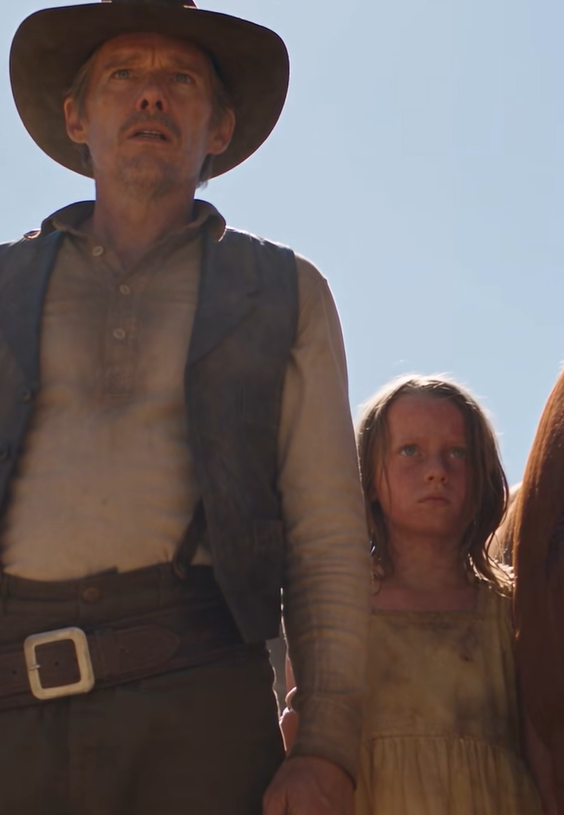
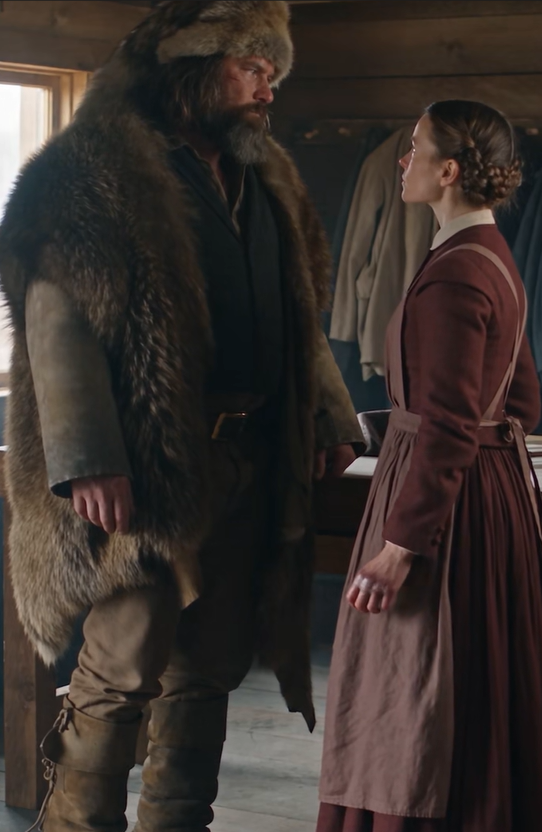
“Silas Blackthorn! You’re under arrest!”
Silas fired.
The shot went wild.
Henry shoved Clara away from the window.
Gunfire erupted.
Snow burst from the fence posts.
A horse screamed.
Abigail dropped behind the stove.
Henry fired twice.
One of Silas’s men fell from his saddle.
Then Silas turned toward the cabin and fired directly through the broken window.
Clara stumbled backward.
Henry heard her gasp.
He turned.
Blood was spreading across the front of her dress.
Chapter Thirteen: What Love Weighs
For one moment, Henry could not comprehend what he was seeing.
Clara looked down at the blood.
Then at him.
“Henry?”
Her voice was small.
Terribly small.
Her knees buckled.
He caught her before she struck the floor.
“No.”
He lowered her carefully.
“No, Clara. No.”
Outside, gunshots continued.
But Henry heard none of them.
He pressed his hands against the wound high on her shoulder.
Blood seeped between his fingers.
Clara stared at him, frightened.
“Am I dying?”
“Not if I can help it.”
Her eyes filled.
“Henry—”
“Save your strength.”
He tore a clean cloth and pressed firmly against the wound.
She winced.
“I’m sorry.”
He stared at her.
“For what?”
“For making everything difficult.”
His heart seemed to split.
She was bleeding.
She was frightened.
And still, somewhere inside her, that cruel old belief remained.
That she was a burden.
That her body made her difficult to love.
Henry bent close.
“Listen carefully.”
She blinked.
“You have never been a burden to me.”
Tears rolled down her cheeks.
“You have been the best thing that ever happened to this house.”
Her lips trembled.
“Henry…”
“I love you, Clara.”
The words came out rough.
Desperate.
Perfectly certain.
“I love every part of you. The stubborn parts. The frightened parts. The parts you think make you impossible to love.”
Clara began crying.
He brushed her hair away from her face.
“And I need you to stay.”
Outside, a final shot rang out.
Then silence.
The cabin door burst open.
Abigail turned with her revolver raised.
“It’s me!” the marshal shouted.
He rushed inside.
Behind him came Judge Whitaker and two deputies.
Henry barely looked up.
“She needs a doctor.”
The marshal knelt beside Clara.
“Doctor’s coming. We brought him with us.”
Henry nodded.
Clara reached weakly for his hand.
He held it.
“Don’t leave,” she whispered.
“Never.”
He remained beside her as the doctor entered.
Remained while instruments were arranged and the wound was examined.
Remained while the doctor explained that the bullet had passed through the fleshy upper shoulder without striking bone or a major vessel.
There had been frightening blood loss, but the bleeding was controlled.
She had a chance.
A good chance, if infection could be prevented.
Henry nearly collapsed with relief.
Outside, Silas Blackthorn lay wounded beneath a pine tree, guarded by four men.
He would live long enough to face trial.
And for the first time in twenty years, Clara’s father would be required to answer for what he had done.
Chapter Fourteen: The Woman Who Stayed
Spring came late to the mountains.
By the time the snow began melting from the ridge, Clara could use her injured arm again.
The trial had taken place in Helena.
Silas Blackthorn had been convicted on multiple counts connected to fraud, conspiracy, and attempted murder.
The recovered records had restored Clara’s legal identity and the trust her mother had created for her.
The newspapers called her the Blackthorn heiress.
Reporters came from as far away as Chicago.
They described her fortune.
Her unusual marriage.
Her father’s crimes.
Some wrote cruelly about her body.
Clara burned those articles without reading them twice.
She had learned something.
Other people’s opinions were not obligations she had to carry.
Henry refused every interview.
When one reporter asked why a wealthy heiress would remain married to a poor mountain rancher, Clara answered before Henry could speak.
“Because he’s the only man I’ve ever met who knew how little money mattered.”
The reporter looked disappointed.
Henry looked at his wife.
And smiled.
With the restored estate, Clara could have purchased an entire street of fine houses in Helena.
Instead, she bought the neighboring grazing land, paid the outstanding debts on several struggling ranches, and established a small schoolhouse for mountain children.
She insisted the building have a large stove and plenty of windows.
Henry insisted it have a strong roof.
They argued pleasantly about everything.
The color of the curtains.
Where the garden should go.
Whether chickens belonged near the porch.
Henry said no.
Clara brought home six.
He built the coop himself.
Abigail moved into a cottage near the cabin.
For the first time in twenty years, she had a family around her.
Sometimes she and Clara sat on the porch together, watching the sunset.
They spoke about Margaret.
About Eleanor.
About the strange ways love survives loss.
One afternoon, Abigail gave Clara a small wooden bird.
It had been carved from pine.
One wing was slightly crooked.
Clara stared.
“Where did you get this?”
“Henry made it when he was fourteen. He gave it to you the day you were taken away. I found it among Margaret’s things after she died.”
Clara held the little bird against her chest.
The memory returned with sudden clarity.
A boy with dark hair.
A little girl crying.
A wooden bird pressed into tiny hands.
And a promise.
I’ll find you.
Clara began weeping.
Abigail kissed her forehead.
“He never remembered making that promise,” she whispered. “But somehow, he kept it.”
That evening, Clara showed the bird to Henry.
He studied it.
Then shook his head.