“I thought Mr.
Sturgis and I might discuss your purchase.”
“No need.”
“There may be.”
He climbed the porch steps.
“Mr.
Sturgis represents interests prepared to pay you thirty thousand dollars Monday morning.”
Tessa’s head turned.
Four thousand dollars profit for doing nothing but winning an auction.
Clay did not even blink.
“No.”
“Thirty-two.”
“No.”
Harlon’s smile weakened.
“You haven’t heard the final offer.”
“I heard enough.”
Sturgis finally spoke.
“Thirty-five thousand.”
Silence followed.
Even Tessa stared at Clay.
Nine thousand dollars profit.
A fortune to most men.
Clay shook his head.
Sturgis took one step closer.
“You’re either very foolish or you know something.”
Clay smiled faintly.
“Which worries you more?”
Harlon’s pleasant expression vanished.
“You purchased distressed agricultural land, Barrett.
Nothing more.”
“Then why are you offering nine thousand above the auction price six hours later?”
Nobody answered.
Tessa felt the first cold ripple move along her spine.
She stepped forward.
“What’s on my land?”
Harlon looked at her.
“Nothing that concerns you anymore.”
Those six words changed something inside Tessa.
Until that moment, part of her had still believed there might be an innocent explanation.
There was none.
She saw it in Harlon’s eyes.
He had expected her to be gone.
Clay saw it too.
He descended the porch steps.
“I think you gentlemen should leave.”
Sturgis rested one hand near his revolver.
Clay looked down at the hand.
Then back at Sturgis.
“That would be a very expensive mistake.”
For a moment neither man moved.
Finally Harlon turned away.
He mounted his horse.
Before leaving, he looked at Tessa.
“You should be careful about believing stories simply because you desperately want them to be true.”
Tessa held up the three receipts.
“Would you call these stories?”
Harlon froze.
Only for a fraction of a second.
But Tessa saw it.
Clay saw it.
And Sturgis certainly saw it, because his face drained of color.
Harlon recovered quickly.
“Old accounting documents.”
“Signed by you.”
“I signed hundreds of receipts.”
“These payments aren’t on my loan statement.”
“Then perhaps your father applied them elsewhere.”
“He had no other debt.”
Harlon pulled his reins.
“Bring them to the bank Monday.”
He rode away.
Sturgis followed.
Neither man looked back.
Clay waited until they disappeared beyond the cottonwoods.
Then he said quietly:
“Now we know Puit is involved.”
Tessa stared at the empty road.
“How?”
“Because you never said where the receipts came from.”
She turned toward him.
Clay continued.
“He didn’t ask whether they were genuine.”
A chill ran through her.
“He already knew.”
“Yes.”
They searched Jacob Morgan’s study until midnight.
Tessa had gone through the room many times since her father’s death, but grief had made her treat certain things as sacred.
His books.
His maps.
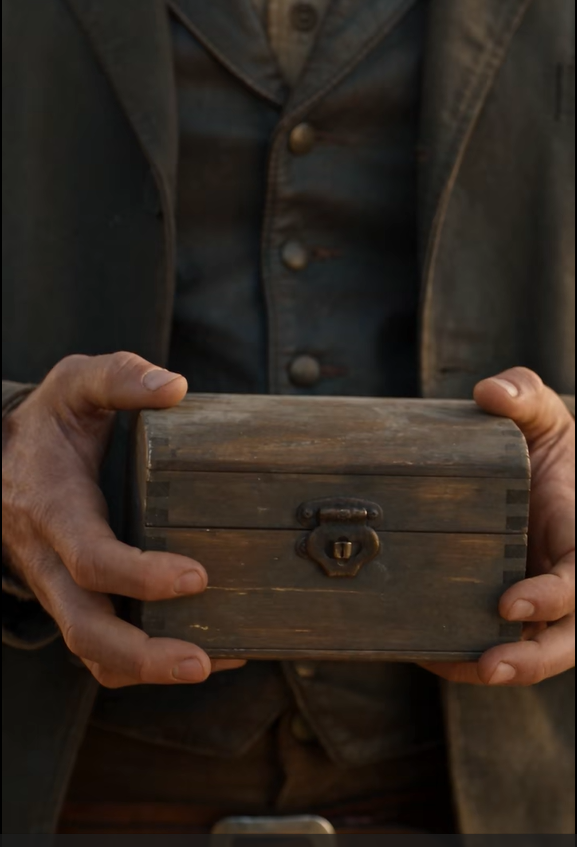
The cedar box containing letters from her mother.
His old cattle ledgers.
Now Clay made her look at everything differently.
“Your father believed records mattered,” he said.
“He recorded the weather every evening for twenty-three years.”
“Exactly.”
“He also recorded every calf born, every steer sold, every sack of grain purchased, and every ranch hand who borrowed more than fifty cents.”
Clay glanced at her.
“Then he wouldn’t make eight thousand dollars in payments without recording them somewhere.”
Tessa stopped.
She turned toward the bookshelf.
Her father’s cattle books were arranged by year.
She pulled down the volume from six years earlier.
Dust moved through the lamplight.
They sat at the desk.