
Three Hundred Warriors Came for Corvin Torne. By Sunset, He Learned Why the Woman at His Well Had Chosen Him.
By sunrise, Corvin Torne understood that one small act of kindness might have brought an army to his doorstep.
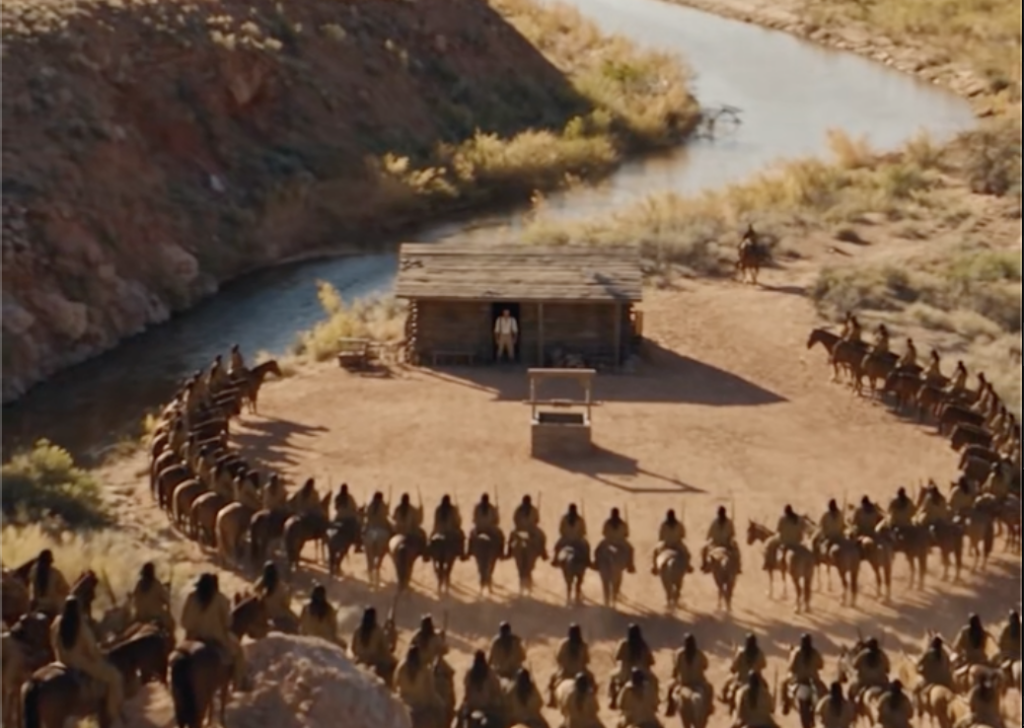
Apache warriors covered the ridges around his ranch.
They lined the northern rise, watched from the eastern slope, and waited along the dry creek bed to the west.
Spears stood like black needles against the pale morning sky while rifle barrels caught the first light of day.
Corvin stopped counting after the first few dozen.
There had to be nearly three hundred men surrounding him.
Enough to erase one lonely ranch from the valley.
Enough to make certain no one ever found much of the man who owned it.
And somehow, Corvin believed it all began with a ladle of water.
The previous afternoon had been brutally hot.
Corvin was carrying water from the well when he noticed a figure leaning against the fence.
A woman.
An Apache woman.
And she was unlike anyone he had ever seen.
Even hunched from exhaustion, she seemed unusually tall.
When Corvin moved closer, he saw dried blood tangled through her dark hair and dust hardened across her deerskin clothing.
Faded beads rested around her throat.
Her lips were nearly white from thirst.
Corvin approached carefully.
He made no sudden movement.
He lowered a ladle into the bucket, filled it, and slowly offered it to her.
The woman stared directly into his eyes.
She did not beg.
She did not show fear.
She simply studied him.
Then she accepted the water.
She drank three controlled mouthfuls.
Not desperately.
Not greedily.
Even half-dead from thirst, she carried herself with a strange dignity that made Corvin hesitate.
When she finally straightened, he realized just how tall she truly was.
She stood well above the fence rail.
For several silent seconds, she looked at Corvin as though memorizing his face.
Then, without speaking, she turned north and walked toward the hills.
Corvin watched until the heat swallowed her silhouette.
He assumed that would be the end of it.
His ranch stood two days from the nearest neighbor.
That isolation suited him.
No gossip.
No questions.
No one demanding explanations.
That evening, Corvin returned to his usual routine.
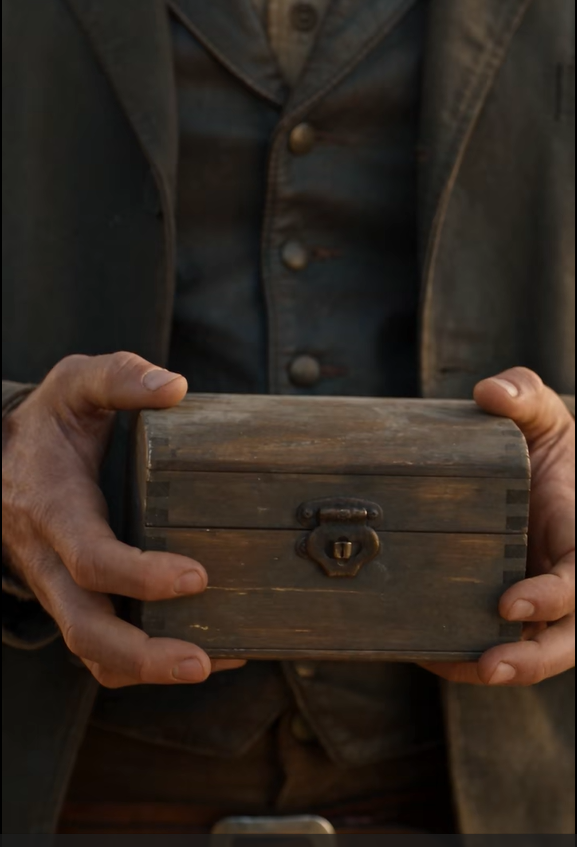
He fed the horses, checked the fences, repaired a loose cabin hinge, and at exactly
7:42 PM opened the brass-bound ledger he kept on the shelf.
He wrote one short entry.
“Apache woman by the well.
Injured.
Gave her water.
Went north.”
Nothing more.
Years of living alone had taught Corvin that fear could twist memory.
Writing things down kept events honest.
That night, however, the horses became restless.
One kicked its stall.
Another repeatedly snorted toward the darkness beyond the fence.
Then a mare screamed.
Corvin woke instantly and reached for the rifle beside his bed.
He waited.
No gunfire came.
No voices.
Only wind against the cabin walls.
Eventually, Corvin convinced himself morning would make everything ordinary again.
It didn’t.
At dawn, he stepped outside with his suspenders hanging loose.
The valley smelled of dust, ash, and nervous horses.
Movement appeared along the northern ridge.
One rider.
Then another.
Then five more.
Ten.
Twenty.
Corvin stopped counting.
Apache warriors were everywhere.
His horses crowded against the rear fence, eyes wide.
His hand moved instinctively toward the rifle near the doorway.
Then he stopped himself.
One rifle against three hundred men was not courage.
It was death.