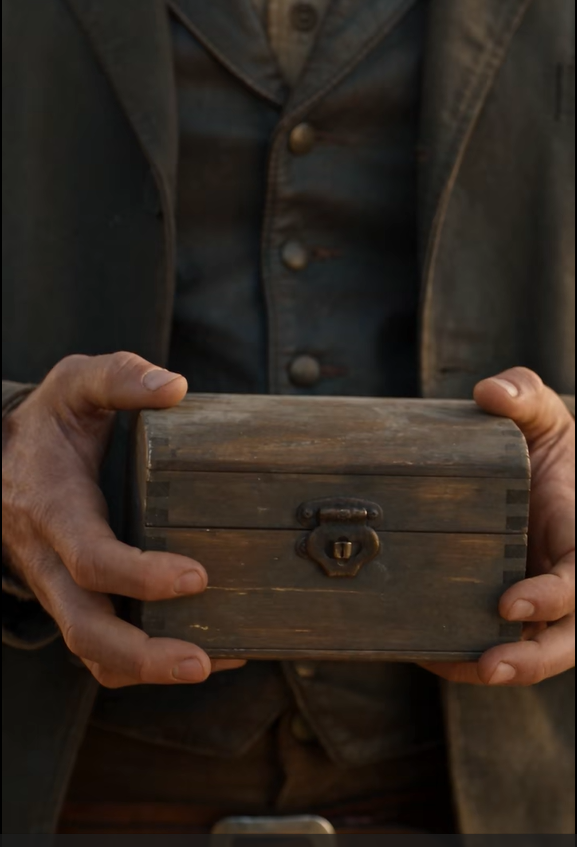
A small iron key blackened with age.
Corvin whispered, “What the hell did you do, Father?”
Outside, riders shouted.
Vale’s men were coming.
Corvin gripped the key.
Sena looked toward the door.
“Where does it go?”
“I don’t know.”
“Think.”
He looked around the cabin.
Desk.
Chest.
Gun cabinet.
Cupboard.
None had keyholes that size.
Then his eyes moved through the doorway.
Toward the well.
The well.
Corvin ran.
Sena followed.
Her father shouted something as they crossed the yard.
Corvin reached the old stone well and dropped to his knees.
His father had built the upper wall himself.
Corvin remembered helping as a boy.
Stone after stone.
Mortar.
Heat.
His father swearing every time Corvin handed him the wrong tool.
Then Corvin remembered one particular stone.
A rectangular slab beneath the iron crank.
Elias had refused to let him touch it.
That one stays where I put it.
Corvin scraped dirt away.
A tiny black opening appeared in the mortar.
A keyhole.
His hands began trembling.
He inserted the key.
Turned.
Something released inside the stone.
He pulled.
The entire face of the block opened like a door.
Inside was a metal cylinder wrapped in rotting canvas.
Behind Corvin, hundreds of warriors watched.
From the east came the thunder of approaching horses.
Corvin lifted the cylinder.
His father had hidden it less than twenty feet from where Corvin had given Sena water.
He opened it.
Inside were survey maps.
Government seals.
Letters.
And a narrow envelope.
Across the front, in faded ink, were two words.
FOR CORVIN.
He stopped.
The hoofbeats were getting louder.
Sena touched his arm.
“Later.”
Corvin almost agreed.
Then he saw the date on the envelope.
Twenty-four years earlier.
The year of the Red Wash killings.
His fingers tore it open.
The letter began:
Corvin, if you are reading this, then I have failed to tell you while I am alive.
His vision blurred.
He forced himself onward.
There are crimes a man commits with a gun, and crimes he commits with a pencil.
Mine was committed with a pencil.
Corvin shut his eyes.
The world seemed to tilt beneath him.
His father confessed everything.
He had altered the survey.
He had accepted money.
He had believed no one would die.
When families refused to leave, Vale’s men were sent.
Elias tried to stop them.
Too late.
By sunrise, Red Wash was filled with bodies.
Then came the part that made Corvin’s heart stop.
I rode into the wash after the shooting.
There were eleven dead settlers.
I found one living child.
Corvin’s hand began shaking violently.
Sena watched him.
He kept reading.
The child was perhaps four years old.
He was beneath his mother’s body.
He had a cut above his left eye.
Corvin’s hand rose involuntarily.
His fingers touched the thin scar above his eyebrow.
The scar he had carried his entire life.
His father had always said he received it falling from a wagon.
Corvin looked down again.
His name was written inside his coat.
Corvin Hale.
The paper nearly slipped from his fingers.
His name.
Not Torne.
Hale.
His parents were Miriam and Daniel Hale.
They had refused to sell their claim to Vale.
I took the boy because I knew what would happen if Vale learned someone had survived.
I gave him my name.
Corvin could no longer hear the horses.
Could no longer feel the heat.
Elias Torne had not been his father.