“He could forge sales.”
“Forge debts.”
“Forge signatures.”
“But under your grandmother’s patent,
the water rights could only be transferred voluntarily by a living female Larkin heir.
”
Mae stared at Gideon.
That was why he kept her alive.
Why Owen alternated cruelty with apologies.
Why they needed her frightened, obedient and sane enough to sign.
Anna looked toward Beatrice.
“I sent Beatrice that letter eight years ago.”
Mae touched the folded paper in her pocket.
“For the woman who finally runs.”
Anna nodded.
“I hoped nobody would ever need it.”
Her eyes moved toward Mae’s bruises.
“I was wrong.”
Owen suddenly stood.
“This changes nothing!”
Everyone looked at him.
He pointed at Mae.
“She’s my wife!
Whatever belongs to her belongs to—”
“No.”
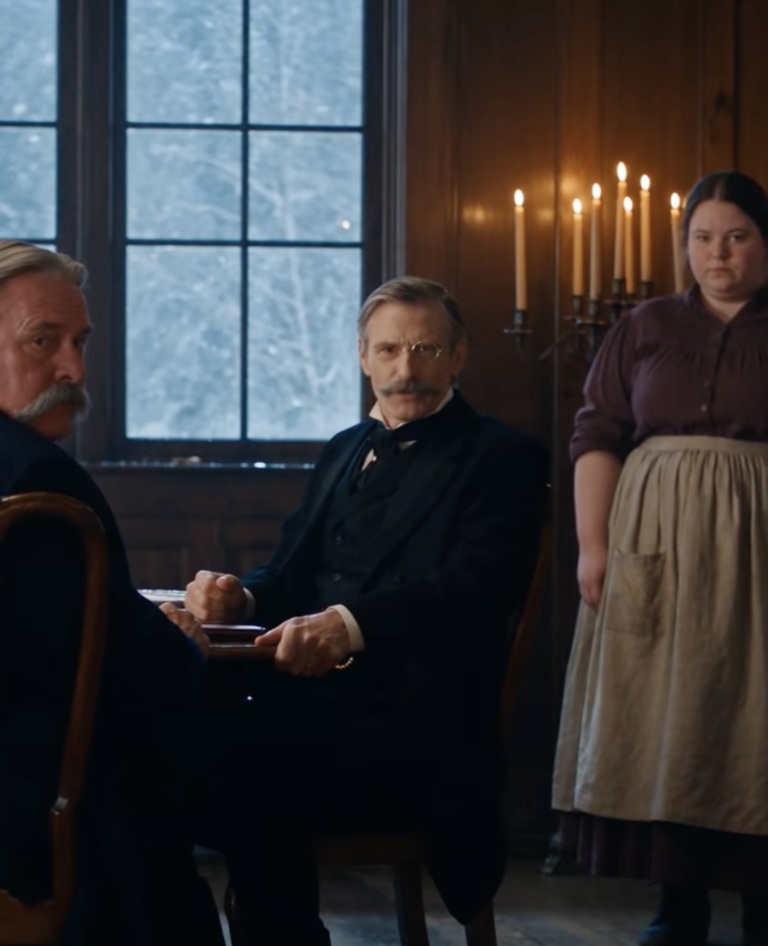
The territorial examiner spoke for the first time.
He held the original land patent.
“Not this.”
Owen stopped.
The examiner adjusted his spectacles.
“This clause predates your marriage and specifically excludes the water claim from marital ownership.”
Gideon closed his eyes.
Owen stared at Mae.
For years, Mae had feared that look.
The narrowing eyes.
The tightening jaw.
The moment before pain.
Now something was different.
There were forty people between them.
Two marshals beside him.
Caleb near her shoulder.
Anna holding nine years of evidence.
And Mae finally understood something.
Owen Drayton had never been powerful.
He had merely been protected.
Remove the protection—
and he was only a frightened little man with angry hands.
Mae stepped forward.
Owen stared at her.
“You’ll regret this.”
Silence filled the church.
Then Mae said:
“No.”
Her voice did not shake.
“You will.”
Sheriff Hollis was caught two days later attempting to cross into Idaho.
Judge Carver resigned before warrants reached his house.
Reverend Clay vanished.
Gideon Drayton was charged with conspiracy, fraud, bribery and two murders prosecutors believed they could prove.
Several older deaths were reopened.
Owen faced charges for assault, unlawful imprisonment and participation in the property scheme.
The ledger was discovered beneath the floorboards of Sheriff Hollis’s office.
There were more than two hundred entries.
Anna had been right.
She had not been first.
But neither was Mae the last woman the ledger mentioned.
Some were alive.
Some had disappeared.
Some had spent years believing nobody would ever care enough to ask what happened.
Mercy Bend finally asked.
Caleb expected Mae to leave.
Perhaps Wyoming.
Perhaps Helena.
Anywhere that did not contain memories of Owen.
Instead, three weeks after the arrests, she rode with Caleb to Larkin Spring.
Autumn had begun touching the valley.
Cottonwoods shimmered gold beside the water.
Mae stood at the edge of the creek.
“So all of this is mine?”
Caleb leaned against Juniper.
“Apparently.”
“That sounds ridiculous.”
“Most ownership does when you look at enough sky.”
Mae smiled.
Her wrist was healing.
The bruises had faded.
The scars remained.
Perhaps they always would.
Caleb no longer looked away from them.
He had learned that sometimes looking away was the cruelty.
“What will you do?” he asked.
Mae watched the water.
Gideon had controlled Mercy Bend for decades because people feared losing access to it.
Water had made him powerful.
Fear had kept him powerful.
Mae could become wealthy enough to rival him.
She could charge every ranch.
Every household.
Every field.
Instead, Mae returned to town the following Monday carrying a legal document drafted in Helena.
The entire town gathered outside the mercantile.