Behind the house stood a massive stone-and-timber smokehouse Jared’s grandfather had built.
It was completely empty.
Martha slowly turned toward him.
“You brought me fifteen hundred miles to feed twenty-two men with this?”
“We have no money,” Jared admitted. “The cattle are too thin to slaughter. What’s left must go to market next month to pay the bank. Kill them, and Fletcher takes the ranch. Don’t feed the men, and they leave.”
Martha walked to the window.
She looked across the dusty plains.
Then toward the empty smokehouse.
When she turned back, something had changed in her expression.
No fear.
No disappointment.
Calculation.
“Where I come from, Mr. Sanders, a kitchen without food is just a room waiting to die.”
She stepped closer.
“But I didn’t travel fifteen hundred miles to preside over a funeral.”
Jared stared at her.
“We are making a new agreement,” Martha continued. “I will be your wife in name. I will keep your twenty-two men fed, and I will keep them from hanging you.”
Then she pointed toward the kitchen.
“But this kitchen, that smokehouse, and every decision concerning food belong to me. You will not question me. You will not interfere.”
Jared had nothing left to bargain with.
“Agreed.”
Martha rolled up her sleeves, revealing thick, powerful forearms.
“Good.”
Then she looked Jared directly in the eyes.
“Get me your strongest horse, your sturdiest wagon… and the one man out there who hates you the least.”
The man who hated Jared the least turned out to be Billy.
That was not especially comforting, because Billy was only seventeen and had threatened to leave Ironwood twice that week.
Martha climbed onto the wagon bench.
Jared caught the side rail.
“Where are you going?”
“Oak Haven.”
“We just came from Oak Haven.”
“And you apparently rode through it with your eyes closed.”
She snapped the reins.
Jared watched the wagon disappear.
Thaddius stepped beside him.
“You sure this marriage agency didn’t send us a general?”
Jared exhaled.
“I’d settle for a general if she can make supper.”
Martha returned six hours later.
The wagon was overflowing.
Not with good food.
With garbage.
Wilted cabbages.
Bruised apples.
Potatoes with blackened skins.
Beef bones stripped nearly bare.
Two buckets of hog fat.
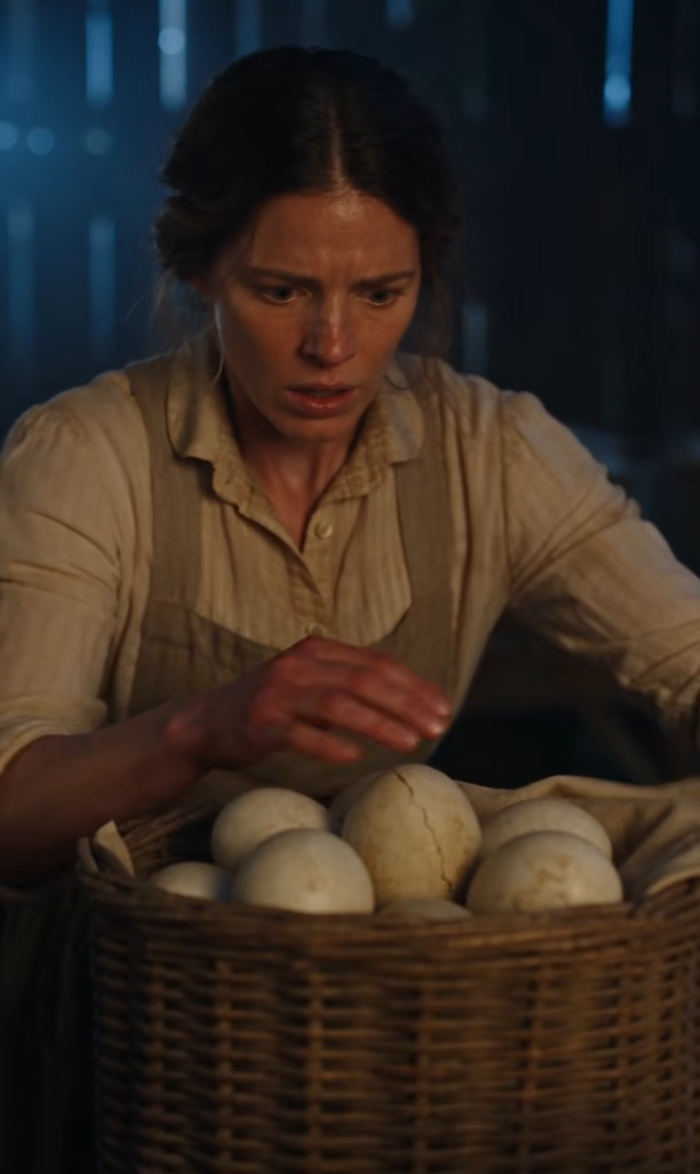
Cracked eggs.
Stale bread.
Chicken feet.
A sack of barley swept from the floor of the grain merchant’s warehouse.
And one enormous burlap bag that smelled so vile Thaddius backed away.
“What in God’s name is that?”
“Fish heads.”
Twenty-two hungry cowboys stared at her.
Then at Jared.
One man burst out laughing.
“Boss ordered himself a wife and she brought us trash.”
Martha climbed down.
“What is your name?”
The laughing cowboy hesitated.
“Cal Hensley.”
“Mr. Hensley, have you eaten today?”
“No.”
“Yesterday?”
“A rabbit leg.”
“Then you’ll find trash has a remarkably pleasant flavor when properly seasoned.”
Cal’s smile disappeared.
Martha pointed at six men.
“You. You. You. And the three pretending not to listen. Wash those potatoes. Cut away everything rotten.”
She pointed at Billy.
“Build up the stove.”
At Thaddius.
“Split those bones.”
Then she looked at Jared.
“You have something useful to do as well.”
“What?”
“Stay out of my kitchen.”
By sunset the smell reached the bunkhouse.
Men appeared in the doorway one by one.
The bones had been roasted until dark, then boiled with onions and cabbage. Martha rendered the hog fat, browned barley in it, added beans and chopped potatoes, then poured in the rich broth.
She crushed stale bread into dumplings.
The cracked eggs became thick ribbons in the stew.
Even the fish heads had been simmered separately for stock.
When she lifted the lid from the largest pot, silence fell.
It smelled like heaven.
Cal Hensley swallowed loudly.