Her Dying Husband Sent Her Into a Blizzard to Find a Door Hidden Inside a Cliff. What Mary Ann Discovered Behind the Stone Changed the Fate of Her Children Forever.
Thomas Shaw did not spend his final breath saying goodbye.
Instead, with blood at the corner of his mouth and barely enough strength left to lift one hand, he pushed a crumpled, hand-drawn map into his wife’s trembling fingers.
“Cliff,” he whispered.
Mary Ann bent so close that her dark hair brushed his cheek.
“Thomas?”
His chest rattled.
“Before the frost. Don’t wait.”
Her throat tightened.
Outside their little cabin, October wind dragged dead leaves across the yard. Their three-year-old twin sons slept in the next room, unaware that the strongest man they had ever known was dying ten feet away.
Mary Ann pressed the cloth harder against the wound beneath Thomas’s ribs, though both of them knew the bleeding had gone too deep.
“What cliff?” she whispered desperately. “Thomas, what’s there?”
His eyes found hers.
For one terrible second, they were clear again.
Not frightened.
Not confused.
Urgent.
“Trust… me.”
Then his breath slipped out.
His hand fell from hers.
And Thomas Shaw was gone.
Nineteen days later, Mary Ann walked into Bell Creek Mercantile wearing mourning black beneath a heavy wool coat.
Grief had hollowed her face, but her spine remained straight.
“I need a wagon and two men,” she said. “Four days. Five at most.”
The conversations around the iron stove stopped immediately.
Old Mr. Bell glanced at the men warming their hands near the fire.
No one met Mary Ann’s eyes.
Everyone knew what she was asking.
Winter had descended early on northern Colorado that year. Every reliable horse, wagon, and able-bodied man was already hauling firewood, grain, cattle feed, or families toward safer country before snow sealed the mountain roads.
And as far as Bell Creek was concerned, Mary Ann Shaw was not following a plan.
She was a grieving widow chasing the final confused words of a dying husband.
Mr. Bell rubbed his gray beard.
“Mary Ann…”
“I can pay.”
“With what?”
She swallowed.
He regretted the question instantly.
The Shaws had never been wealthy.
Thomas cut timber, repaired wagons, trapped in winter, and sometimes disappeared north for several days hauling lumber for jobs he rarely discussed. After his death, Mary Ann had found twelve dollars in their strongbox.
Twelve dollars, two small boys, a worn cabin, one milk cow, and three months of flour.
That was her fortune.
“I’ll work it off.”
Mr. Bell sighed.
“You’ve got two boys depending on you.”
“I know.”
“You ought to take Silas and Samuel back to Ohio. Your sister wrote you twice last year, didn’t she?”
Mary Ann’s jaw tightened.
Thomas had been the reason she stayed in Colorado.
They all knew it.
Mr. Bell lowered his voice.
“Thomas is gone.”
No one contradicted him.
Worse, no one volunteered.
Not one horse.
Not one wagon.
Not one man.
Mary Ann stood silently for several seconds.
Then she nodded once.
“Thank you for your time.”
She turned toward the door.
A ranch hand near the stove muttered, perhaps believing she could not hear him, “Woman’s going to get herself killed.”
Another answered, “And those babies with her.”
Mary Ann stopped.
Everyone watched her shoulders stiffen.
But she did not turn around.
Instead she opened the door and walked into the wind.
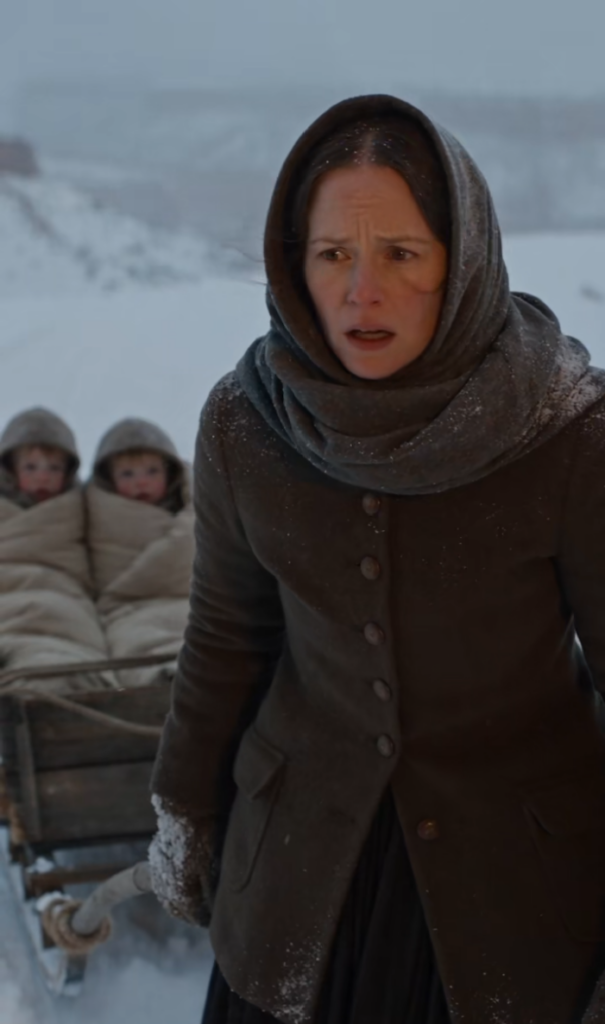
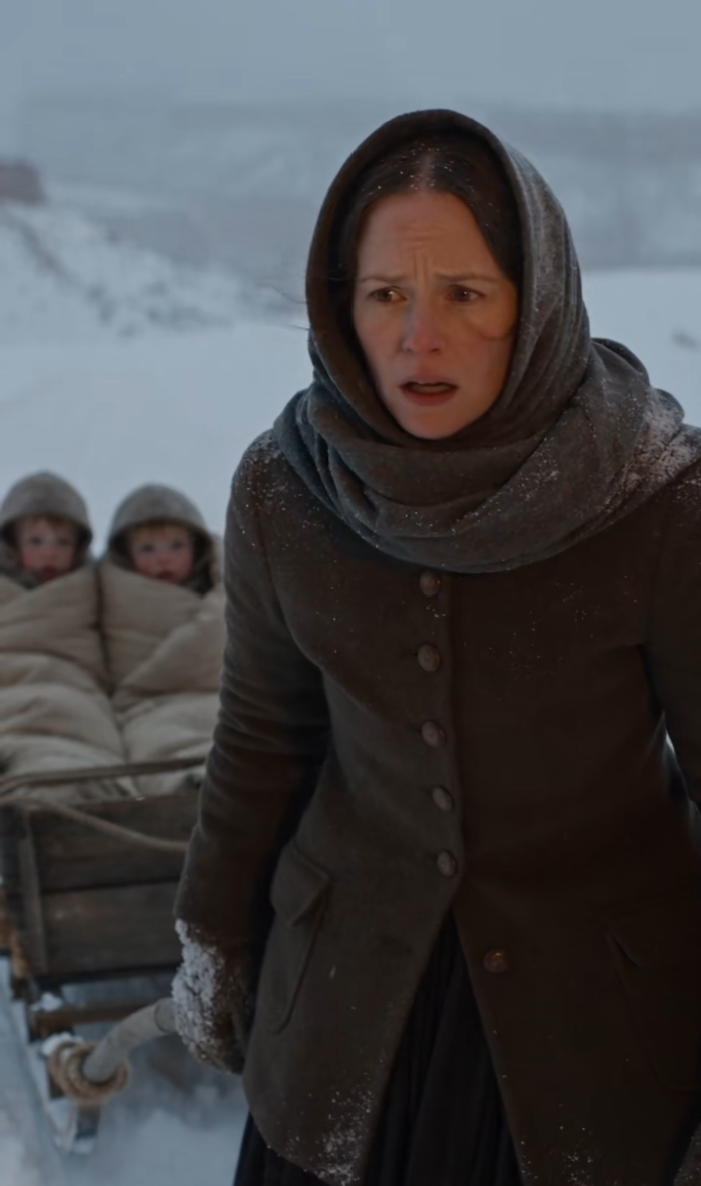
Before dawn the next morning, Mary Ann wrapped Silas and Samuel in quilts, strapped a canvas cover over a rough wooden sledge, and tied the pulling rope around her waist.
Her neighbor, Mrs. Harper, came running through the darkness.
“Mary Ann!”
Mary Ann kept adjusting the blankets.
Mrs. Harper seized her arm.
“You cannot mean to do this.”
“I do.”
“You don’t even know what’s there.”
“No.”
“Then stay.”
Mary Ann finally looked at her.
Her eyes were red from too many nights without sleep.
“Thomas knew he was dying.”
Mrs. Harper said nothing.
“He had maybe ten breaths left. He could have told me he loved me. He could have asked me to take the boys east. He could have said anything.”