Sadie’s irritation softened.
“Rebecca?”
He nodded.
“She would have liked you.”
Sadie pulled the blanket higher over Nora.
“I’m sorry she died.”
“So am I.”
Something in the simplicity of those words hurt more than tears would have.
They reached Elk Ridge late on the third afternoon.
Sadie had imagined a cabin.
What she found was closer to a small fortress built against winter.
Thick pine logs.
Stone chimney.
A smokehouse.
Stable.
Root cellar.
Wood stacked beneath long sheds.
The mountains towered around it, white and merciless.
The nearest neighboring cabin, Gideon told her, was twelve miles south.
Sadie stared at the wilderness.
No whispering women.
No church windows.
No Mrs. Pritchard.
No one watching her carry empty baskets home and wondering why there were never toys inside them.
For the first time, loneliness looked like freedom.
Then she stepped inside the cabin.
And nearly reconsidered everything.
Dirty plates covered the table.
Clothing hung from chairs.
Ash spilled from the hearth.
A sack of flour had torn open near the pantry.
A chicken—an actual chicken—was roosting beneath the bench.
Sadie turned slowly toward Gideon.
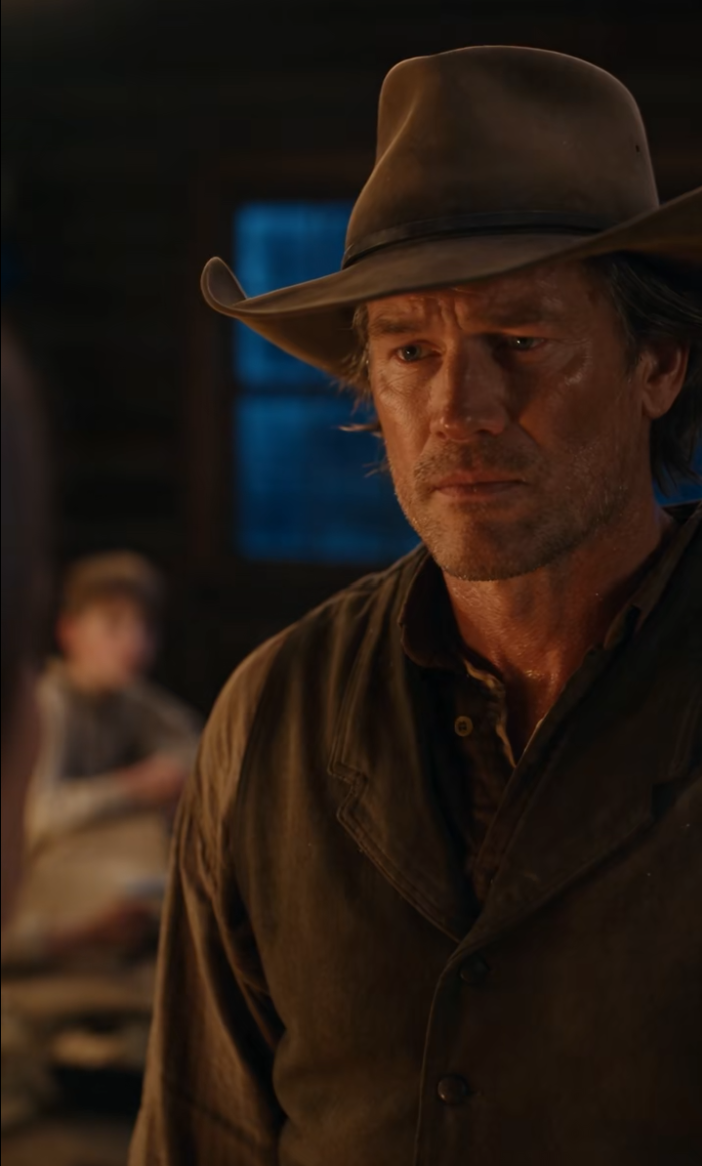
He removed his hat.
“I said we needed help.”
“You neglected to mention civilization had already collapsed.”
Caleb snorted.
Gideon looked at him.
The boy instantly straightened.
Sadie pointed at the chicken.
“Does that animal have a name?”
“Margaret,” Eli said.
“Margaret lives outside beginning today.”
Eli looked horrified.
“She doesn’t like outside.”
“I don’t like chicken droppings in kitchens.”
“She’ll be lonely.”
“So was I. I survived.”
Gideon coughed into his fist.
Sadie suspected he was hiding laughter.
By sunset Margaret had been evicted.
By morning the children had jobs.
By the end of the week, the cabin smelled of bread instead of smoke and damp wool.
And something stranger happened.
The children began making noise.
Benjamin and Eli fought over a carved horse.
Ruth sang while kneading dough.
Nora followed Sadie everywhere, dragging a wooden spoon.
Even Caleb, who resisted every attempt at affection, began leaving extra firewood beside Sadie’s chair without explanation.
Sadie never thanked him.
He seemed to prefer it that way.
Gideon kept his promise.
He slept in the small loft above the main room.
Sadie had Rebecca’s old bedroom.
The arrangement felt awkward at first.
Rebecca’s dresses remained inside the cedar chest.
Her brush sat beside the washbasin.
A half-finished piece of embroidery rested in a basket.
Sadie refused to move any of it.
She was not there to erase a dead woman.
One night Gideon noticed.
“You can put her things away.”
“They belong to the children.”
“They’ve had two months.”
“Grief doesn’t own a calendar.”
His eyes lingered on her.
“You know that.”
Sadie looked toward the fire.
“Yes.”
After that, something changed between them.
Not romance.
Not yet.
Recognition.
Two people who understood that loving the dead did not mean a person had to remain buried beside them.
Winter sealed the mountain by early December.
Snow rose halfway up the fences.
Gideon trapped close to home.
Sadie learned to split kindling with one clean blow.
Ruth learned Sadie’s biscuit recipe.
The boys learned to sweep without behaving as though a broom were an instrument of torture.