Not forgiveness yet.
Hope.
They began talking again.
Slowly.
Painfully.
Without pretending.
On an October afternoon, Helen entered the Bellamy Grand for a foundation meeting.
The general manager greeted her in the lobby.
“We’ve completed the renovation you approved.”
“Good.”
“There’s one other change.”
He led her toward the ballroom level.
Helen frowned when she saw a brass plaque beside the entrance.
The hotel board had renamed the main ballroom.
She stared at the words.
THE RICHARD AND HELEN WARREN BALLROOM
Helen laughed.
“Oh, Richard would have hated this.”
The manager smiled.
“The board thought it appropriate.”
She touched the plaque.
Behind those doors, months earlier, a woman had told her she was nobody.
Helen had believed, for one terrible moment, that losing her son’s loyalty meant losing her place in the world.
But age had taught her something wealth never could.
Importance was not decided by a seating chart.
Not by diamonds.
Not by whose name appeared on a guest list.
Not even by who owned the building.
It came from knowing who you were when the people you loved chose not to see you clearly.
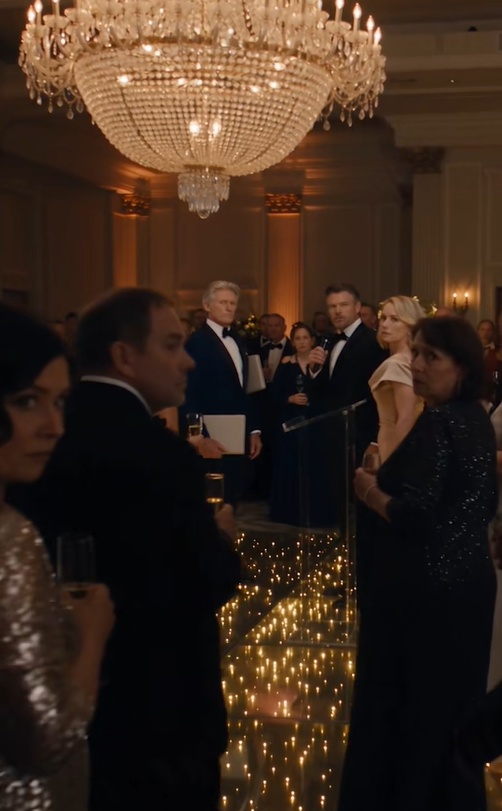
The manager opened the ballroom doors.
Sunlight poured through the enormous windows.
There were no roses now.
No wedding aisle.
No Clara.
No frightened son at the altar.
Only an empty room and the Chicago skyline beyond it.
Helen walked to table nineteen’s old location.
The marble column was still there.
She rested one hand against the cool stone where Clara had shoved her.
Then she smiled.
Because the strangest part was that Clara had been right about one thing.
Helen Warren had spent years making herself smaller.
Richard’s widow.
David’s mother.
The quiet woman at the edge of photographs.
The person who fixed problems without needing anyone to know.
That night had changed something.
Helen no longer needed to prove she belonged in anyone else’s story.
She had finally reclaimed her own.
Her phone vibrated.
A message from David.
First paycheck from the new job today.
A second message followed.
Paid my own rent.
Then a third.
I know that sounds stupid.
Helen smiled.
She typed back.
It doesn’t.
She slipped the phone into her purse and turned toward the windows.
Far below, Chicago moved in every direction.
Cars.
People.
Lives continuing.
Helen thought of Richard’s letter.
Let him fall far enough to stand on his own.
Perhaps Richard had not written those words only for David.
Perhaps Helen had needed them too.
She had spent half her life holding everyone else upright.
Now, at seventy, she understood the difference between love and surrender.
Between forgiveness and permission.
Between being needed and being valued.
Helen walked toward the ballroom doors.
Before she left, she glanced once more at the marble column.
Six months earlier, Clara had pressed her against it and whispered:
“You’re nobody here.”
Helen smiled.
Then she stepped into the hallway beneath the brass plaque bearing her name.
And for the first time in decades, she did not feel like someone’s wife.
Or someone’s mother.
Or someone’s obstacle.
She simply felt like Helen Warren.
And that was more than enough.