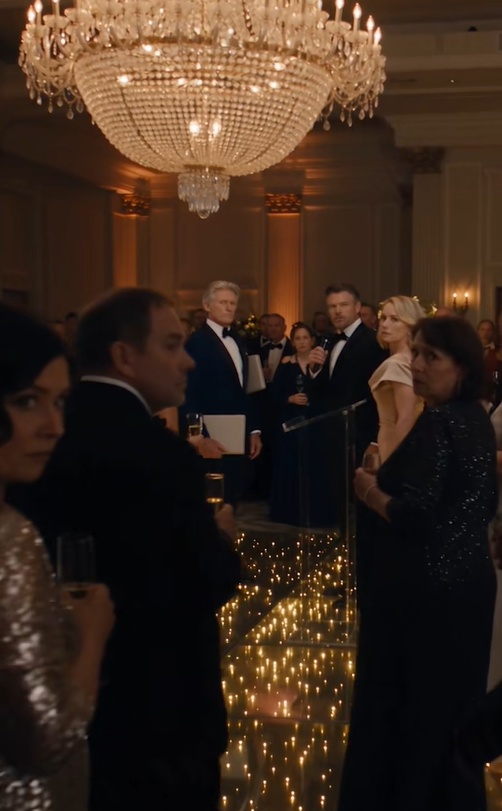
The room became quiet.
“You don’t ask whether their clothes are expensive enough. You don’t ask what job they have. You don’t ask how useful they might become to you someday.”
His eyes found mine.
“You just pull out a chair.”
People applauded.
I did not.
I was crying too hard.
Later, after everyone had gone, Reid and I walked through the empty dining hall.
Forty tables.
Hundreds of chairs.
He stopped beside one near the window.
“Mom?”
“Yes?”
“You hungry?”
“A little.”
He pulled out a chair.
“For you.”
I looked at it.
Seven years earlier, my daughter-in-law had stood beside the only empty chair in an expensive restaurant and decided I was the one person who did not deserve it.
That humiliation had cost me a dinner.
It had nearly cost my son his career.
It had ended a marriage.
It had exposed greed, cowardice, deception, and a betrayal I would never have imagined from a trusted friend.
But it had also done something else.
It had forced two people who loved each other to stop confusing love with rescue.
I sat down.
Reid took the chair across from me.
“You know,” I said, “I never actually cared about the four-thousand-dollar restaurant bill.”
He grinned.
“I figured.”
“I cared about you looking at your plate.”
His smile disappeared.
“I know.”
I reached across the table.
“But I don’t see that man anymore.”
He swallowed.
“Neither do I.”
Outside the windows, evening settled over the city.
Somewhere downstairs, volunteers were preparing breakfast for families arriving in the morning.
Children would sleep safely upstairs.
Parents would meet counselors.
People who had lost jobs would find training.
People who had lost homes would receive keys.
And anyone who came through those doors hungry would have somewhere to sit.
Reid squeezed my hand.
“Dad would’ve liked this.”
I looked toward the brass plaque near the entrance bearing Peter’s name.
“Yes.”
Then I remembered the letter that had waited in a cardboard box for decades.
You always carry too much.
Put something down.
So I finally did.
I put down the anger.
Not the memory.
Never the lesson.
Just the anger.
Because forgiveness is not pretending someone never failed you.
Forgiveness is recognizing who they became after they did.
And that was the final thing money had taught me.
One hundred sixty-five million dollars could buy buildings.
It could fund scholarships.
It could rescue companies and create foundations.
It could expose people who loved your bank account more than they loved you.
But it could not purchase character.
Character was built differently.
One consequence at a time.
One difficult truth at a time.
One empty chair at a time.
Reid stood and disappeared into the kitchen.
A minute later he returned carrying two bowls of soup.
He set one before me.
“No restroom?”
I stared at him.
Then he started laughing.
I tried not to.
I failed.
“Too soon?” he asked.
“Seven years, Reid.”
“So yes?”
I picked up my spoon.
“Sit down before I rewrite the trust.”
His eyes widened.
“There’s another trust?”
I smiled.
And for once, I let my son wonder.