He chose four different pastries.
Outside, he broke one in half and gave the larger piece to Elena.
The gesture was so natural that she had to turn away.
He had missed every birthday.
He had missed scraped knees, school performances, her first heartbreak.
But here was half a warm pastry.
Here was somewhere to start.
Months later, Elena found a final envelope among Samuel’s papers.
It had been tucked into the lining of his violin-tool case.
Inside was a letter addressed to Gabriel.
She took it to him unopened.
They were in the music room, where the curtains now stood open and the piano had been tuned.
Gabriel recognized Samuel’s handwriting.
He read silently.
Then he covered his eyes.
Elena waited.
At last, he passed her the page.
Gabriel,
I don’t know how to ask forgiveness for loving your daughter and being afraid that the truth would take her from me.
You trusted me to protect her. Somewhere along the way, I began confusing protection with keeping her.
I am trying again with another lawyer. This one has no connection to Whitmore. If I die before anything comes of it, the documents are in the tool case.
But there is something you should know now.
She has your habit of putting her head to one side when she listens. She has Eleanor’s temper when someone is cruel. When she thinks no one can hear, she plays the same four bars you used to play while you waited for her to be born.
I gave her a home.
She never stopped carrying you.
Elena lowered the letter.
For a long time, neither of them spoke.
Then Gabriel said, “He should have told you.”
“Yes.”
“He loved you.”
“Yes.”
Both things remained true.
Elena was learning that truth did not always arrive neatly enough to choose only one part.
That evening, she played in the music room.
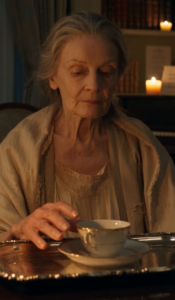
Eleanor sat by the window in her lavender shawl.
Maxwell leaned against the piano, his white shirtsleeves rolled up, no rose on his chest and no ring on his hand.
Gabriel sat close enough to see the little crescent beneath the violin’s chin rest.
Elena began with the melody from his letters.
At the difficult shift, she slowed down.
Made the frightening thing smaller.
Then she played it again.
This time, her hand did not hesitate.
When the final note faded, Gabriel reached into his pocket and took out a folded sheet of paper.
“What’s that?” Elena asked.
“The first letter you ever sent me.”
She laughed softly.
“I was sixteen. It must be awful.”
“It contains a very strong opinion about school lunches.”
She held out her hand.
He gave it to her.
The paper had softened along its folds. Someone had repaired one corner with a narrow strip of clear tape.
At the bottom, beneath her awkward account of lessons and weather, she had written a sentence she no longer remembered.
Samuel says you don’t have any family nearby, so you can borrow us.
Elena looked up.
Gabriel was crying.
“For ten years,” he said, “that was how I got through the morning.”
She crossed the room and knelt beside him.
Outside, rain began touching the windows.
Nobody closed the curtains.
The girl the world said he had murdered took his hand and called him Dad.