
The person on the other end of the phone did not ask which plan I meant.
That was the first thing that frightened Robert.
I saw it happen.
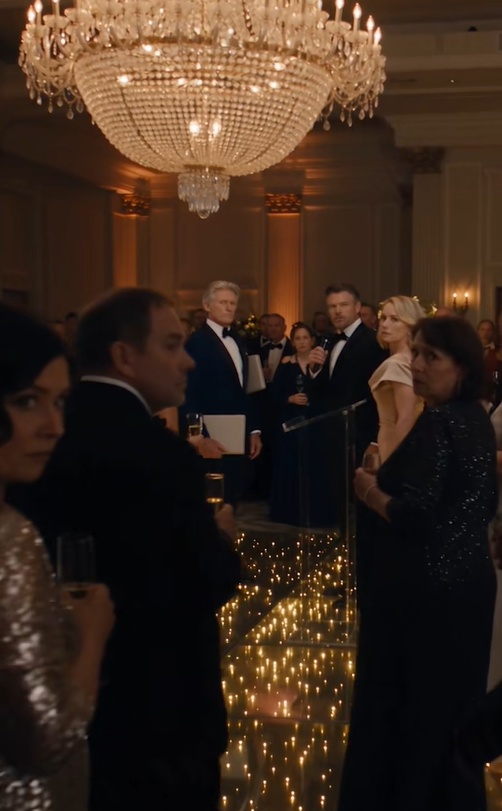
My son stood ten feet away from me in the living room where I had raised him, surrounded by strangers drinking my wine, eating from my dishes, and admiring a house that apparently everyone except me had been told belonged to him.
His expression changed the instant I said:
“We need to activate the plan—right now.”
There was a brief silence on the line.
Then my attorney, David Hale, answered.
“Are Robert and Megan in the house?”
I looked directly at them.
“Yes.”
“Have they moved belongings in?”
My stomach tightened.
“I haven’t checked upstairs.”
“Do not argue with them.
Do not sign anything.
Photograph every room before anything is moved.
I’m sending you something now.”
“What?”
“A document I hoped we’d never need.”
That was when Megan stepped toward me.
Her cream dress moved softly against her knees.
The wineglass in her hand trembled just enough for me to notice.
“Margaret, who are you talking to?”
I held up one finger.
Not rudely.
Simply because David was still speaking.
“And Margaret?”
“Yes?”
“Do not let Robert touch your mail.”
The room around me seemed to shrink.
“My mail?”
“Just check it.”
The line went dead.
I lowered the phone.
Twenty or thirty people were staring at me.
Some looked embarrassed.
A few looked fascinated.
One woman slowly put down the hors d’oeuvre she’d been holding.
Megan forced a laugh.
“Well, this is becoming unnecessarily dramatic.”
I looked at her.
“Is it?”
Robert finally moved.
“Mom, what did David say?”
The fact that he knew immediately which David I had called told me more than he probably intended.
I slipped my phone into my purse.
“Why are you asking?”
“Because he’s your attorney.”
“Yes.”
“Mom, nobody is trying to hurt you.”
Behind him, Henry’s photograph remained facedown on the side table.
That image did something to me.
My husband had smiled in that photograph.
Not a formal smile.
A crooked one.
The picture had been taken during our fortieth wedding anniversary when Henry had spent most of the evening complaining that the restaurant’s mashed potatoes weren’t as good as mine.
Four years after his death, I still sometimes talked to that picture while making coffee.
And someone had turned him facedown to make room for white flowers.
I walked across the room.
Megan followed.
“Margaret.”
I picked up Henry’s photograph.
There was a faint smear of something sticky across the glass.
I wiped it with my thumb.
Then I returned it to the center of the mantel.
Exactly where it belonged.
Nobody said anything.
I turned around.
“Who moved this?”
Megan folded her arms.
“It didn’t fit the decor.”
There are sentences so revealing that arguing with them becomes unnecessary.
I looked at my son.
He closed his eyes.
That was his habit when he wanted a problem to disappear without requiring anything from him.
He had done it as a child when teachers called home.
As a teenager when he dented Henry’s truck.
As an adult when bills became overdue.
When his first business failed.
When Megan insulted me at Thanksgiving.
Robert had always mistaken looking away for remaining neutral.
Henry never had.
“Robert,” I said.
He opened his eyes.
“Did you move into this house?”
He glanced at Megan.
“I’m not asking her.”
“Mom—”
“Did you move into my house while I was gone?”
He rubbed his forehead.
“Our lease ended.”
“That isn’t an answer.”
“We brought some things over.”