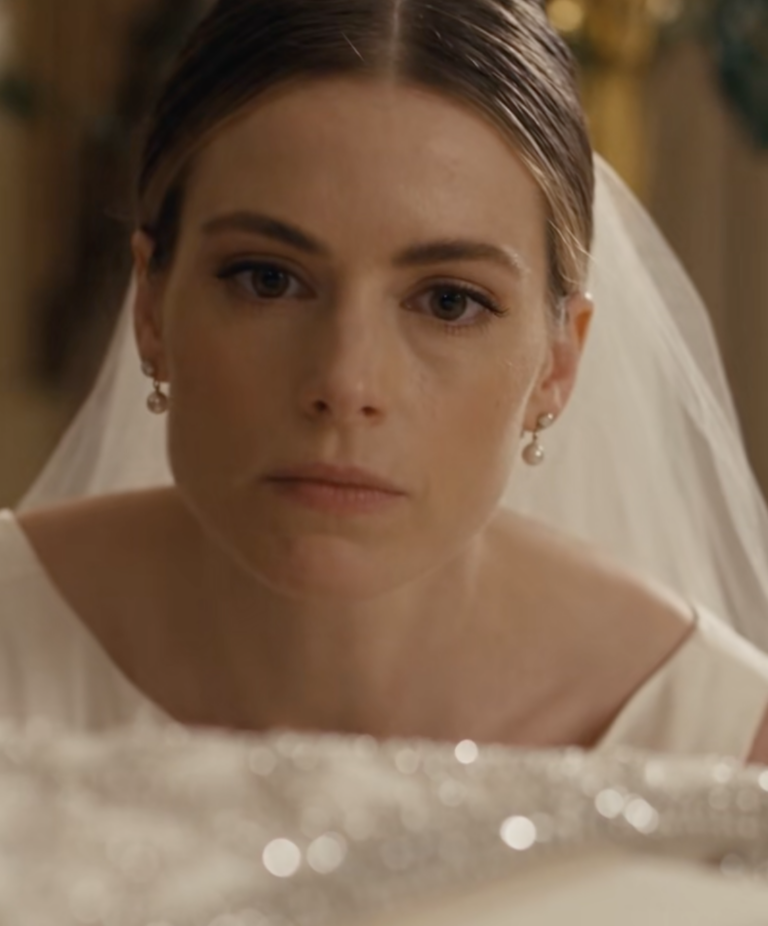
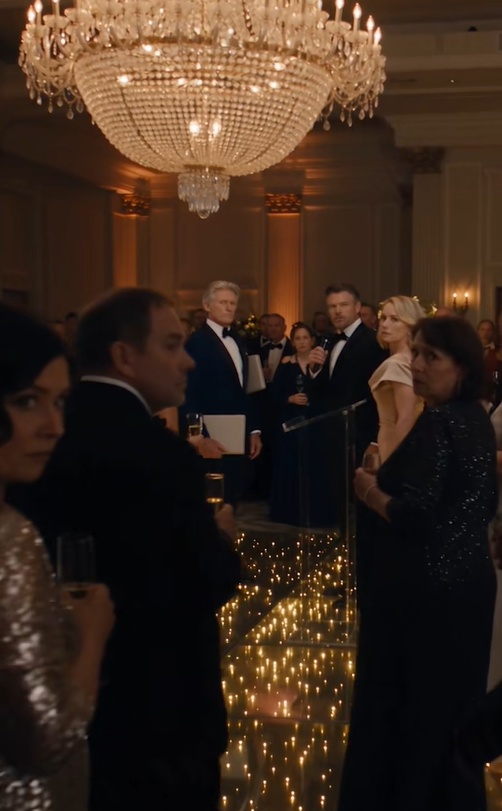
A wedding?
An arrest?
A family confession?
The collapse of an empire?
Maybe all of them.
Chloe stood alone on the dance floor.
Mascara streaked her face.
For several moments, I could not look at her.
Finally, she whispered:
“Evelyn.”
I turned.
She started toward me.
I raised one hand.
She stopped.
“I helped you,” she said.
“You did.”
“I wore the wire.”
“Yes.”
“I gave you the recordings.”
“Yes.”
Her face crumpled.
“But you can’t forgive me.”
“Not tonight.”
She nodded.
I could see the pain in her eyes.
A younger version of me would have rushed to comfort her.
That woman was gone.
Maybe someday I would forgive Chloe.
Maybe I wouldn’t.
Saving me from the fire did not erase the fact that she had helped strike the match.
“I love you,” she whispered.
I looked at her for a long moment.
“Then become someone who understands what that word costs.”
She cried quietly.
I walked away.
The wedding ended without a bride and groom.
Westbridge collapsed within two weeks.
Its board removed Carter immediately.
Creditors seized assets.
Federal prosecutors charged Martin Vale with securities fraud, conspiracy, obstruction and multiple other offenses.
The investigation into my father’s death reopened.
Eleven months later, prosecutors proved Martin had paid a mechanic to tamper with my father’s car.
The mechanic had kept records.
My father had not died in an accident.
He had been murdered.
Martin Vale received a sentence ensuring he would never leave prison.
Carter cooperated.
His testimony convicted his father.
It also convicted himself.
Forgery.
Fraud.
Conspiracy.
Obstruction.
He received seven years.
Some people told me I should feel sorry for him.
I did.
That surprised me.
But sympathy is not absolution.
You can understand why someone became what they became and still refuse to let them hurt you again.
Chloe entered therapy.
She left New York.
For nearly a year, we barely spoke.
Then one December afternoon, I received a handwritten letter.
Not an email.
Not a text.
A letter.
She wrote:
I spent most of my life wanting to be chosen.
Carter chose me, and I mistook that for love.
You loved me without making me compete for it, and I treated that love like it could never disappear.
I’m sorry.
I did not call her immediately.
But I kept the letter.
Six months later, we had coffee.
It was awkward.
Painful.
Real.
Healing sometimes begins that way.
Not with forgiveness.
With truth.
My mother and I established the Arthur Hart Foundation using money recovered from the Westbridge litigation.
Its mission was simple:
legal assistance for victims of financial abuse and coercive control.
On the first anniversary of my almost-wedding, I visited my father’s grave.
The afternoon was warm.
I brought no flowers.
My father never liked cut flowers.
“They’re already dead,” he used to say.
“Seems rude to give someone a corpse as a present.”
So I brought coffee.
One for me.
One for him.
I sat in the grass beside his grave.
For a while, I said nothing.
Then I told him everything.
About Carter.
Chloe.
The audit.
The trial.
The foundation.
Finally, I placed a copy of his letter against the stone.
“You were wrong about one thing, Dad.”
Wind moved through the trees.
“You thought Carter wasn’t his father.”