Instead, he asked what kind of case had taught me the most.
I liked him immediately.
That should probably embarrass me.
It doesn’t.
The man I fell in love with was carefully constructed.
And Carter Vale was very good at construction.
We dated for years.
There were trips to Rome and Kyoto.
Sunday mornings with coffee and newspapers.
Hospital visits when my mother had surgery.
Long evenings when I worked late and found dinner waiting outside my office.
He remembered anniversaries.
He adored my parents.
He brought Chloe souvenirs whenever he traveled.
He became family long before he proposed.
By the time he placed a ring on my finger overlooking Lake Como, nobody questioned whether I should say yes.
Least of all me.
But betrayal rarely arrives wearing a villain’s face.
It arrives in familiar clothes.
It knows where you keep the spare keys.
It knows how you take your coffee.
And sometimes it sleeps beside you for years before you understand what it is.
The first crack appeared eighteen months before our wedding.
A hotel charge.
Nothing dramatic.
The Bristol Hotel in Boston.
Carter had supposedly been in Chicago.
When I asked, he barely blinked.
“Client meeting got moved.”
“From Chicago to Boston?”
“Last minute.”
He kissed my forehead.
I let it go.
Then Chloe suddenly owned a Cartier bracelet nearly identical to one Carter had once pointed out in a boutique window.
“Birthday gift from someone,” she said.
“Someone?”
She smiled.
“You don’t know him.”
I let that go too.
Then came the disappearing messages.
Muted notifications.
A second phone Carter claimed belonged to the office.
A perfume scent in his jacket that wasn’t mine.
Every instinct I had developed during years of litigation began whispering the same thing.
Something was wrong.
But I didn’t confront him.
People later assumed that meant I was weak.
It meant the opposite.
An attorney learns very early that asking a question before you know the answer is sometimes the stupidest thing you can do.
So I stopped asking questions.
And I started watching.
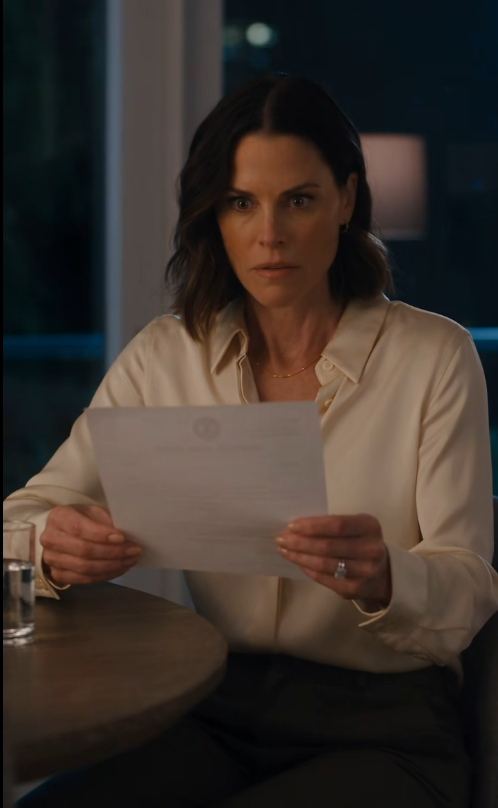
Three months before our wedding, I found the document that changed everything.
Carter was in London.
I was home reviewing financial disclosures required for our prenuptial agreement.
We had separate assets.
His company, Westbridge Capital, was valued at just over $180 million on paper.
My assets came primarily from the Hart Family Trust, established by my grandfather and expanded by my father.
Carter had always joked that my family’s money made his look “adorable.”
I never found the joke funny.
That evening, our accountant uploaded a new batch of disclosures into the secure portal.
One file had been mislabeled.
WESTBRIDGE CREDIT FACILITY — SUPPLEMENTAL GUARANTEE.
I almost ignored it.
Then I saw my name.
Evelyn Hart.
My pulse slowed.
Not quickened.
Slowed.
That strange sensation people describe when their body understands danger before their mind catches up.
I opened the document.
Westbridge had borrowed $74 million through a network of lenders.
The debt was secured by company assets.
And by a secondary guarantee.
My family trust.
I reread the page.
Then again.
My signature appeared at the bottom.
Elegant.
Fluid.
Almost perfect.
Except it wasn’t mine.
I knew immediately.
Most people think signatures are difficult to distinguish.
They aren’t when you’ve signed your own name tens of thousands of times.