A pause.
Eleanor’s answer:
“Ethan disagrees with me until disagreeing becomes inconvenient.”
I stopped the recording.
Silence.
Ethan looked destroyed.
But Eleanor recovered.
“A private conversation taken out of context proves nothing.”
“You’re right,” Dana said.
She opened the envelope.
“That’s why we didn’t rely on it.”
Eleanor’s face tightened.
Dana handed Marcus several documents.
He passed one to Ethan.
“Five years ago,” Dana said, “Ms.
Sinclair attempted to contact you regarding her pregnancy.”
Ethan looked at me.
“I never knew.”
“I emailed you.”
“No.”
“I received an answer.”
“I never sent one.”
Dana nodded.
“We know.”
For the first time, my composure cracked.
“What?”
She had told me there was evidence.
Not everything.
Dana turned toward the screen.
A technical report appeared.
“The email telling Ms.
Sinclair never to contact Ethan Montgomery again originated from a device assigned to Eleanor Montgomery’s executive assistant.”
Ethan stopped breathing.
Eleanor stared at Dana.
“That’s impossible.”
“We also located the former assistant.”
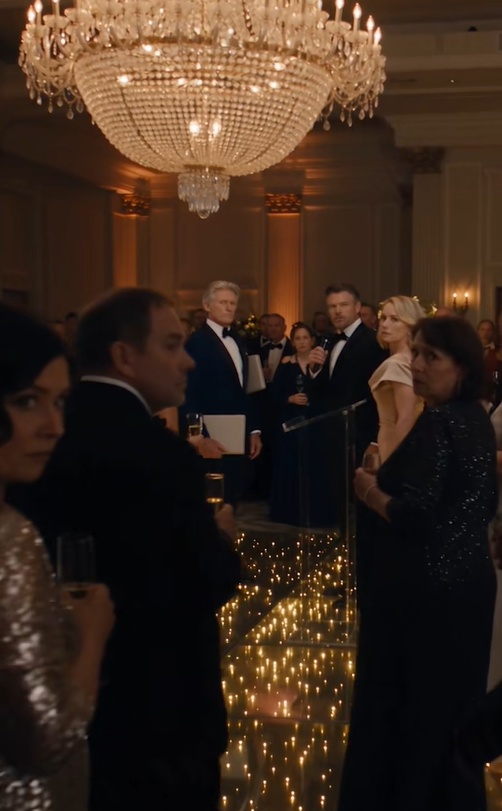
A woman near the back of the pavilion stood.
Late forties.
Dark hair.
Nervous.
I recognized her.
Margaret Wells.
Eleanor’s assistant during my marriage.
My heart slammed against my ribs.
Margaret spoke without approaching us.
“Mrs.
Montgomery told me Ethan wanted no further communication with Olivia.”
Ethan whispered, “Margaret.”
She looked ashamed.
“She gave me access to your account.
I sent the message.”
My knees almost weakened.
For five years, I had believed Ethan rejected the possibility of our child without even asking whether one existed.
For five years, I had hated him for that email.
He hadn’t written it.
But that didn’t erase everything.
I turned toward him.
“You still signed the divorce.”
Pain crossed his face.
“Yes.”
“You still let her destroy me.”
“Yes.”
“You still watched me leave.”
His eyes shone.
“Yes.”
No excuse.
No plea.
Just yes.
Strangely, that hurt less than a lie would have.
Caroline looked at him.
“Did you know Olivia was pregnant?”
“No.”
“Did you suspect?”
“No.”
Then Eleanor laughed.
A brittle little sound.
“This is ridiculous.
Three children appear after five years and everyone simply assumes they’re Ethan’s?”
Nobody answered.
She looked triumphant for half a second.
Then Liam walked forward.
He stood directly beside Ethan.
Same eyes.
Same hair.
Same expression.
The resemblance was so absurd that someone actually laughed.
Eleanor’s triumph vanished.
Still, she said:
“Appearance is not proof.”
“No,” Marcus agreed.
“It isn’t.”
He lifted another document.
“But this is where the story becomes interesting.”
The Montgomery fortune had begun eighty-seven years earlier with Ethan’s great-grandfather.
Rail freight.
Warehousing.
Real estate.
Then hotels.
Then private equity.
By Ethan’s generation, most people assumed the family wealth belonged to Eleanor and her son.
It didn’t.
Not exactly.
Marcus looked toward the guests.
“Arthur Montgomery, Ethan’s grandfather, established a family voting trust before his death.”
Ethan frowned.
“I know about the trust.”
“Do you know about Schedule Seven?”
Ethan’s face changed.
“No.”
Eleanor whispered:
“Marcus, don’t.”
That was the moment I knew she was terrified.
Marcus continued.
“Schedule Seven created a dormant class of controlling shares designed to prevent any one generation from selling the company before the next generation existed.”
The screen displayed a scanned document.
I had seen it only forty-eight hours earlier.
Still, reading it made my skin prickle.
Upon the birth of lawful biological issue to Ethan Alexander Montgomery, fifty-one percent of family voting rights shall transfer to the Descendant Trust, held independently for said issue until the youngest beneficiary reaches twenty-five years of age.