They Laughed When Rowan Mercer Saved 350 Broken Goose Eggs. By Spring, Caldwell Flats Learned Why Someone Had Wanted Them Destroyed.
Nobody in Caldwell Flats thought the broken eggs were worth saving.
Rowan Mercer did.
That was how three hundred and fifty cracked goose eggs—mud-stained, leaking, and already written off as worthless—became the strangest gamble anyone in town had ever seen.
It started on an ordinary afternoon in late March, when a delivery wagon came rattling down the western road far too fast.
Rowan was replacing a leaning fence post near the edge of her property when she heard the wheels first.
They struck the ruts hard enough to sound like gunshots.
She straightened, one hand resting on the shovel.
The wagon appeared beyond the cottonwoods, its two chestnut horses lathered with sweat. The driver wore a gray coat despite the warming weather and kept his hat pulled low over his face.
He did not wave.
He did not stop.
He barely slowed before wrenching the wagon toward the roadside ditch.
Then he began throwing wooden crates over the side.
One shattered open when it struck a stone.
Eggs spilled everywhere.
Large eggs.
Goose eggs.
They rolled through mud and dead grass, colliding with one another in soft, sickening knocks.
Some cracked.
Others split wide enough for pale liquid to seep into the dirt.
Rowan stared.
“What are you doing?”
The driver looked back.
“Bad shipment.”
He tossed another crate.
“Cracked shells. Nobody’ll buy them.”
Another crate hit the ground.
More eggs tumbled into the ditch.
“There are hundreds of them!”
“Then you’ve got hundreds of reasons not to touch them.”
His horses were already moving again.
Rowan stepped into the road.
“Where were they going?”
For the first time, the driver hesitated.
Only for a second.
Then he shrugged.
“Doesn’t matter now.”
He snapped the reins.
“They’ll be spoiled by morning anyway.”
The wagon disappeared in a cloud of dust.
Rowan stood beside the ditch, watching until the road was empty.
Then something rolled gently against the toe of her boot.
One egg.
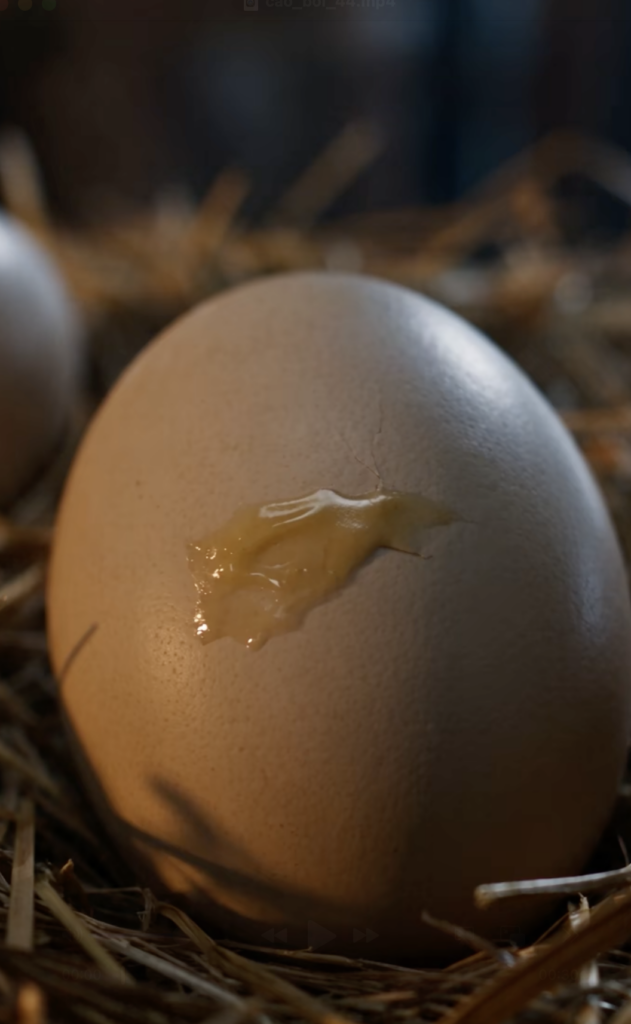
Its ivory shell had a long fracture running from end to end.
She crouched.
The shell was warm.
Not sun-warm.
Living warm.
Rowan turned it carefully beneath the afternoon light.
There was no way to know whether anything inside had survived.
But when she placed the egg against her palm, something about its weight made her chest tighten.
Perhaps because Rowan knew what it meant to be discarded before anyone bothered checking whether there was still life inside.
She whispered, “I’m not throwing you away yet.”
That was the moment the laughter began.
Caldwell Flats was the kind of town where news outran horses.
By sunset, everyone knew Rowan Mercer was carrying abandoned goose eggs back to the Sink.
The Sink was what the townspeople called her farm.
Nobody remembered when the name began, but everybody agreed it fit.
Ten acres of low land sat south of town where spring rain collected faster than it drained. Wagon wheels sank in the east field. The pasture flooded near the creek. Mosquitoes gathered in summer thick enough to make cattle restless.
No sensible farmer wanted it.
Rowan had inherited it from a grandfather she had met only twice.
She had arrived in Caldwell Flats eight months earlier with eighty-three dollars, two dresses, a canvas bag, and no husband.
That alone had been enough to make people stare.
A twenty-six-year-old woman living alone on useless land attracted opinions the way spilled sugar attracted ants.
Some thought she was brave.