The Wife He Married for Survival Became the Woman He Could Not Live Without. But the Secret Buried Beneath the Montana Snow Would Change Everything.
The first time Henry Mercer realized he loved his wife, she was dying in his arms—and the only road to a doctor had disappeared beneath six feet of Montana snow.
Outside, the blizzard screamed like something alive.
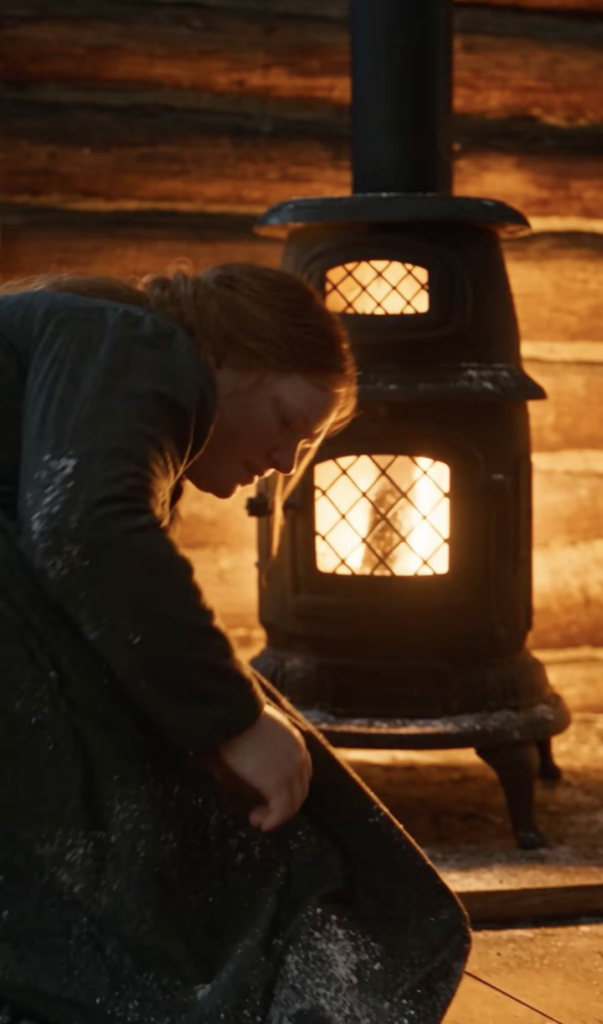
Inside the tiny mountain cabin, Clara Mercer lay beneath three blankets, her lips pale, her breathing shallow, and her enormous body trembling despite the heat pouring from the newly cleared stove.
Henry knelt beside the bed, his frozen fingers wrapped around her hand.
“Clara?”
Her eyelids fluttered.
“Don’t you dare go to sleep on me.”
A faint smile touched her lips.
“Is that an order, Mr. Mercer?”
“Yes.”
“Then you’re going to be disappointed.”
Her eyes closed.
For one terrible instant, Henry thought she had stopped breathing.
“Clara!”
He pressed his cheek near her mouth.
Warm air brushed his skin.
Barely.
He had faced wolves, broken horses, and spent three winters alone in a wilderness that swallowed careless men without leaving their bones.
But nothing had frightened Henry Mercer more than the possibility of losing a woman he had known for only twenty-one days.
And the worst part was that he had never told her what she had become to him.
Not once.
Three weeks earlier, he had believed marriage was nothing more than an arrangement.
Now he was beginning to understand that some arrangements were made by human hands.
Others were made by fate.
And somewhere beyond the storm, buried beneath twenty years of lies, another truth was waiting to destroy everything he thought he knew.
Chapter One: The Woman Nobody Wanted
The matrimonial agency in Chicago had described Clara Whitcomb in precisely seventeen words.
Thirty-two. Educated. Capable. Excellent health. Experienced in household management. Respectable family background. Seeking permanent marriage in the West.
There had been no photograph.
Henry had not requested one.
He wanted a wife who could survive a Montana winter, not a pretty face to admire while the firewood ran out.
At thirty-four, he owned one hundred and sixty acres of stubborn mountain land, nineteen cattle, two horses, a cabin, and a reputation for speaking only when necessary.
He had spent eleven years building that life.
There was one thing it lacked.
Someone to share it.
Not because he was lonely.
At least, that was what he told himself.
The truth was that winter evenings had grown longer, and the silence inside his cabin had begun to sound remarkably like regret.
When Clara stepped down from the stagecoach in Helena, Henry immediately knew the agency had omitted something.
She was enormous.
Nearly four hundred pounds, perhaps more, with a broad figure beneath a dark green wool dress, a softly rounded face, chestnut-brown hair pinned beneath a modest traveling hat, and remarkable gray-blue eyes.
Eyes that looked directly at him.
Not apologetically.
Not timidly.
Simply directly.
“Mr. Mercer?”
He removed his hat.
“Miss Whitcomb?”
“Unless another woman has arrived looking foolish enough to marry a stranger in Montana.”
Henry studied her.
Clara studied him back.
Behind the stagecoach, two men exchanged amused looks.
One whispered something.
The other laughed.
Clara heard them.
Henry saw it in the slight tightening around her mouth.
But she raised her chin.
“Well?” she asked.
“Well, what?”
“Have you changed your mind?”
Henry frowned.
“About what?”
“Marrying me.”
The question hung between them.
A gust lifted the hem of her dress.
Henry looked toward the mountains.
“Storm coming. We ought to leave.”
Clara blinked.
“That’s your answer?”
“Yes.”
Then he reached for her carpetbag.
It weighed almost nothing.
“This everything?”
“Yes.”
He stared at it.
“A woman travels fifteen hundred miles with one bag?”
“A woman can lose nearly everything she owns and still have more than she needs.”
Something in her voice made him look up.
But Clara had already turned toward his wagon.
The ride took four hours.
Halfway into the mountains, she began shaking uncontrollably.
Her coat was barely thick enough for a Chicago autumn.
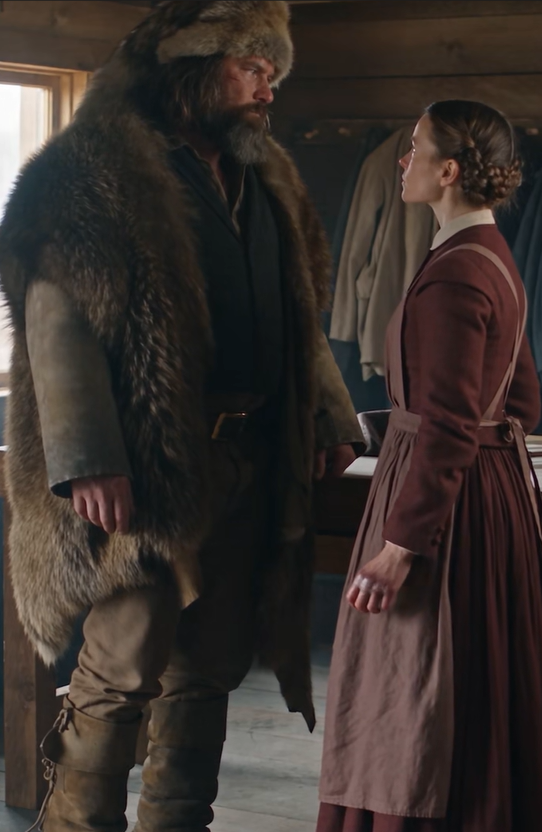
Without speaking, Henry pulled a buffalo hide from beneath the wagon seat and dropped it over her shoulders.
“If you freeze before we reach the ridge, I don’t get my agency money back.”
Clara looked at him from beneath the heavy fur.
“Your concern overwhelms me, Mr. Mercer.”
Henry nearly smiled.
That unsettled him.
He had forgotten what it felt like to be amused by another person.
At dusk, they reached his cabin.
Clara climbed down carefully, looked at the small wooden building surrounded by towering pines, and considered it in silence.
One window faced west.
Smoke rose from the chimney.
A narrow porch leaned slightly to the left.
Beyond the house stood a barn, a woodshed, and miles of wilderness.
“Well,” Clara said finally, “it’s certainly private.”
“Neighbors are eight miles away.”
“How reassuring.”
“Closest town is twenty-three.”
“Even better.”
Henry opened the door.
Inside were a heavy oak table, two chairs, a cast-iron stove, a narrow kitchen counter, a large bed, and a canvas cot.
There were no pictures.
No curtains.
No flowers.
Nothing soft except the blankets.
Clara looked around.
“Did someone die here?”
Henry stiffened.
“No.”
“Then why does it look like a memorial?”
He glanced at the walls.
“It’s a house.”
“It’s a storage shed with aspirations.”
That time, he did smile.
Only slightly.
But Clara noticed.
And for the first time since leaving Chicago, she allowed herself to hope.
They had been married that afternoon by a justice of the peace.
A plain ceremony.
No flowers.
No guests.