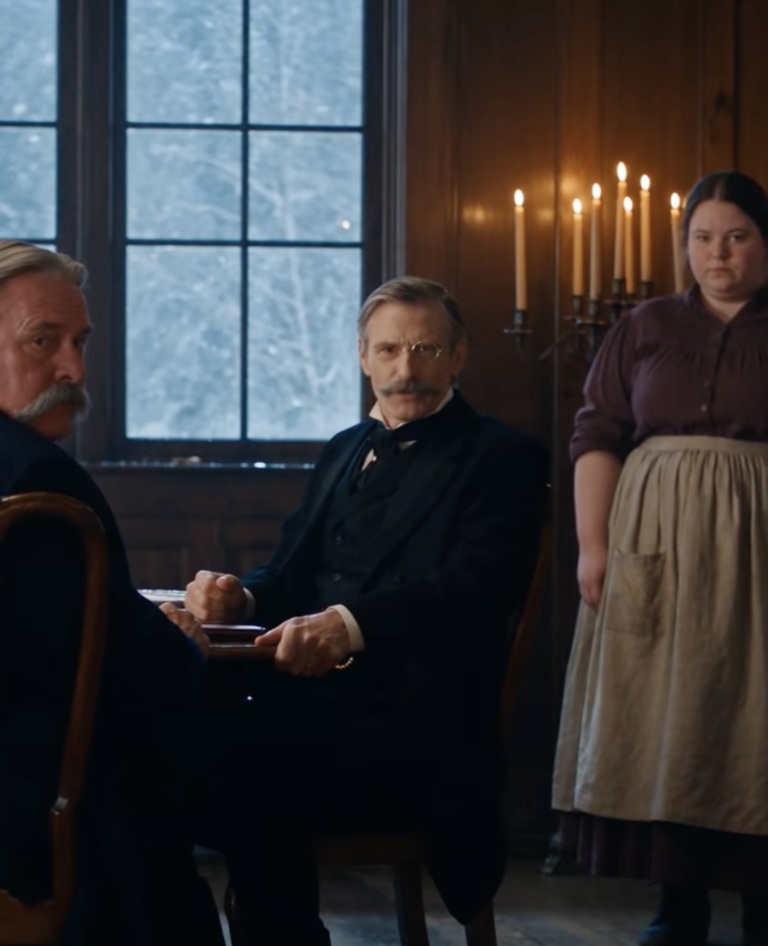
“I think I’ve done enough disappearing.”
Winter came early that year.
Snow covered the hills above Deadwood.
The Calder sign came down from the ranch gate.
Clara burned it.
In spring, she replaced it.
Not with VANE.
Not with CALDER.
The new sign read:
WHITEWOOD RANCH
Below it, in smaller letters:
NO MAN OWNS ANOTHER SOUL HERE.
People laughed at first.
Then something unexpected happened.
Women began arriving.
A widow whose husband’s creditors had taken her home.
A girl fleeing a violent employer.
A miner’s wife abandoned with two children.
A Lakota seamstress whose boardinghouse had burned.
Clara hired them.
Some worked in the kitchen.
Some kept books.
Some tended horses.
Some stayed only until they could leave.
No one was required to explain.
Gideon complained that his daughter had turned a cattle ranch into “a sanctuary with cows.”
Clara told him to mend the eastern fence.
He obeyed.
Silas took the cabin near Crow Creek.
He lasted longer than five months.
Then six.
Then a year.
Deadwood gradually stopped calling him the nameless gunslinger.
Children called him Mr.
Crow.
Gideon called him Samuel when he wanted to annoy him.
Clara called him Silas.
And Silas never corrected either man.
Two years after Elias’s conviction, Clara received a package from the territorial prison.
No return message.
Inside was a Bible.
Her marriage Bible.
The authorities had recovered it from the old ranch bedroom after the trial.
Clara almost threw it into the fire.
Then she noticed something.
The back cover felt unusually thick.
She had removed the original deed long ago.
Nothing should have remained beneath the lining.
Clara took a knife and carefully peeled it open.
A second paper fell out.
She stared.
It was older than the deed she had hidden.
Much older.
The writing had faded.
At the bottom was her mother’s signature.
Elizabeth Vane.
Clara sat down.
She read.
Then read it again.
Her hands began shaking.
“Papa.”
Gideon entered from the kitchen.
“What?”
She handed him the page.
He read three lines.
His face lost all color.
“Where did you find this?”
“In the Bible.”
“That isn’t possible.”
“What is it?”
Gideon sat.
For several moments he said nothing.
Then the front door opened.
Silas entered carrying snow on his shoulders.
“Took care of that broken—”
He stopped.
“What happened?”
Clara gave him the document.
Silas read it.
And went completely still.
At last he whispered:
“No.”
Clara looked between them.
“What aren’t you telling me?”
Gideon covered his face.
Silas reread the final paragraph.
Then he sat across from Clara.
“Your mother bought the Crow Creek parcel from Rebecca.”
“Yes.”
“No.”
He pushed the paper toward her.
“She didn’t buy it.”
Clara frowned.
“What?”
“Read the date.”
She did.
March 3, 1859.
Silas continued.
“That’s four months before my mother married Amos Calder.”
Clara looked at Gideon.
He had tears in his eyes.
“What does that mean?”
Silas pointed toward one sentence.
Clara read aloud.
I hereby place the land and all proceeds from its future sale in trust for my son, Samuel Hale, and for the child Elizabeth carries, both being descendants of—
Clara stopped.
The room seemed to tilt.
Silas whispered, “Keep reading.”
She couldn’t.
Gideon finished for her.
“Both being descendants of Jacob Hale.”
Clara stared.
“Hale.”
Silas’s mother’s maiden name.
Gideon nodded slowly.
“Rebecca Hale had a brother.”
Clara’s mouth went dry.
“Jacob.”
“Yes.”
“My mother’s—”
“Father.”
Silence.
Clara turned toward Silas.
He stared back.
Years of mysteries collapsed into one astonishing fact.
Rebecca Hale had been Silas’s mother.
Jacob Hale had been Elizabeth Vane’s father.
Which meant—
Clara laughed once from pure disbelief.