Tell him I sent you.
Show him this letter.
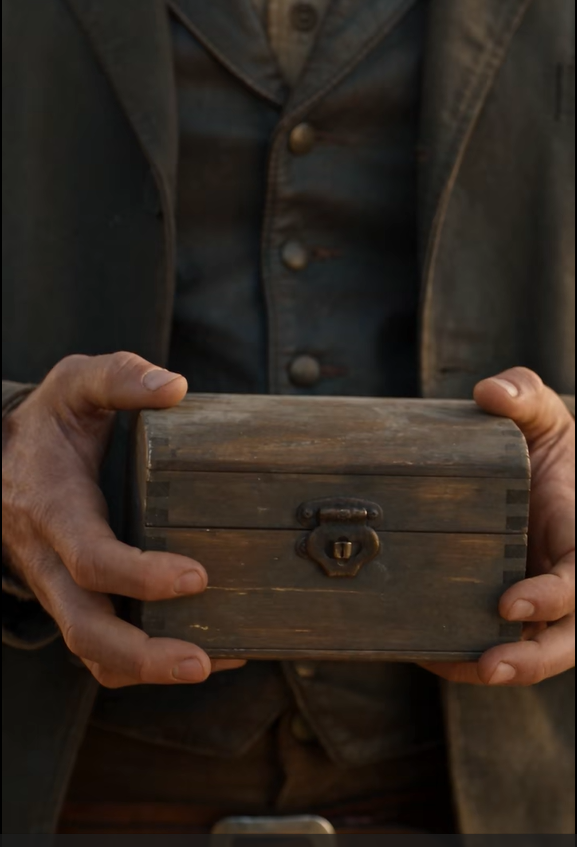
Then ask him to open Vault Box 17.
Do not let Elias Calder reach it first.
And Clara—
You were never poor.
You were robbed.
I am sorry I understood it too late.
Your loving father,
Gideon
Clara read the final lines again.
You were never poor.
You were robbed.
She slowly lowered the page.
“What does it mean?”
Silas was still looking away.
“My father said you have another name.”
Silas said nothing.
“Who are you?”
“A man who owes Gideon Vane a debt.”
“That isn’t an answer.”
“No.”
“Then give me one.”
He finally looked at her.
“Not yet.”
Clara almost laughed from disbelief.
“You rode into my husband’s ranch, shot a gun out of his brother’s hand, ordered him to untie me, handed me a letter telling me not to trust you until I know your real name, and now you expect me to ride quietly beside you?”
“Wouldn’t blame you if you didn’t.”
“Then tell me.”
Silas’s face tightened.
“I will.”
“When?”
“When we reach Bell.”
Clara studied him.
Then turned Daisy toward Deadwood.
“Fine.”
Silas followed.
After several yards Clara said, “For a mysterious gunslinger, you’re very irritating.”
For the first time, she heard him almost laugh.
“I’ve been called worse.”
Deadwood had learned to make money from nearly every human weakness.
Gold.
Whiskey.
Loneliness.
Violence.
Hope.
By 1881 the camp of muddy tents and raw timber had become a town crowded with hotels, saloons, merchants, freight wagons, gamblers, miners, widows, thieves, businessmen, preachers, and men who frequently belonged to several of those categories at once.
People noticed Clara immediately.
They noticed Silas more.
By the time they reached Sherman Street, the story had already outridden them.
Elias Calder’s wife had fled.
A stranger had taken her.
There had been gunfire.
Micah Calder had been shot.
The last part was wrong, but Deadwood rarely improved a story by making it accurate.
Judge Horace Bell kept an office above a mercantile near the courthouse.
They found the door open.
The room empty.
A chair overturned.
Papers scattered across the floor.
Silas drew his revolver.
Clara whispered, “Judge Bell?”
No answer.
They stepped inside.
A dark stain marked the carpet beside the desk.
Blood.
Still wet.
Clara’s heart began pounding.
Silas crouched.
“One man hurt.
Maybe badly.”
“How long?”
“Less than an hour.”
A floorboard creaked behind them.
Silas spun.
An elderly man emerged from behind a bookcase holding a tiny derringer in both hands.
“Don’t move.”
Clara stared.
“Judge Bell?”
His spectacles were cracked.
Blood ran from his forehead.
He looked at her.
“Gideon’s girl?”
“Yes.”
His shoulders sagged.
“Thank God.”
Then he saw Silas.
And his face drained white.
The derringer dropped.
“No.”
Silas did not move.
Bell whispered one word.
“Samuel?”
Clara turned.
Silas closed his eyes.
The name seemed to strike him harder than a bullet.
Judge Bell stumbled backward.
“You’re alive.”
Silas holstered his gun.
“For the moment.”
Clara looked from one man to the other.
“My father’s letter said—”
“Not here,” Bell interrupted.
He locked the door.
Then pulled the blinds.
Clara’s unease sharpened.
“What happened?”
“Two men came asking about Box 17.”
“Calder men?”
Bell gave a bitter laugh.
“Wade Calder and Sheriff Dawes.”
Clara felt suddenly cold.
The sheriff.
Bell continued.
“They knew Gideon had left something here.
Didn’t know which box.
I refused to tell them.”
Silas examined the blood.
“You need a doctor.”
“I need another twenty minutes of consciousness.”
Bell crossed to an iron safe behind his desk.
His hands shook while turning the dial.
Clara waited.
Silas stood near the door.