Then cried until he could no longer laugh.
One evening, Sena brought him something wrapped in cloth.
Inside was a turquoise necklace.
The beads were old.
Worn smooth.
Corvin recognized them.
They matched the necklace Sena had worn the day she collapsed.
“Our mother made two,” Sena said.
“One for each child.”
Corvin held them carefully.
“Mine?”
She nodded.
“She kept it.”
“For thirty years?”
“Yes.”
Corvin closed his hand around the beads.
For the first time since discovering the truth, he allowed himself to say the word.
“Mother.”
Sena sat beside him.
Neither spoke for a while.
Then Corvin asked the question he had feared asking.
“What was my name?”
Sena told him.
He repeated it badly.
She corrected him.
He tried again.
She laughed.
“Terrible.”
Corvin smiled.
“I’ve been Corvin for thirty-five years.
Give me a week.”
“A month.”
“Cruel.”
“A year.”
They both laughed.
Across the yard, their father heard them.
He turned away quickly.
But Corvin saw him wipe his eyes.
Winter came early that year.
The first snow dusted the northern peaks while the valley remained brown and gold.
Corvin kept the ranch.
That surprised people.
Some expected him to leave.
Others expected him to give everything away.
Instead, he changed its purpose.
Travelers could water horses there without payment.
Families moving through Red Basin could camp near the cottonwoods.
And whenever Sena’s people traveled through the valley, the gates remained open.
No one asked permission to approach the well.
Corvin carved a new symbol into the stone where the hidden compartment had been.
Not a ranch brand.
Not his initials.
Two simple lines within a circle.
The mark he had found there.
He finally learned what it represented within his family.
Not ownership.
Not war.
Return.
Years passed.
Captain Hale died in prison.
Major Brennan eventually retired and occasionally wrote Corvin letters containing too many apologies.
The Barstow company vanished into lawsuits and bankruptcy.
The story of the three hundred riders became legend among settlers.
Naturally, the legend was wrong.
People said an Apache army had surrounded Corvin Torne’s ranch and spared him because he gave water to a mysterious giant woman.
Some versions claimed Sena was a chief’s daughter.
Others claimed she was a supernatural omen.
One ridiculous newspaper story described her as nearly seven feet tall.
Sena kept that clipping.
She thought it was hilarious.
Corvin hated it.
“You are not seven feet tall.”
She would grin.
“Almost.”
“You are five inches taller than me.”
“Very small man.”
“I regret giving you water.”
“No.”
She always smiled when she said it.
“You do not.”
And she was right.
Corvin never regretted that ladle.
But even Sena did not know the final secret.
Not until eight years later.
It happened after their father died.
He passed peacefully beneath the cottonwoods near the ranch, surrounded by family.
After the burial, Sena gave Corvin a small leather pouch.
“He told me to give this to you when he was gone.”
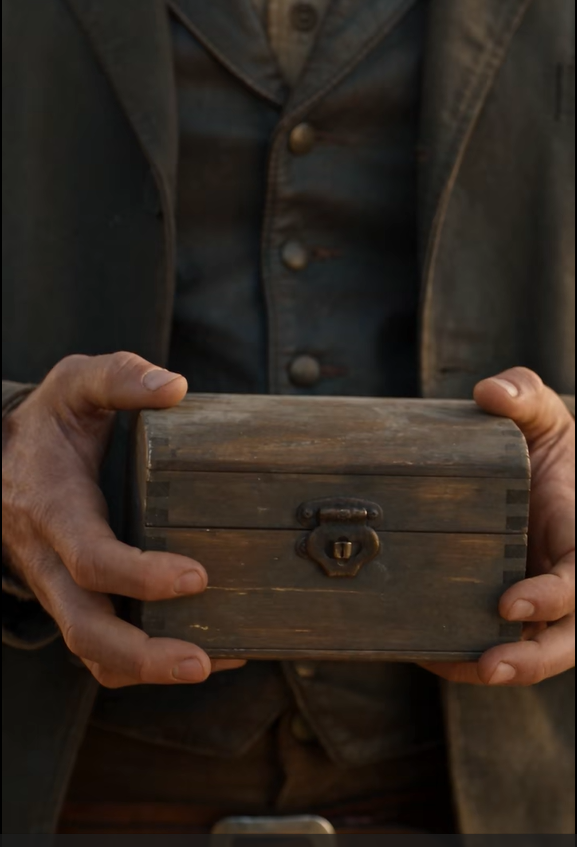
Inside lay a key.
Corvin stared.
He recognized it immediately.
Captain Hale’s iron key.
The one Hale had used beside the well.
“I thought this opened the compartment.”